



 Chat with AI
Exam 2: Thinking Like an Economist

Exam 1: Ten Principles of Economics220 Questions
Exam 2: Thinking Like an Economist284 Questions
Exam 3: Interdependence and the Gains From Trade192 Questions
Exam 4: The Market Forces of Supply and Demand277 Questions
Exam 5: Elasticity and Its Application222 Questions
Exam 6: Supply, Demand, and Government Policies321 Questions
Exam 7: Consumers, Producers, and the Efficiency of Markets218 Questions
Exam 8: Applications: The Costs of Taxation203 Questions
Exam 9: Application: International Trade214 Questions
Exam 10: Externalities204 Questions
Exam 11: Public Goods and Common Resources182 Questions
Exam 12: The Design of the Tax System225 Questions
Exam 13: The Costs of Production261 Questions
Exam 14: Firms in Competitive Markets243 Questions
Exam 15: Monopoly231 Questions
Exam 16: Monopolistic Competition246 Questions
Exam 17: Oligopoly204 Questions
Exam 18: The Markets for the Factors of Production232 Questions
Exam 19: Earnings and Discrimination230 Questions
Exam 20: Income Inequality and Poverty194 Questions
Exam 21: The Theory of Consumer Choice209 Questions
Exam 22: Frontiers in Microeconomics185 Questions
Exam 23: Measuring a Nations Income231 Questions
Exam 24: Measuring the Cost of Living214 Questions
Exam 25: Production and Growth187 Questions
Exam 26: Saving, Investment, and the Financial System225 Questions
Exam 27: Tools of Finance198 Questions
Exam 28: Unemployment and Its Natural Rate361 Questions
Exam 29: The Monetary System210 Questions
Exam 30: Money Growth and Inflation201 Questions
Exam 31: Open-Economy Macroeconomics: Basic Concepts194 Questions
Exam 32: A Macroeconomic Theory of the Open Economy188 Questions
Exam 33: Aggregate Demand and Aggregate Supply189 Questions
Exam 34: The Influence of Monetary and Fiscal Policy on Aggregate Demand207 Questions
Exam 35: The Short-Run Tradeoff Between Inflation and Unemployment223 Questions
Exam 36: Six Debates Over Macroeconomic Policy154 Questions
Select questions type


In the circular-flow diagram, one loop represents the flow of goods and services, and the other loop represents the flow of factors of production.
(True/False)
4.8/5  (73)
(73) A macroeconomist, rather than a microeconomist, would study the effects on a market from two firms merging.
(True/False)
4.9/5 (68)
(68) The broken window fallacy states that when a window breaks and someone spends money to repair it, they have created new economic activity that would not have otherwise taken place.
(True/False)
4.9/5 (72)
(72) Because almost all economists oppose policies that restrict trade among nations, policymakers do not restrict imports of certain goods.
(True/False)
4.7/5 (69)
(69) Which type of statement - positive or normative - can be evaluated by analyzing data alone?
(Short Answer)
4.8/5 (83)
(83) In the circular flow diagram, when Brian provides labor through the markets for factors of production to ABC Company, the flow of money he receives in exchange is called
(Short Answer)
4.9/5 (82)
(82) Two variables that have a negative correlation move in opposite directions.
(True/False)
4.7/5 (91)
(91) Figure 2-1
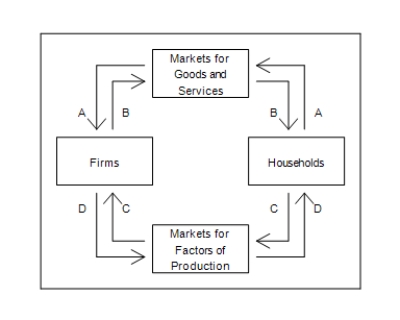 -Refer to Figure 2-1. Brianna buys a refrigerator for her new home. To which of the arrows does this transaction directly contribute?
 (Multiple Choice)
4.9/5 (84)
(84) Table 2-1
Production Possibilities Tennis Rackets Tennis Balls 150 9,000 300 7,500 450 ?
-Suppose an economy produces two goods, food and machines. This economy always operates on its production possibilities frontier. Last year, it produced 1,000 units of food and 47 machines. This year it experienced a technological advance in its machine-making industry. As a result, this year the society wants to produce 1,050 units of food and 47 machines. Which of the following statements is correct?
(Multiple Choice)
4.9/5 (88)
(88) A technological advance in the production of the first good increases the opportunity cost of the first good in terms of the second good.
(True/False)
4.8/5 (86)
(86) Table 2-2
Socks Glasses 1,200 0 900 400 600 700 300 900 0 1,000
-Refer to Table 2-2. What is the opportunity cost to Ecoville of increasing the production of socks from 600 to 900?
(Multiple Choice)
4.8/5 (77)
(77) While the production possibilities frontier is a useful model, it cannot be used to illustrate economic growth.
(True/False)
4.9/5 (68)
(68) The slope of a horizontal line is infinite, and the slope of a vertical line is zero.
(True/False)
4.9/5 (73)
(73) Is the following a positive or normative statement? The United States government should mandate that every citizen purchases health insurance.
(Short Answer)
4.7/5 (83)
(83) In the ordered pair (10,30), 10 is the horizontal location of the point and 30 is the vertical location of the point.
(True/False)
4.9/5 (77)
(77) The scientific method is the dispassionate development and testing of theories about how the world works.
(True/False)
5.0/5 (82)
(82) In the circular-flow diagram, factors of production include land, labor, and capital.
(True/False)
4.8/5 (71)
(71) In the circular-flow diagram, which of the following items flows from firms to households through the markets for the factors of production?
(Multiple Choice)
4.9/5 (78)
(78) The President counts among his economic advisors the Congressional Budget Office.
(True/False)
4.9/5 (78)
(78) Figure 2-5
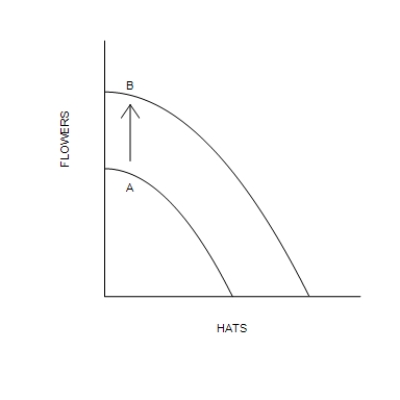 -Refer to Figure 2-5. Which of the following events would explain the shift of the production possibilities frontier from A to B?
 (Multiple Choice)
4.7/5 (85)
(85) 
Filters
- Essay(0)
- Multiple Choice(0)
- Short Answer(0)
- True False(0)
- Matching(0)