



 Chat with AI
Exam 8: The Family of Stars

Exam 1: Here and Now97 Questions
Exam 2: A Users Guide to the Sky116 Questions
Exam 3: Cycles of the Sun and Moon154 Questions
Exam 4: The Origin of Modern Astronomy144 Questions
Exam 5: Light and Telescopes156 Questions
Exam 6: Atoms and Spectra125 Questions
Exam 7: The Sun146 Questions
Exam 8: The Family of Stars190 Questions
Exam 9: The Formation and Structure of Stars136 Questions
Exam 10: The Deaths of Stars128 Questions
Exam 11: Neutron Stars and Black Holes99 Questions
Exam 12: The Milky Way Galaxy117 Questions
Exam 13: Galaxies: Normal and Active151 Questions
Exam 14: Modern Cosmology112 Questions
Exam 15: Origin of the Solar System and Extrasolar Planets104 Questions
Exam 16: Earth and Moon: Bases for Comparative Planetology98 Questions
Exam 17: Mercury, Venus, and Mars83 Questions
Exam 18: The Outer Solar System137 Questions
Exam 19: Meteorites, Asteroids, and Comets91 Questions
Exam 20: Astrobiology: Life on Other Worlds97 Questions
Select questions type


____________________ can be used to determine the distance to a star when the spectrum of the star can be used to determine its spectral type and luminosity class.
(Short Answer)
4.9/5  (86)
(86) Compared with the spectral lines in the solar spectrum, lines in a supergiant spectrum are
(Multiple Choice)
4.8/5 (88)
(88) Reorder the spectral sequence to include the L and T dwarfs. What is the new sequence?
(Short Answer)
4.9/5 (75)
(75) Compared with the spectral lines in the solar spectrum, lines in a supergiant star's spectrum are
(Multiple Choice)
5.0/5 (72)
(72) The star named Sheat is of M2 II spectral type and luminosity class. Based on this information, which of the following are true?
I. Sheat has a surface temperature less than the Sun.
II. Sheat has a diameter that is greater than that of the Sun.
III. Sheat is more luminous than the Sun.
IV. Sheat is located near the upper left-hand corner in the H-R diagram.
(Multiple Choice)
4.8/5 (80)
(80) We know that giant stars are larger in diameter than the Sun because
(Multiple Choice)
4.9/5 (87)
(87)  -Table 8-2 Use the chart below to answer the following question(s).
Which star in Table 8-2 is the closest to Earth?
-Table 8-2 Use the chart below to answer the following question(s).
Which star in Table 8-2 is the closest to Earth? (Multiple Choice)
4.8/5 (75)
(75) 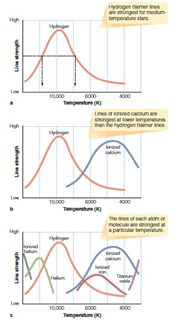 Which graphs of line strength and temperature would give the most precise value of the star's surface temperature?
 (Multiple Choice)
4.9/5 (84)
(84) The Moon orbits the Earth the Earth orbits the Sun. If the Earth-moon system is ˜1 AU from the Sun and takes ˜1 Earth year to orbit, what is the combined mass of the triple system? Express your answer in solar mass units.
(Multiple Choice)
4.7/5 (68)
(68) Hadar has an apparent visual magnitude of 0.6 and an absolute visual magnitude of -5.4. Its distance is 102.2 pc.
(True/False)
5.0/5 (82)
(82) If a star is twice as hot as the Sun and only half the Sun's diameter, it will be less luminous than the Sun.
(True/False)
4.7/5 (70)
(70) Stars in the upper right part of the Hertzsprung-Russell diagram are always ____ when compared to stars near the middle of the diagram.
(Multiple Choice)
4.9/5 (94)
(94) 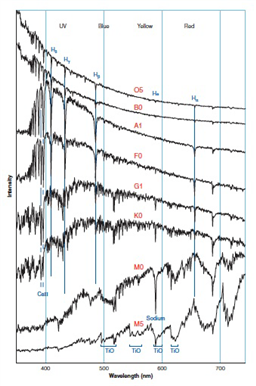 As shown in the spectra above, sodium is present in _________ spectral classes.
 (Multiple Choice)
5.0/5 (79)
(79) We know that the numbers of stars _________ from _______ to ________ on the H-R diagram.
(Multiple Choice)
4.8/5 (57)
(57) If two stars are emitting the same amount of light and are the same size, the star that is farther will appear
(Multiple Choice)
4.8/5 (79)
(79) At what point in the light curve below is the cooler star in front of the hotter star of an eclipsing binary system?

(Multiple Choice)
5.0/5 (90)
(90) If we can solve the orbital motion of an eclipsing binary, we can find
(Multiple Choice)
4.7/5 (68)
(68) 
Filters
- Essay(0)
- Multiple Choice(0)
- Short Answer(0)
- True False(0)
- Matching(0)