



 Chat with AI
Exam 8: The Family of Stars

Exam 1: Here and Now97 Questions
Exam 2: A Users Guide to the Sky116 Questions
Exam 3: Cycles of the Sun and Moon154 Questions
Exam 4: The Origin of Modern Astronomy144 Questions
Exam 5: Light and Telescopes156 Questions
Exam 6: Atoms and Spectra125 Questions
Exam 7: The Sun146 Questions
Exam 8: The Family of Stars190 Questions
Exam 9: The Formation and Structure of Stars136 Questions
Exam 10: The Deaths of Stars128 Questions
Exam 11: Neutron Stars and Black Holes99 Questions
Exam 12: The Milky Way Galaxy117 Questions
Exam 13: Galaxies: Normal and Active151 Questions
Exam 14: Modern Cosmology112 Questions
Exam 15: Origin of the Solar System and Extrasolar Planets104 Questions
Exam 16: Earth and Moon: Bases for Comparative Planetology98 Questions
Exam 17: Mercury, Venus, and Mars83 Questions
Exam 18: The Outer Solar System137 Questions
Exam 19: Meteorites, Asteroids, and Comets91 Questions
Exam 20: Astrobiology: Life on Other Worlds97 Questions
Select questions type


________ dwarfs are M dwarfs on the main sequence whereas _________ dwarfs are hot, dim, and not on the main sequence.
(Short Answer)
4.7/5  (80)
(80) The most accurate way to determine the surface temperature of a star is to study
(Multiple Choice)
4.9/5 (75)
(75) If a star with an absolute magnitude of − 5 has an apparent magnitude of +5, then its distance is
(Multiple Choice)
4.9/5 (86)
(86) The light curve of a/an ___________ binary can reveal both masses and diameters of the stars.
(Short Answer)
4.8/5 (86)
(86) How does absolute visual magnitude tell us the intrinsic brightness of a star?
(Essay)
4.9/5 (88)
(88) The star named Circini has the spectral type and luminosity class of O 8.5 V. Based on this information, which of the following are true?
I. Circini has a surface temperature less than the Sun.
II. Circini has a diameter that is greater than that of the Sun.
III. Circini is more luminous than the Sun.
IV. Circini is located near the upper left-hand corner in the H-R diagram.
(Multiple Choice)
4.7/5 (77)
(77) 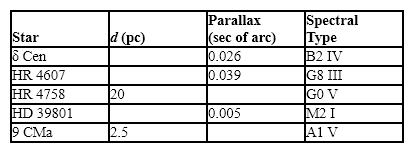 -Table 8-2 Use the chart below to answer the following question(s).
Which star in Table 8-2 has the greatest diameter?
-Table 8-2 Use the chart below to answer the following question(s).
Which star in Table 8-2 has the greatest diameter? (Multiple Choice)
4.8/5 (74)
(74) The two stars near one another are shown. Positions of one member are shown relative to the other star at different times. From plots like this one, astronomers conclude that 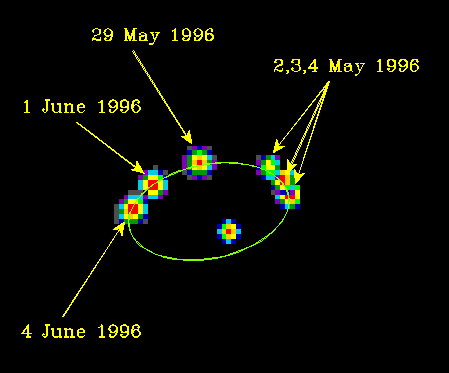
(Multiple Choice)
4.9/5 (89)
(89) Red giant stars are
I. more luminous than the Sun.
II. larger in diameter than the Sun.
III. cooler than B stars.
IV. located above the main-sequence stars in the H-R diagram.
(Multiple Choice)
5.0/5 (72)
(72) ? star has a radius similar to that of the Sun but half the Sun's luminosity. What is the surface temperature of this star using this data?
(Multiple Choice)
4.8/5 (77)
(77) 
Filters
- Essay(0)
- Multiple Choice(0)
- Short Answer(0)
- True False(0)
- Matching(0)