



 Chat with AI
Exam 3: Cycles of the Sun and Moon

Exam 1: Here and Now97 Questions
Exam 2: A Users Guide to the Sky116 Questions
Exam 3: Cycles of the Sun and Moon154 Questions
Exam 4: The Origin of Modern Astronomy144 Questions
Exam 5: Light and Telescopes156 Questions
Exam 6: Atoms and Spectra125 Questions
Exam 7: The Sun146 Questions
Exam 8: The Family of Stars190 Questions
Exam 9: The Formation and Structure of Stars136 Questions
Exam 10: The Deaths of Stars128 Questions
Exam 11: Neutron Stars and Black Holes99 Questions
Exam 12: The Milky Way Galaxy117 Questions
Exam 13: Galaxies: Normal and Active151 Questions
Exam 14: Modern Cosmology112 Questions
Exam 15: Origin of the Solar System and Extrasolar Planets104 Questions
Exam 16: Earth and Moon: Bases for Comparative Planetology98 Questions
Exam 17: Mercury, Venus, and Mars83 Questions
Exam 18: The Outer Solar System137 Questions
Exam 19: Meteorites, Asteroids, and Comets91 Questions
Exam 20: Astrobiology: Life on Other Worlds97 Questions
Select questions type


In the above picture, Sagittarius and Scorpius are above the southern horizon. Where is the ecliptic in the picture?
In the above picture, Sagittarius and Scorpius are above the southern horizon. Where is the ecliptic in the picture?
Free
(Multiple Choice)
4.9/5  (80)
(80) Correct Answer: Verified
D
If you live in Florida and your aunt lives in Seattle and both of you have a clear night then you both will see the same phase of the Moon that night.
Free
(True/False)
5.0/5 (75)
(75) Correct Answer:Verified
VerifiedTrue
The totally eclipsed Moon glows coppery red because sunlight reaches the Moon's surface after passing through Earth's atmosphere.
Free
(True/False)
4.8/5 (83)
(83) Correct Answer:Verified
VerifiedTrue
The Sun traces a path along the ecliptic in a period that is longer than 365 days.
(True/False)
4.8/5 (72)
(72) An eclipse of the Moon (lunar eclipse) as seen from Earth, happens when
(Multiple Choice)
4.8/5 (89)
(89) Earth doesn't experience a solar eclipse every month because
(Multiple Choice)
4.9/5 (82)
(82) If the Moon's orbital plane was aligned with the celestial equator we could
(Multiple Choice)
4.9/5 (87)
(87) A solar or lunar eclipse may occur when the line of nodes (The line connecting the points of the Moon's orbit that intersects the plane of the Earth's orbit around the Sun)
(Multiple Choice)
4.9/5 (74)
(74) 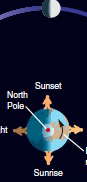 In the picture shown, what phase is the Moon?
You are located on Earth and you see the Moon in its third-quarter phase. Draw the Sun, your location on Earth's surface, and the Moon in the sky, correctly shadowing the portions of the Moon's surface not in the Sun's light. Label the time of day you would see this Moon phase.
(Essay)
4.9/5 (79)
(79)  What is the phase of the Moon shown in the above image?
At sunset, the ____ Moon phase will be highest above the southern horizon for an observer in the Northern Hemisphere.
(Multiple Choice)
4.8/5 (70)
(70) A total solar eclipse will be visible from the same location on Earth one Saros cycle later.
(True/False)
4.9/5 (65)
(65) The summer solstice (at the start of summer) is the point on the ecliptic where the Sun
(Multiple Choice)
4.8/5 (79)
(79) A(n) ____________________ eclipse occurs when the Moon is at its greatest distance from Earth and the Moon is new and at a node in its orbit.
(Short Answer)
4.8/5 (82)
(82) 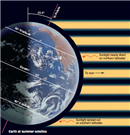 Which season is shown in the picture for the southern hemisphere?
 (Multiple Choice)
4.9/5 (75)
(75) 
Filters
- Essay(0)
- Multiple Choice(0)
- Short Answer(0)
- True False(0)
- Matching(0)