



 Chat with AI
Exam 3: Cycles of the Sun and Moon

Exam 1: Here and Now97 Questions
Exam 2: A Users Guide to the Sky116 Questions
Exam 3: Cycles of the Sun and Moon154 Questions
Exam 4: The Origin of Modern Astronomy144 Questions
Exam 5: Light and Telescopes156 Questions
Exam 6: Atoms and Spectra125 Questions
Exam 7: The Sun146 Questions
Exam 8: The Family of Stars190 Questions
Exam 9: The Formation and Structure of Stars136 Questions
Exam 10: The Deaths of Stars128 Questions
Exam 11: Neutron Stars and Black Holes99 Questions
Exam 12: The Milky Way Galaxy117 Questions
Exam 13: Galaxies: Normal and Active151 Questions
Exam 14: Modern Cosmology112 Questions
Exam 15: Origin of the Solar System and Extrasolar Planets104 Questions
Exam 16: Earth and Moon: Bases for Comparative Planetology98 Questions
Exam 17: Mercury, Venus, and Mars83 Questions
Exam 18: The Outer Solar System137 Questions
Exam 19: Meteorites, Asteroids, and Comets91 Questions
Exam 20: Astrobiology: Life on Other Worlds97 Questions
Select questions type


The Moon always keeps the same side facing Earth and therefore Earth always keeps the same side facing the Moon.
(True/False)
4.8/5  (75)
(75) You are in the northern hemisphere and the season is winter. The Sun is above a geographic point in the southern hemisphere and below the celestial equator.
(True/False)
4.9/5 (76)
(76) For a northern hemisphere observer the ____________________ Moon is visible in the south-eastern sky just after sunset.
(Short Answer)
4.8/5 (73)
(73) The Moon and visible planets are always within a few degrees of the ecliptic.
(True/False)
4.9/5 (89)
(89) The point in Earth's orbit where Earth is farthest from the Sun is known as
(Multiple Choice)
5.0/5 (70)
(70) The path of totality for a solar eclipse is swept out by the tip of the Moon's umbra as the umbra moves over Earth.
(True/False)
4.9/5 (82)
(82) On a clear night when an observer in Los Angeles sees a first-quarter Moon, an observer in London would see
(Multiple Choice)
4.9/5 (68)
(68) ____________________ is the point in Earth's orbit when Earth is closest to the Sun.
(Short Answer)
4.7/5 (74)
(74) a) If you are on the near side of the Moon, the side facing Earth, describe what you would see of Earth over one lunar cycle. b) If you are on the far side of the Moon, the side facing away from Earth, describe what you would see of Earth over one lunar cycle.
(Essay)
4.7/5 (86)
(86) At what two celestial locations do the celestial equator and ecliptic coincide?
(Multiple Choice)
4.8/5 (64)
(64) If the Sun passes directly overhead on at least one day per year, then
(Multiple Choice)
5.0/5 (81)
(81) A total solar eclipse occurred in Wolf Point, Montana, on Feb. 26, 1979. When was (will) an eclipse like this eclipse next (be) visible again in Montana? Hint: A Saros is 18 years and 11 1/3 days. Twice a Saros is 36 years 22 2/3 days. Three times a Saros is 56 years 34 days. So the best choice answer of these listed will be late ______.
(Multiple Choice)
4.9/5 (72)
(72) 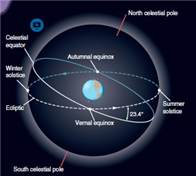 Of the lines drawn in the picture, which one traces the path of the Sun during fall in the northern hemisphere?
 (Multiple Choice)
4.8/5 (88)
(88) The ____ Moon is visible above the eastern horizon a couple of hours before sunrise.
(Multiple Choice)
4.9/5 (67)
(67) You are located at 40 degrees south latitude on Earth and the northern hemisphere is experiencing winter. Days for you are short whereas nights for you are long.
(True/False)
4.9/5 (74)
(74) 
Filters
- Essay(0)
- Multiple Choice(0)
- Short Answer(0)
- True False(0)
- Matching(0)