



 Chat with AI
Exam 3: Cycles of the Sun and Moon

Exam 1: Here and Now97 Questions
Exam 2: A Users Guide to the Sky116 Questions
Exam 3: Cycles of the Sun and Moon154 Questions
Exam 4: The Origin of Modern Astronomy144 Questions
Exam 5: Light and Telescopes156 Questions
Exam 6: Atoms and Spectra125 Questions
Exam 7: The Sun146 Questions
Exam 8: The Family of Stars190 Questions
Exam 9: The Formation and Structure of Stars136 Questions
Exam 10: The Deaths of Stars128 Questions
Exam 11: Neutron Stars and Black Holes99 Questions
Exam 12: The Milky Way Galaxy117 Questions
Exam 13: Galaxies: Normal and Active151 Questions
Exam 14: Modern Cosmology112 Questions
Exam 15: Origin of the Solar System and Extrasolar Planets104 Questions
Exam 16: Earth and Moon: Bases for Comparative Planetology98 Questions
Exam 17: Mercury, Venus, and Mars83 Questions
Exam 18: The Outer Solar System137 Questions
Exam 19: Meteorites, Asteroids, and Comets91 Questions
Exam 20: Astrobiology: Life on Other Worlds97 Questions
Select questions type


What two pieces of information are needed to determine the diameter of a faraway object? Explain how that information is used to determine the diameter.
(Essay)
4.8/5  (75)
(75) A(n) ____________________ Moon rises in the eastern sky approximately as Sun sets.
(Short Answer)
4.9/5 (76)
(76) The Moon has an angular diameter of 0.5°. What is the Moon's angular diameter in minutes of arc?
(Multiple Choice)
4.9/5 (76)
(76) A portion or all of the same zodiac constellations can be seen by those in either hemisphere year round.
(True/False)
4.8/5 (82)
(82) The equator receives the same amount of sunlight from season to season.
(True/False)
4.9/5 (87)
(87) An eclipse season is the interval during which the Sun crosses a node of the Moon's orbit.
(True/False)
4.8/5 (71)
(71) A total lunar eclipse is visible only from the path of totality.
(True/False)
4.9/5 (65)
(65) Why can neither Venus nor Mercury remain visible throughout the night as the full Moon does?
(Essay)
4.8/5 (93)
(93) Describe the evidence that best supports the Milankovitch hypothesis.
(Essay)
4.8/5 (82)
(82) 
The solar corona is shown as white lines streaming from the Sun and you are viewing it from Earth. Which eclipse are you observing?
The solar corona is shown as white lines streaming from the Sun and you are viewing it from Earth. Which eclipse are you observing? (Multiple Choice)
4.8/5 (80)
(80) 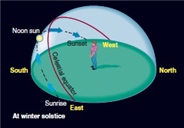
In the picture shown, in which hemisphere is the person located and the location of the Sun is above what geographic point on Earth?
In the picture shown, in which hemisphere is the person located and the location of the Sun is above what geographic point on Earth? (Multiple Choice)
4.8/5 (80)
(80) Describe the difference between an umbral and a penumbral lunar eclipse as seen by an observer on Earth.
(Essay)
4.8/5 (100)
(100) A dime is 1.8 cm in diameter. Earth's Moon is 3.844 × 1010 cm from Earth and has a diameter of 3.76 × 108 cm. At what distance from your eye would you have to hold a dime so that it has the same angular diameter as the full Moon?
(Multiple Choice)
4.9/5 (73)
(73) Assume all else is unchanged, and the Earth's rotational axis is perpendicular to the ecliptic. As a result, seasonal variations on the Earth would
(Multiple Choice)
4.9/5 (77)
(77) 
Filters
- Essay(0)
- Multiple Choice(0)
- Short Answer(0)
- True False(0)
- Matching(0)