



 Chat with AI
Exam 3: Cycles of the Sun and Moon

Exam 1: Here and Now97 Questions
Exam 2: A Users Guide to the Sky116 Questions
Exam 3: Cycles of the Sun and Moon154 Questions
Exam 4: The Origin of Modern Astronomy144 Questions
Exam 5: Light and Telescopes156 Questions
Exam 6: Atoms and Spectra125 Questions
Exam 7: The Sun146 Questions
Exam 8: The Family of Stars190 Questions
Exam 9: The Formation and Structure of Stars136 Questions
Exam 10: The Deaths of Stars128 Questions
Exam 11: Neutron Stars and Black Holes99 Questions
Exam 12: The Milky Way Galaxy117 Questions
Exam 13: Galaxies: Normal and Active151 Questions
Exam 14: Modern Cosmology112 Questions
Exam 15: Origin of the Solar System and Extrasolar Planets104 Questions
Exam 16: Earth and Moon: Bases for Comparative Planetology98 Questions
Exam 17: Mercury, Venus, and Mars83 Questions
Exam 18: The Outer Solar System137 Questions
Exam 19: Meteorites, Asteroids, and Comets91 Questions
Exam 20: Astrobiology: Life on Other Worlds97 Questions
Select questions type


Why does one cycle of lunar phases take 29.53 days even though the Moon orbits Earth in 27.32 days?
(Essay)
4.9/5  (81)
(81) Describe how a small change in the relative distance of Earth from the Sun at perihelion could affect the formation of glaciers on Earth.
(Essay)
4.7/5 (81)
(81) At the time of the winter solstice (the start of winter) the sunlight is at a lower angle and thus is ____ than(as) in the start of summer in the northern hemisphere.
(Multiple Choice)
4.8/5 (69)
(69) The observed amount of difference between the perihelion of Earth in early January and aphelion in early July results in the northern hemisphere being _____.
(Multiple Choice)
5.0/5 (75)
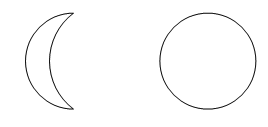
(75)  What is the phase of the Moon shown in the above image?
A "supermoon" is when the Moon is larger in the sky because it is closer to Earth in its elliptical orbit. This point is called ________________?
(Multiple Choice)
4.8/5 (87)
(87) If the Earth's period of rotation were halved, but the period of revolution about the Sun stayed the same,
(Multiple Choice)
4.7/5 (75)
(75) 
When it is winter in the northern hemisphere, it is ____ in the southern hemisphere.
(Multiple Choice)
4.8/5 (93)
(93) The vernal equinox is the point on the sky where the Sun crosses the ____________ going north and east.
(Multiple Choice)
4.9/5 (83)
(83) Northern hemisphere winters are colder than northern hemisphere summers because
(Multiple Choice)
4.8/5 (79)
(79) If tonight is a full Moon then in about two weeks it will be a _______ Moon.
(Short Answer)
4.8/5 (68)
(68) Choose the correct word(s) that make the statement true. A (lunar, solar) eclipse occurs when the Moon is (new, quarter, gibbous, full) and the ordering of aligned celestial objects is always Sun, Earth, Moon.
(Short Answer)
4.9/5 (75)
(75) Earth is closest to the Sun during the month of January. Explain then why we do not experience our hottest weather in January in the northern hemisphere.
(Essay)
4.9/5 (67)
(67) If the plane of the Earth's equator were not tilted with respect to the ecliptic plane,
(Multiple Choice)
4.8/5 (74)
(74) The most distant point in the Moon's orbit is called _________________.
(Multiple Choice)
4.8/5 (76)
(76) 
Filters
- Essay(0)
- Multiple Choice(0)
- Short Answer(0)
- True False(0)
- Matching(0)