



 Chat with AI
Exam 7: The Sun

Exam 1: Here and Now97 Questions
Exam 2: A Users Guide to the Sky116 Questions
Exam 3: Cycles of the Sun and Moon154 Questions
Exam 4: The Origin of Modern Astronomy144 Questions
Exam 5: Light and Telescopes156 Questions
Exam 6: Atoms and Spectra125 Questions
Exam 7: The Sun146 Questions
Exam 8: The Family of Stars190 Questions
Exam 9: The Formation and Structure of Stars136 Questions
Exam 10: The Deaths of Stars128 Questions
Exam 11: Neutron Stars and Black Holes99 Questions
Exam 12: The Milky Way Galaxy117 Questions
Exam 13: Galaxies: Normal and Active151 Questions
Exam 14: Modern Cosmology112 Questions
Exam 15: Origin of the Solar System and Extrasolar Planets104 Questions
Exam 16: Earth and Moon: Bases for Comparative Planetology98 Questions
Exam 17: Mercury, Venus, and Mars83 Questions
Exam 18: The Outer Solar System137 Questions
Exam 19: Meteorites, Asteroids, and Comets91 Questions
Exam 20: Astrobiology: Life on Other Worlds97 Questions
Select questions type


Fusion is promoted in the core of the Sun by the _______ there.

Free
(Multiple Choice)
5.0/5  (87)
(87) Correct Answer: Verified
B
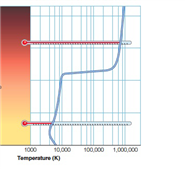 The above picture shows the Sun's change in temperature with elevation into the Sun's atmospheric layers. The region from 10,000-70,000 K is known as the ____________.
Free
(Multiple Choice)
4.9/5 (73)
(73) Correct Answer:Verified
VerifiedD
Spicules occur in the _______________ atmospheric layer of the Sun.
Free
(Multiple Choice)
4.9/5 (80)
(80) Correct Answer:Verified
VerifiedB
Lithium has less binding energy than _____________, thus the neutrons and protons are easier to unbind from the nucleus.
(Multiple Choice)
4.7/5 (86)
(86) A recent sunspot maximum occurred in 2013. What is the year of the sunspot maximum that immediately follows the 2013 maximum if the solar cycle continues?
(Multiple Choice)
4.9/5 (82)
(82) 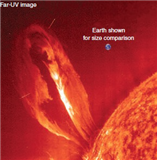 The above image shows a prominence mostly in the ____________ atmospheric layer of the Sun. Because of the far-ultraviolet (FUV) image, we know the _____________ layer of the Sun's atmosphere is shown.
 (Multiple Choice)
4.8/5 (84)
(84) A(n) ____________________ is a subatomic particle produced in nuclear fusion that can travel through the Sun and escape to space without interacting with any particles in the Sun.
(Short Answer)
4.9/5 (82)
(82) Diagram 7-1 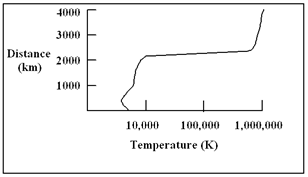 Diagram 7-1 shows a plot of the temperature of the Sun as a function of distance above the bottom of the photosphere. What is the temperature of the Sun at a distance of 2,000 km?
 (Multiple Choice)
4.7/5 (76)
(76) a) Draw the p-p fusion chain that generates helium from hydrogen, labeling each of the four hydrogen atoms needed in the reaction. Label each product formed or particle generated by its common name. b) Discuss how many particles and products are generated in one fusion chain.
(Essay)
4.7/5 (83)
(83) Astronomers can use ________ to measure magnetic fields on the Sun.
(Multiple Choice)
4.9/5 (71)
(71) Why does a filtergram reveal details in higher layers of the solar atmosphere?
(Essay)
4.7/5 (96)
(96) Neutrinos are created in reactions in the _______ of the Sun.
(Multiple Choice)
5.0/5 (71)
(71) 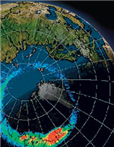 The multicolored ring in the image above of Earth is a/an ___________.
 (Multiple Choice)
4.8/5 (83)
(83) 
Filters
- Essay(0)
- Multiple Choice(0)
- Short Answer(0)
- True False(0)
- Matching(0)