



 Chat with AI
Exam 7: The Sun

Exam 1: Here and Now97 Questions
Exam 2: A Users Guide to the Sky116 Questions
Exam 3: Cycles of the Sun and Moon154 Questions
Exam 4: The Origin of Modern Astronomy144 Questions
Exam 5: Light and Telescopes156 Questions
Exam 6: Atoms and Spectra125 Questions
Exam 7: The Sun146 Questions
Exam 8: The Family of Stars190 Questions
Exam 9: The Formation and Structure of Stars136 Questions
Exam 10: The Deaths of Stars128 Questions
Exam 11: Neutron Stars and Black Holes99 Questions
Exam 12: The Milky Way Galaxy117 Questions
Exam 13: Galaxies: Normal and Active151 Questions
Exam 14: Modern Cosmology112 Questions
Exam 15: Origin of the Solar System and Extrasolar Planets104 Questions
Exam 16: Earth and Moon: Bases for Comparative Planetology98 Questions
Exam 17: Mercury, Venus, and Mars83 Questions
Exam 18: The Outer Solar System137 Questions
Exam 19: Meteorites, Asteroids, and Comets91 Questions
Exam 20: Astrobiology: Life on Other Worlds97 Questions
Select questions type


Fusion occurs in __________ numbers of atomic mass nuclei whereas fission occurs in ___________ numbers of atomic mass nuclei up to _________.
(Multiple Choice)
4.8/5  (95)
(95) Draw all zones and layers of the Sun from the interior through the atmospheres and beyond, if needed.
(Essay)
4.8/5 (71)
(71) The ordering of the atmospheric layers of the Sun from outer to inner is chromosphere, corona, photosphere.
(True/False)
4.9/5 (85)
(85) If energy is carried by the bulk motion of matter, that is called ____________________.
(Short Answer)
4.8/5 (67)
(67) The _________ coincides with the period known as the "little ice age" of Europe and North America. This provides one piece of evidence that suggests a link between solar activity and the amount of solar energy Earth receives.
(Multiple Choice)
4.9/5 (78)
(78) Most of the visible light we see coming from the Sun originates from the
(Multiple Choice)
4.8/5 (81)
(81) The ____________________ shows that sunspots are associated with magnetic activity.
(Short Answer)
5.0/5 (81)
(81) One sees differences in ________ depending on the time in the sunspot cycle.
I. the latitude at which most sunspots occur
II. the number of sunspots that are visible
III. the rotation rate of the Sun's equator
IV. the magnetic polarity of the sunspot pair members in a hemisphere
(Multiple Choice)
4.8/5 (82)
(82) The intensity of a sunspot is found to be 3 times smaller than the intensity emitted by the solar surface. What is the approximate temperature of this sunspot if the temperature of the solar surface is 5800 K?
(Multiple Choice)
4.7/5 (90)
(90) Solar prominences have twisted and looped shapes because of the solar magnetic field.
(True/False)
4.8/5 (71)
(71) Most of the visible light from the Sun originates in the photosphere.
(True/False)
4.8/5 (78)
(78) 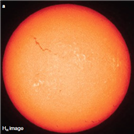 The above image of the Sun was taken using a filtergram.
Which of the following is suggested as the best explanation of the missing solar neutrinos?
(Multiple Choice)
4.9/5 (89)
(89) How did measurements of neutrinos from the Sun pose a problem for modern astronomy and how was it resolved?
(Essay)
4.8/5 (89)
(89) 
Filters
- Essay(0)
- Multiple Choice(0)
- Short Answer(0)
- True False(0)
- Matching(0)