



 Chat with AI
Exam 7: The Sun

Exam 1: Here and Now97 Questions
Exam 2: A Users Guide to the Sky116 Questions
Exam 3: Cycles of the Sun and Moon154 Questions
Exam 4: The Origin of Modern Astronomy144 Questions
Exam 5: Light and Telescopes156 Questions
Exam 6: Atoms and Spectra125 Questions
Exam 7: The Sun146 Questions
Exam 8: The Family of Stars190 Questions
Exam 9: The Formation and Structure of Stars136 Questions
Exam 10: The Deaths of Stars128 Questions
Exam 11: Neutron Stars and Black Holes99 Questions
Exam 12: The Milky Way Galaxy117 Questions
Exam 13: Galaxies: Normal and Active151 Questions
Exam 14: Modern Cosmology112 Questions
Exam 15: Origin of the Solar System and Extrasolar Planets104 Questions
Exam 16: Earth and Moon: Bases for Comparative Planetology98 Questions
Exam 17: Mercury, Venus, and Mars83 Questions
Exam 18: The Outer Solar System137 Questions
Exam 19: Meteorites, Asteroids, and Comets91 Questions
Exam 20: Astrobiology: Life on Other Worlds97 Questions
Select questions type


The four fundamental forces in nature are ______________, _____________, ____________________, and _____________________.
(Short Answer)
4.7/5  (72)
(72) Explain how a photon is generated in the core of the Sun and how it is transported out from the Sun.
(Essay)
4.9/5 (70)
(70) The ____________________ of the Sun is composed of ionized gas and produces a continuous spectrum with a superimposed emission spectrum.
(Short Answer)
4.8/5 (70)
(70) In nuclear fission, (more/less) massive and (higher/lower) atomic number elements on the periodic table are broken into smaller and less massive nuclei. In nuclear fusion, (more/less) massive and (higher/lower) atomic number elements on the periodic table are fused into larger are more massive nuclei.
(Short Answer)
4.8/5 (85)
(85) What evidence do we have that the chromosphere is hotter than the photosphere?
(Essay)
4.9/5 (79)
(79) The dark areas outlining a granule are cooler than the granule.
(True/False)
4.9/5 (75)
(75) A __________________ cycle lasts 11 years, whereas a ________________ cycle lasts 22 years.
(Short Answer)
4.8/5 (89)
(89) 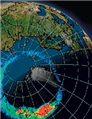 The above image of an aurora on Earth is centered near Earth's rotational axis.
 (True/False)
4.8/5 (91)
(91) Diagram 7-1  Diagram 7-1 shows a plot of the temperature of the Sun as a function of distance above the bottom of the photosphere. At what distance above the bottom of the photosphere is the temperature of the Sun the smallest?
 (Multiple Choice)
4.7/5 (85)
(85)  The squiggly dark line in the upper left quadrant of the Sun in the image above is called a ___________.
 (Multiple Choice)
4.7/5 (83)
(83) The United States consumes 2.5 × 10¹⁹ J of energy each year. A typical solar flare releases 5.0 × 1024 J of energy. How many years could we run the United States on the energy released by this solar flare if all of the released energy could be used?
(Multiple Choice)
4.8/5 (91)
(91) ________ occur(s) because photons we receive from the edge of the solar disk are emitted further from the base of the photosphere than the photons we receive from the center of the solar disk.
(Multiple Choice)
4.8/5 (80)
(80) Initially, scientists detected lower than the expected number of neutrinos from the Sun.
(True/False)
4.8/5 (84)
(84) Coronal holes are holes in the chromosphere to allow the solar wind to stream away from the Sun.
(True/False)
4.9/5 (88)
(88) In the third step of the p-p fusion chain, a _____________ is fused with a _______________ to generate a ________________ with _____________ and _______________ as byproducts.
(Short Answer)
5.0/5 (102)
(102) In the second step of the p-p fusion chain, light helium is formed by the fusion of a ______________ with a __________. A byproduct of the reaction is a ____________.
(Short Answer)
4.8/5 (76)
(76) 
Filters
- Essay(0)
- Multiple Choice(0)
- Short Answer(0)
- True False(0)
- Matching(0)