



 Chat with AI
Exam 7: The Sun

Exam 1: Here and Now97 Questions
Exam 2: A Users Guide to the Sky116 Questions
Exam 3: Cycles of the Sun and Moon154 Questions
Exam 4: The Origin of Modern Astronomy144 Questions
Exam 5: Light and Telescopes156 Questions
Exam 6: Atoms and Spectra125 Questions
Exam 7: The Sun146 Questions
Exam 8: The Family of Stars190 Questions
Exam 9: The Formation and Structure of Stars136 Questions
Exam 10: The Deaths of Stars128 Questions
Exam 11: Neutron Stars and Black Holes99 Questions
Exam 12: The Milky Way Galaxy117 Questions
Exam 13: Galaxies: Normal and Active151 Questions
Exam 14: Modern Cosmology112 Questions
Exam 15: Origin of the Solar System and Extrasolar Planets104 Questions
Exam 16: Earth and Moon: Bases for Comparative Planetology98 Questions
Exam 17: Mercury, Venus, and Mars83 Questions
Exam 18: The Outer Solar System137 Questions
Exam 19: Meteorites, Asteroids, and Comets91 Questions
Exam 20: Astrobiology: Life on Other Worlds97 Questions
Select questions type


In the Sun, rising currents of hot gas below the photosphere cause granulation.
(True/False)
4.8/5  (76)
(76) The ________ is (are) the hot gases that are the moving extension of the Sun's corona.
(Multiple Choice)
4.8/5 (88)
(88) What does the granulation tell us about the layers below the photosphere?
(Essay)
4.7/5 (74)
(74) In some regions of the corona, the magnetic field does not loop back to the Sun, and the gas escapes unimpeded. These regions are called _______ and are believed to be the source of the solar wind.
(Multiple Choice)
4.9/5 (63)
(63) 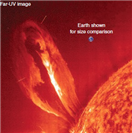 The feature shown in the above image of the Sun is a solar flare.
 (True/False)
4.9/5 (75)
(75) The Sun's magnetic field is evident in the looped shapes of
(Multiple Choice)
4.9/5 (72)
(72) The ________ occurs when a rapidly rotating conductor is stirred by convection to produce a magnetic field.
(Multiple Choice)
4.9/5 (80)
(80) The figure shows the Sun and pairs of sunspots. One could say that there is really a 22-year sunspot cycle because 
(Multiple Choice)
4.9/5 (86)
(86) The sunspot cycle affects
I. the latitude at which sunspots are visible at a given time.
II. the number of sunspots that are visible at a given time.
III. the rotation rate of the Sun's equator at a given time.
IV. the magnetic polarity of the sunspots at a given time.
(Multiple Choice)
4.9/5 (70)
(70) How long do sunspots typically last? Choose the best answer.
(Multiple Choice)
4.8/5 (70)
(70) Granulation is caused by rising currents of hot gas below the photosphere.
(True/False)
4.9/5 (68)
(68) If a sunspot has a temperature of 4,500 K and the surrounding solar surface has a temperature of 5,800 K, how many times brighter is the surface compared to the sunspot?
(Multiple Choice)
4.8/5 (88)
(88) The study of the oscillations of the surface and interior of the Sun is known as ____________________.
(Short Answer)
4.9/5 (68)
(68) 
Filters
- Essay(0)
- Multiple Choice(0)
- Short Answer(0)
- True False(0)
- Matching(0)