



 Chat with AI
Exam 8: The Family of Stars

Exam 1: Here and Now97 Questions
Exam 2: A Users Guide to the Sky116 Questions
Exam 3: Cycles of the Sun and Moon154 Questions
Exam 4: The Origin of Modern Astronomy144 Questions
Exam 5: Light and Telescopes156 Questions
Exam 6: Atoms and Spectra125 Questions
Exam 7: The Sun146 Questions
Exam 8: The Family of Stars190 Questions
Exam 9: The Formation and Structure of Stars136 Questions
Exam 10: The Deaths of Stars128 Questions
Exam 11: Neutron Stars and Black Holes99 Questions
Exam 12: The Milky Way Galaxy117 Questions
Exam 13: Galaxies: Normal and Active151 Questions
Exam 14: Modern Cosmology112 Questions
Exam 15: Origin of the Solar System and Extrasolar Planets104 Questions
Exam 16: Earth and Moon: Bases for Comparative Planetology98 Questions
Exam 17: Mercury, Venus, and Mars83 Questions
Exam 18: The Outer Solar System137 Questions
Exam 19: Meteorites, Asteroids, and Comets91 Questions
Exam 20: Astrobiology: Life on Other Worlds97 Questions
Select questions type


A star's luminosity depends only on the star's

Free
(Multiple Choice)
5.0/5  (77)
(77) Correct Answer: Verified
D
The absorption lines in the infrared portion of the spectrum of a star that are produced by hydrogen are from the
Free
(Multiple Choice)
4.9/5 (83)
(83) Correct Answer:Verified
VerifiedC
Binary (double) stars can be detected by
Free
(Multiple Choice)
5.0/5 (74)
(74) Correct Answer:Verified
VerifiedE
Of the three units of astronomical distances, _________ is shorter than _________, which is shorter than _________.
(Short Answer)
4.9/5 (82)
(82) The amount of light received at Earth from a star is called luminosity.
(True/False)
4.9/5 (83)
(83) What is the total mass of a binary star system with P = 20 yr and a = 10 AU?
(Multiple Choice)
4.7/5 (74)
(74) Groombridge 34 is an M1 V star. Based on this information, which of the following are true?
I. Groombridge 34 has a surface temperature that is less than the Sun.
II. Groombridge 34 has a mass that is greater than that of the Sun.
III. Groombridge 34 is less luminous than the Sun.
IV. Groombridge 34 is located near the middle of the H-R diagram.
(Multiple Choice)
4.8/5 (88)
(88) Consider a two-body system of the Earth orbiting the Sun. The center of mass would be located near the _________.
(Multiple Choice)
4.8/5 (72)
(72) 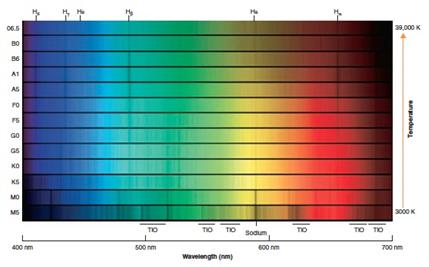 Based upon the information given in the above color photographs, what would you predict to see in a spectra class L0 color photo?
 (Multiple Choice)
4.9/5 (83)
(83) Why would parallaxes be easier to observe if Earth were farther from the Sun?
(Essay)
4.8/5 (74)
(74) Polaris is 10 times larger than Capella A and both are the same color. How much brighter or dimmer is Polaris to Capella?
(Multiple Choice)
4.9/5 (65)
(65) To observe a spectroscopic binary, we must be able to see both stars individually.
(True/False)
4.8/5 (89)
(89) If the orbital velocity of an eclipsing binary is 97 km/s and the smaller star is completely eclipsed in 2 hours, what is the diameter of the smaller star?
(Multiple Choice)
4.9/5 (77)
(77) You want to find a mass of a star on the main sequence of the H-R diagram. What do you need?
(Multiple Choice)
4.9/5 (90)
(90) 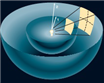 The concept the picture above is trying to get across is _______.
 (Multiple Choice)
4.7/5 (57)
(57) Describe the measurements needed to determine the orbit of a visual binary star.
(Essay)
4.7/5 (92)
(92) If a star's spectrum does not contain spectral lines characteristic of a certain element, can we conclude that the star does not contain that element? Why or why not?
(Essay)
4.8/5 (78)
(78) Why are the Balmer lines weak in the spectra of hot and cool stars, but strong in the spectra of intermediate-temperature stars?
(Essay)
4.8/5 (80)
(80) The method of spectroscopic parallax cannot be applied to stars beyond about 100 pc.
(True/False)
4.9/5 (87)
(87) 
Filters
- Essay(0)
- Multiple Choice(0)
- Short Answer(0)
- True False(0)
- Matching(0)