



 Chat with AI
Exam 8: The Family of Stars

Exam 1: Here and Now97 Questions
Exam 2: A Users Guide to the Sky116 Questions
Exam 3: Cycles of the Sun and Moon154 Questions
Exam 4: The Origin of Modern Astronomy144 Questions
Exam 5: Light and Telescopes156 Questions
Exam 6: Atoms and Spectra125 Questions
Exam 7: The Sun146 Questions
Exam 8: The Family of Stars190 Questions
Exam 9: The Formation and Structure of Stars136 Questions
Exam 10: The Deaths of Stars128 Questions
Exam 11: Neutron Stars and Black Holes99 Questions
Exam 12: The Milky Way Galaxy117 Questions
Exam 13: Galaxies: Normal and Active151 Questions
Exam 14: Modern Cosmology112 Questions
Exam 15: Origin of the Solar System and Extrasolar Planets104 Questions
Exam 16: Earth and Moon: Bases for Comparative Planetology98 Questions
Exam 17: Mercury, Venus, and Mars83 Questions
Exam 18: The Outer Solar System137 Questions
Exam 19: Meteorites, Asteroids, and Comets91 Questions
Exam 20: Astrobiology: Life on Other Worlds97 Questions
Select questions type


Describe two methods that could be used to determine the temperature of a star.
(Essay)
5.0/5  (79)
(79) Vega is an A0 V star. Based on this information, which of the following are true?
I. Vega has a surface temperature less than the Sun.
II. Vega has a mass that is greater than that of the Sun.
III. Vega is more luminous than the Sun.
IV. Vega is located in the upper left-hand corner in the H-R diagram.
(Multiple Choice)
4.7/5 (80)
(80) The absorption lines in the visible portion of the spectrum of a star that are produced by hydrogen are from the
(Multiple Choice)
4.9/5 (78)
(78) On the H-R diagram, lines of constant radius slants down from left to right.
(True/False)
4.9/5 (87)
(87) Luminosity class IV objects are known as ____________________.
(Short Answer)
4.8/5 (81)
(81) Most stars on the H-R diagram are on the ____________________.
(Short Answer)
4.9/5 (87)
(87) To determine the orbital period of a visual binary, we must measure
(Multiple Choice)
4.7/5 (89)
(89) A pair of stars orbit around one another in an elliptical orbit with a semi-major axis, a , of 1 AU with an orbital period, P , of 1 year. What is the mass of the pair of stars?
(Multiple Choice)
4.7/5 (74)
(74) A star whose parallax is 0.01 seconds arc is at a distance of 1000 pc.
(True/False)
4.9/5 (81)
(81) The diagram below shows the radial velocity curve of a double-line spectroscopic binary. Based on this radial velocity curve, which of the following statements is correct? 
(Multiple Choice)
4.8/5 (88)
(88) 
 a
 B
 C
Predict the next panel in the spectral sequence of the binary star system shown above.
a
B
C
Predict the next panel in the spectral sequence of the binary star system shown above. (Multiple Choice)
4.8/5 (95)
(95) The least massive main-sequence stars have a/an _____ luminosity class and a/an _____ spectral class.
(Short Answer)
4.8/5 (88)
(88) How does the luminosity depend on temperature for stars of the same size?
(Essay)
4.9/5 (76)
(76) If a star's apparent visual magnitude is equal to its absolute visual magnitude, how far is the star located from Earth?
(Multiple Choice)
4.8/5 (78)
(78) How do humans use their eyes to measure relative distance by parallax?
(Multiple Choice)
4.7/5 (84)
(84) 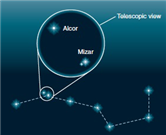 Which is the binary system, and what is the type, in the above figure?
 (Multiple Choice)
4.7/5 (83)
(83) In an eclipsing binary, the orbits are face-on so you can see both stars orbiting each other at all times.
(True/False)
4.9/5 (71)
(71)  A ___________________ binary is shown in the above simulated spectra.
 (Multiple Choice)
4.8/5 (74)
(74) 
Filters
- Essay(0)
- Multiple Choice(0)
- Short Answer(0)
- True False(0)
- Matching(0)