



 Chat with AI
Exam 8: The Family of Stars

Exam 1: Here and Now97 Questions
Exam 2: A Users Guide to the Sky116 Questions
Exam 3: Cycles of the Sun and Moon154 Questions
Exam 4: The Origin of Modern Astronomy144 Questions
Exam 5: Light and Telescopes156 Questions
Exam 6: Atoms and Spectra125 Questions
Exam 7: The Sun146 Questions
Exam 8: The Family of Stars190 Questions
Exam 9: The Formation and Structure of Stars136 Questions
Exam 10: The Deaths of Stars128 Questions
Exam 11: Neutron Stars and Black Holes99 Questions
Exam 12: The Milky Way Galaxy117 Questions
Exam 13: Galaxies: Normal and Active151 Questions
Exam 14: Modern Cosmology112 Questions
Exam 15: Origin of the Solar System and Extrasolar Planets104 Questions
Exam 16: Earth and Moon: Bases for Comparative Planetology98 Questions
Exam 17: Mercury, Venus, and Mars83 Questions
Exam 18: The Outer Solar System137 Questions
Exam 19: Meteorites, Asteroids, and Comets91 Questions
Exam 20: Astrobiology: Life on Other Worlds97 Questions
Select questions type


What information about orbital inclination can we get from visual binaries, spectroscopic binaries, and eclipsing binaries?
(Essay)
4.9/5  (68)
(68) In a/an ____________ binary, the orbits of both stars can be mapped.
(Short Answer)
4.8/5 (78)
(78) The diagram below illustrates two stars in a visual binary system and the center of mass of this system. Based on this diagram, what is the ratio of the mass of star A to the mass of star B? 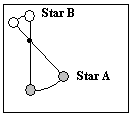
(Multiple Choice)
4.7/5 (93)
(93) Hydrogen Balmer lines are strongest near ____ spectral class whereas ionized Calcium (CaII) lines are strong in ___ stars.
(Multiple Choice)
4.8/5 (86)
(86) The combined mass of a binary system is three solar masses. Star A is 1 AU and Star B is 2 AU from the center of mass. What are the masses of Star A and Star B, respectively?
(Multiple Choice)
4.8/5 (78)
(78) How does an H-R diagram make it clear that giant stars are larger than main-sequence stars of the same temperature?
(Essay)
4.9/5 (79)
(79) Which stars always have large positive absolute magnitude?
(Multiple Choice)
4.8/5 (72)
(72) For what kinds of stars are the masses of stars in the H-R diagram "orderly"? For what kinds of stars are they disorderly? In other words, could you guess the mass of a star from its location (luminosity, temperature) on the H-R diagram?
(Essay)
4.8/5 (76)
(76) Spectroscopic and eclipse duration observations of an eclipsing binary star can enable astronomers to calculate________ of its individual stars.
(Multiple Choice)
4.7/5 (93)
(93) 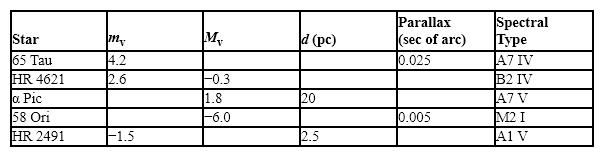 -Table 8-1 Use the chart below to answer the following question(s).
From the data given, which star in Table 8-1 has the greatest diameter?
-Table 8-1 Use the chart below to answer the following question(s).
From the data given, which star in Table 8-1 has the greatest diameter? (Multiple Choice)
4.7/5 (82)
(82) We know the white dwarf star Sirius B has a mass comparable to the Sun because
(Multiple Choice)
4.8/5 (80)
(80) We can find the masses and diameters of stars that are in eclipsing binary systems.
(True/False)
4.8/5 (72)
(72)
-Table 8-1 Use the chart below to answer the following question(s).
From the data given, which star in Table 8-1 is the closest to Earth?
-Table 8-1 Use the chart below to answer the following question(s).
From the data given, which star in Table 8-1 is the closest to Earth? (Multiple Choice)
4.8/5 (80)
(80) The correct sequence of spectral type letters from hot on the left to cool on the right is
(Multiple Choice)
4.9/5 (68)
(68) 
Filters
- Essay(0)
- Multiple Choice(0)
- Short Answer(0)
- True False(0)
- Matching(0)