



 Chat with AI
Exam 13: Galaxies: Normal and Active

Exam 1: Here and Now97 Questions
Exam 2: A Users Guide to the Sky116 Questions
Exam 3: Cycles of the Sun and Moon154 Questions
Exam 4: The Origin of Modern Astronomy144 Questions
Exam 5: Light and Telescopes156 Questions
Exam 6: Atoms and Spectra125 Questions
Exam 7: The Sun146 Questions
Exam 8: The Family of Stars190 Questions
Exam 9: The Formation and Structure of Stars136 Questions
Exam 10: The Deaths of Stars128 Questions
Exam 11: Neutron Stars and Black Holes99 Questions
Exam 12: The Milky Way Galaxy117 Questions
Exam 13: Galaxies: Normal and Active151 Questions
Exam 14: Modern Cosmology112 Questions
Exam 15: Origin of the Solar System and Extrasolar Planets104 Questions
Exam 16: Earth and Moon: Bases for Comparative Planetology98 Questions
Exam 17: Mercury, Venus, and Mars83 Questions
Exam 18: The Outer Solar System137 Questions
Exam 19: Meteorites, Asteroids, and Comets91 Questions
Exam 20: Astrobiology: Life on Other Worlds97 Questions
Select questions type


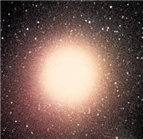 What kind of galaxy is this?

The radio radiation emitted by a radio lobe is mainly synchrotron radiation.

Free
(True/False)
4.9/5  (102)
(102) Correct Answer: Verified
True
The total mass of galaxies in a cluster of galaxies divided by the number of galaxies in the cluster can be used to determine a typical galaxy's ___________.
Free
(Multiple Choice)
4.9/5 (79)
(79) Correct Answer:Verified
VerifiedC
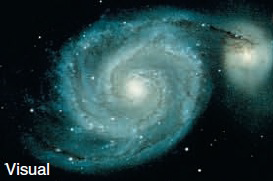 The above visual wavelength image shows galaxies interacting.
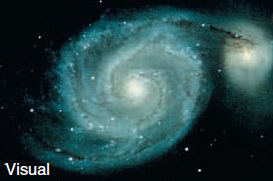 In the above visual wavelength image, the two galaxies shown are most likely to have formed from ____________.
 (Multiple Choice)
4.9/5 (71)
(71) 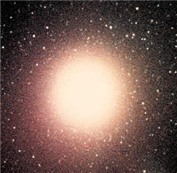 One way we know this is an elliptical galaxy as opposed to a spiral galaxy is that the color is red as shown.
 (True/False)
4.7/5 (73)
(73) What was the first evidence that quasars were different from astronomical objects before they were observed in visual wavelengths?
(Multiple Choice)
4.9/5 (74)
(74) The diagram illustrates physical size and angular size as seen by the observer. We can estimate the size in light years (or parsecs or km) of M31 from 
(Multiple Choice)
4.8/5 (64)
(64) Evidence that tidal interactions and collisions of galaxies may make ordinary galaxies active is that
(Multiple Choice)
4.9/5 (68)
(68) Astronomers who discovered quasars found that they show ___________ of their spectral lines and are thus probably much ___________ than nearby galaxies.
(Multiple Choice)
4.9/5 (78)
(78) If a quasar has a recessional velocity of 2.7 × 10⁵ km/s and is determined to be 3600 Mpc, what is the Hubble constant based on this quasar alone? Hint: Note that the units of your result should be (km/s)/Mpc to see what arithmetic process you need to perform.
(Multiple Choice)
5.0/5 (88)
(88) ___________ have elongated nuclei with spiral structure extending from the ends of the elongations. The Milky Way is a member of this class of galaxy.
(Multiple Choice)
4.9/5 (76)
(76) If the redshifts of quasars arise from the expansion of the universe yet they have brighter magnitudes than galaxies with the same redshifts, the quasar must
(Multiple Choice)
5.0/5 (87)
(87) 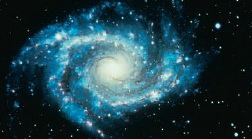 The above visual wavelength image is an ___________-type galaxy.
 (Multiple Choice)
4.9/5 (78)
(78) Which distance indicator technique is best to find distances to galaxies?
(Multiple Choice)
4.8/5 (93)
(93) Mathematical models indicate that ___________ galaxies are produced by high-speed collisions in which a smaller galaxy passes through another galaxy almost perpendicular to the disk of the galaxy.
(Multiple Choice)
4.8/5 (82)
(82) The rapid fluctuations of quasars show that the energy emitting portions of these objects must be very small.
(True/False)
4.8/5 (82)
(82) 
Filters
- Essay(0)
- Multiple Choice(0)
- Short Answer(0)
- True False(0)
- Matching(0)