



 Chat with AI
Exam 13: Galaxies: Normal and Active

Exam 1: Here and Now97 Questions
Exam 2: A Users Guide to the Sky116 Questions
Exam 3: Cycles of the Sun and Moon154 Questions
Exam 4: The Origin of Modern Astronomy144 Questions
Exam 5: Light and Telescopes156 Questions
Exam 6: Atoms and Spectra125 Questions
Exam 7: The Sun146 Questions
Exam 8: The Family of Stars190 Questions
Exam 9: The Formation and Structure of Stars136 Questions
Exam 10: The Deaths of Stars128 Questions
Exam 11: Neutron Stars and Black Holes99 Questions
Exam 12: The Milky Way Galaxy117 Questions
Exam 13: Galaxies: Normal and Active151 Questions
Exam 14: Modern Cosmology112 Questions
Exam 15: Origin of the Solar System and Extrasolar Planets104 Questions
Exam 16: Earth and Moon: Bases for Comparative Planetology98 Questions
Exam 17: Mercury, Venus, and Mars83 Questions
Exam 18: The Outer Solar System137 Questions
Exam 19: Meteorites, Asteroids, and Comets91 Questions
Exam 20: Astrobiology: Life on Other Worlds97 Questions
Select questions type


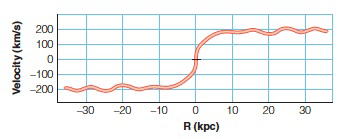 The negative velocity numbers in the above graph represent a galaxy that is moving away from us.
 (True/False)
4.8/5  (84)
(84) Describe the kind of observations that have led astronomers to believe that supermassive black holes lie at the center of many galaxies.
(Essay)
4.7/5 (88)
(88) What type of galaxies do astronomers believe to be the most common?
(Multiple Choice)
4.8/5 (73)
(73) If H equals 70 km/s/Mpc, then a galaxy with a radial velocity of 2100 km/s has a distance of approximately
(Multiple Choice)
4.9/5 (87)
(87) From nearest to furthest from Earth, list the distance indicators and which type of object is best found at that distant indicator.
(Essay)
4.9/5 (81)
(81) If the redshift of a quasar were 3, at what wavelength would the 486.1-nm line of hydrogen appear in the quasar's spectrum?
(Short Answer)
4.8/5 (77)
(77) What observational evidence do we have that eruptions in the centers of galaxies involve magnetic fields?
(Essay)
4.9/5 (76)
(76) 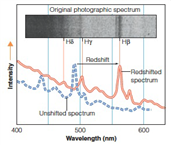 The red line shown above is shifted 15.8% from the blue dashed line. If H β is 486.1 nm, what is the change in the wavelength?
 (Multiple Choice)
4.7/5 (85)
(85) Soon after discovery, it was observed that quasars had a starlike appearance which was blurred by Earth's atmospheric "seeing". Despite the blurring, it was realized that the intense energy-emitting regions of quasars must be small because they
(Multiple Choice)
5.0/5 (80)
(80) 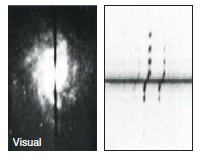 The above visual wavelength image of spectra (right panel) taken from a spiral galaxy (left panel) shows an emission line that is__________ on the side that is rotating away and an emission line that is ___________ on the side that is rotating towards us.
 (Multiple Choice)
4.8/5 (84)
(84) How are astronomers able to determine that quasars are so small?
(Multiple Choice)
4.9/5 (79)
(79) __________ can be used to determine the galaxy's mass if the galaxy is reasonably close, so that the Doppler shift of the galaxy disk material can be measured at several distances from the galaxy's center relative to the center.
(Multiple Choice)
4.7/5 (92)
(92) 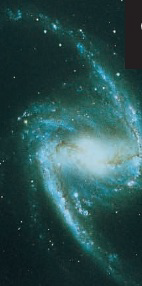 The above visual wavelength image suggests that star formation is currently occurring.
 (True/False)
5.0/5 (84)
(84) If H equals 50 km/s/Mpc, then a galaxy with a radial velocity of 50,000 km/s will have a distance of about 1 Mpc.
(True/False)
4.9/5 (64)
(64) If a quasar has a redshift of 0.98, then it is receding from Earth at 98 percent the speed of light.
(True/False)
4.7/5 (73)
(73) Observations of galaxies and clusters of galaxies indicate that about ___________ percent of the matter in the universe is dark matter.
(Multiple Choice)
4.7/5 (77)
(77) All __________ galaxies are spiral galaxies that have small, luminous nuclei.
(Multiple Choice)
4.9/5 (88)
(88) 
Filters
- Essay(0)
- Multiple Choice(0)
- Short Answer(0)
- True False(0)
- Matching(0)