



 Chat with AI
Exam 13: Galaxies: Normal and Active

Exam 1: Here and Now97 Questions
Exam 2: A Users Guide to the Sky116 Questions
Exam 3: Cycles of the Sun and Moon154 Questions
Exam 4: The Origin of Modern Astronomy144 Questions
Exam 5: Light and Telescopes156 Questions
Exam 6: Atoms and Spectra125 Questions
Exam 7: The Sun146 Questions
Exam 8: The Family of Stars190 Questions
Exam 9: The Formation and Structure of Stars136 Questions
Exam 10: The Deaths of Stars128 Questions
Exam 11: Neutron Stars and Black Holes99 Questions
Exam 12: The Milky Way Galaxy117 Questions
Exam 13: Galaxies: Normal and Active151 Questions
Exam 14: Modern Cosmology112 Questions
Exam 15: Origin of the Solar System and Extrasolar Planets104 Questions
Exam 16: Earth and Moon: Bases for Comparative Planetology98 Questions
Exam 17: Mercury, Venus, and Mars83 Questions
Exam 18: The Outer Solar System137 Questions
Exam 19: Meteorites, Asteroids, and Comets91 Questions
Exam 20: Astrobiology: Life on Other Worlds97 Questions
Select questions type


What is the primary factor in determining the classification for an elliptical galaxy?
(Multiple Choice)
4.7/5  (85)
(85) The hydrogen Balmer line H β has a wavelength of 486.1 nm in the laboratory. It is observed in a quasar at 2430.5 nm. What is the fractional change in wavelength or redshift z of this quasar?
(Multiple Choice)
4.7/5 (68)
(68) The high _______________ of quasars reveals to astronomers that they must be very distant.
(Short Answer)
4.9/5 (73)
(73) Why do astronomers believe supermassive black holes are the source of an AGN's energy?
(Multiple Choice)
4.9/5 (70)
(70) Astronomers now speculate that a galaxy's shape depends on all of the following except
(Multiple Choice)
4.7/5 (93)
(93) What distance method did Edwin Hubble use to determine the distance to local galaxies?
(Multiple Choice)
5.0/5 (69)
(69) In the double-exhaust model, the radio lobes of a radio galaxy are inflated by
(Multiple Choice)
4.9/5 (69)
(69) When two galaxies collide, they pass through each other and their stars almost never collide.
(True/False)
4.9/5 (71)
(71) ___________ are produced when two galaxies pass near each other and pull large streamers of stars, gas, and dust away from the galaxies.
(Multiple Choice)
4.9/5 (76)
(76) Of the following, which of the following is the largest object?
(Multiple Choice)
4.8/5 (84)
(84) The Large and Small Magellanic Clouds are satellites galaxies of the Milky Way.
(True/False)
5.0/5 (94)
(94) The Local Group of galaxies is dominated by the presence of spiral galaxies.
(True/False)
4.8/5 (84)
(84) Centaurus A is a radio galaxy that has a visible galaxy at the center. This central elliptical galaxy of Centaurus A is encircled by a ring of gas and dust, different from most elliptical galaxies. The dust ring orbits about an axis that is perpendicular to the axis of rotation of the elliptical galaxy. What does this suggest about this central elliptical galaxy of Centaurus A?
(Multiple Choice)
4.9/5 (81)
(81) Many disk galaxies, such as Andromeda and the Milky Way, are thought to have extended halos of dark matter because the disk circular orbital speed is observed to ____________ increasing distances from the disk center.
(Multiple Choice)
4.7/5 (78)
(78) 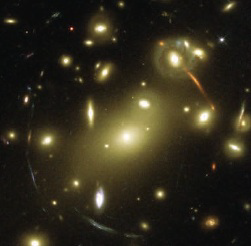 In the above image, the _____________ is the gravitational lens and the ___________ is the lensed object.
 (Multiple Choice)
4.8/5 (76)
(76) The fact that many radio lobes emit more intensely from the side away from the galaxy suggests that
(Multiple Choice)
4.8/5 (82)
(82) Galaxies may contain a supermassive black hole at their center but ___________ an active nucleus because of ____________ into the black hole
(Multiple Choice)
4.9/5 (76)
(76) 
Filters
- Essay(0)
- Multiple Choice(0)
- Short Answer(0)
- True False(0)
- Matching(0)