



 Chat with AI
Exam 13: Galaxies: Normal and Active

Exam 1: Here and Now97 Questions
Exam 2: A Users Guide to the Sky116 Questions
Exam 3: Cycles of the Sun and Moon154 Questions
Exam 4: The Origin of Modern Astronomy144 Questions
Exam 5: Light and Telescopes156 Questions
Exam 6: Atoms and Spectra125 Questions
Exam 7: The Sun146 Questions
Exam 8: The Family of Stars190 Questions
Exam 9: The Formation and Structure of Stars136 Questions
Exam 10: The Deaths of Stars128 Questions
Exam 11: Neutron Stars and Black Holes99 Questions
Exam 12: The Milky Way Galaxy117 Questions
Exam 13: Galaxies: Normal and Active151 Questions
Exam 14: Modern Cosmology112 Questions
Exam 15: Origin of the Solar System and Extrasolar Planets104 Questions
Exam 16: Earth and Moon: Bases for Comparative Planetology98 Questions
Exam 17: Mercury, Venus, and Mars83 Questions
Exam 18: The Outer Solar System137 Questions
Exam 19: Meteorites, Asteroids, and Comets91 Questions
Exam 20: Astrobiology: Life on Other Worlds97 Questions
Select questions type


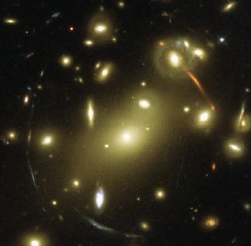 The multiple images forming a ring around the cluster come from two merging distant galaxies.
 (True/False)
4.7/5  (86)
(86) If a galaxy has a radial velocity of 8000 km/s and the Hubble constant is 70 km/s/Mpc, what is the distance to this galaxy?
(Multiple Choice)
4.8/5 (78)
(78) In the unified model of active galactic nuclei, the broad line region in an active galactic nucleus is
(Multiple Choice)
4.8/5 (83)
(83) The radio lobes that are on each side of some radio galaxies and jets from them produce mainly
(Multiple Choice)
4.8/5 (77)
(77) Elliptical galaxies contain more gas, dust, and young stars than do Sa galaxies.
(True/False)
4.9/5 (96)
(96)  The dark lines we see in the above visual wavelength image of a spiral galaxy viewed edge-on is from dust.
 (True/False)
4.9/5 (84)
(84) Quasar redshifts are usually larger than the redshifts of the visible galaxies.
(True/False)
4.8/5 (79)
(79) Double-lobed radio galaxies appear to be emitting jets of gas and radiation.
(True/False)
5.0/5 (91)
(91) 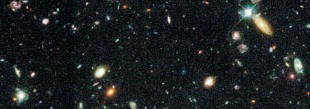 The blue sharp point of light with diffraction spikes in the upper right corner of the visual + NIR image of the Hubble Deep Field, shown above, is a star in our Milky Way Galaxy.
 (True/False)
4.8/5 (75)
(75) ________________ emit radio energy from areas on either side of the galaxy that are inflated by jets.
(Short Answer)
5.0/5 (85)
(85) Some large clusters of galaxies do not appear to contain enough mass to hold themselves together.
(True/False)
4.8/5 (74)
(74) That the radio lobes radiate synchrotron radiation indicates that
(Multiple Choice)
4.7/5 (86)
(86) What of the following distance methods is used to determine the distance to the most distant galaxies?
(Multiple Choice)
4.8/5 (81)
(81) What distance method is used to determine the distance to the most distant galaxies when only a redshift is measured?
(Multiple Choice)
4.9/5 (84)
(84) Via the rotation curve method, we can estimate the mass of galaxies like M31 from
(Multiple Choice)
4.9/5 (79)
(79) Why can't galaxy evolution go from elliptical to spiral to irregular?
(Essay)
5.0/5 (83)
(83) Discuss the observational differences between spiral, elliptical, and irregular galaxies.
(Essay)
4.8/5 (86)
(86) 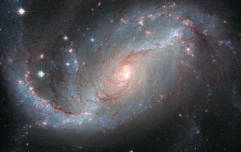 The above visual wavelength image is of an interacting spiral galaxy.
 (True/False)
4.8/5 (83)
(83) 
Filters
- Essay(0)
- Multiple Choice(0)
- Short Answer(0)
- True False(0)
- Matching(0)