



 Chat with AI
Exam 17: Mercury, Venus, and Mars

Exam 1: Here and Now97 Questions
Exam 2: A Users Guide to the Sky116 Questions
Exam 3: Cycles of the Sun and Moon154 Questions
Exam 4: The Origin of Modern Astronomy144 Questions
Exam 5: Light and Telescopes156 Questions
Exam 6: Atoms and Spectra125 Questions
Exam 7: The Sun146 Questions
Exam 8: The Family of Stars190 Questions
Exam 9: The Formation and Structure of Stars136 Questions
Exam 10: The Deaths of Stars128 Questions
Exam 11: Neutron Stars and Black Holes99 Questions
Exam 12: The Milky Way Galaxy117 Questions
Exam 13: Galaxies: Normal and Active151 Questions
Exam 14: Modern Cosmology112 Questions
Exam 15: Origin of the Solar System and Extrasolar Planets104 Questions
Exam 16: Earth and Moon: Bases for Comparative Planetology98 Questions
Exam 17: Mercury, Venus, and Mars83 Questions
Exam 18: The Outer Solar System137 Questions
Exam 19: Meteorites, Asteroids, and Comets91 Questions
Exam 20: Astrobiology: Life on Other Worlds97 Questions
Select questions type


What is the difference between volcanism on Venus and that around the ring of fire on Earth?

Free
(Essay)
4.8/5  (94)
(94) Correct Answer: Verified
Volcanism around the ring of fire is caused by the motion of the tectonic plates, and are composite volcanoes. On Venus, there are no plate tectonics so the volcanoes are shield volcanoes, the type produced by hot-spot volcanism.
Which Terrestrial planet has the combination of most rapid rotation, liquid interior, and strongest magnetic field?
Free
(Multiple Choice)
4.8/5 (99)
(99) Correct Answer:Verified
VerifiedC
_____________ are believed to have formed on Mercury when the planet's interior cooled and shrank.
Free
(Multiple Choice)
5.0/5 (74)
(74) Correct Answer:Verified
VerifiedD
Which of the solar system objects listed below is most similar to Earth in terms of mass and density?
(Multiple Choice)
4.8/5 (66)
(66) Lobate scarps are believed to have formed on Mercury when its interior cooled and shrank.
(True/False)
4.8/5 (87)
(87) Discuss the evidence we have that the surface of Venus is marked by volcanism.
(Essay)
4.9/5 (82)
(82) 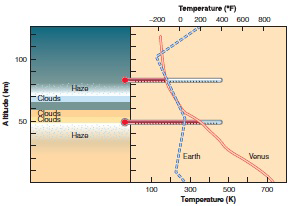 At which altitude is the atmospheric temperature of Venus and Earth the same?
 (Multiple Choice)
4.8/5 (76)
(76) Which one of the phrases below is the current explanation of why the surface of Venus is so hot?
(Multiple Choice)
4.9/5 (91)
(91) ____________________ is the molecule most responsible for the greenhouse effect on Venus and Earth.
(Short Answer)
4.7/5 (87)
(87) The terrestrial planet with the most moons is ____________________.
(Short Answer)
4.7/5 (84)
(84) As seen from Earth and the Hubble Space Telescope, Mars shows
(Multiple Choice)
4.8/5 (86)
(86) 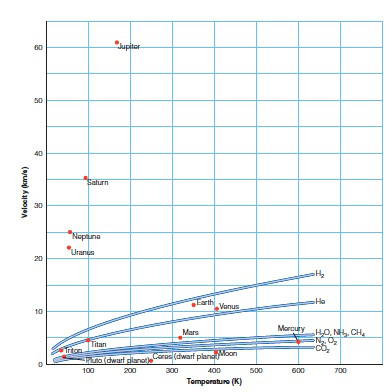 Which celestial object in the above graph has the most difficult time retaining an atmosphere based solely upon escape velocity?
(Multiple Choice)
4.9/5 (67)
(67) The crust of Mars is believed to _____________ than Earth's.
(Multiple Choice)
4.8/5 (72)
(72) Which of the objects below has an atmosphere consisting mostly of carbon dioxide?
(Multiple Choice)
4.7/5 (85)
(85) Whether or not a planet like Mercury can hold a particular gas in its atmosphere depends on that planet's
(Multiple Choice)
5.0/5 (78)
(78) 
Filters
- Essay(0)
- Multiple Choice(0)
- Short Answer(0)
- True False(0)
- Matching(0)