



 Chat with AI
Exam 17: Mercury, Venus, and Mars

Exam 1: Here and Now97 Questions
Exam 2: A Users Guide to the Sky116 Questions
Exam 3: Cycles of the Sun and Moon154 Questions
Exam 4: The Origin of Modern Astronomy144 Questions
Exam 5: Light and Telescopes156 Questions
Exam 6: Atoms and Spectra125 Questions
Exam 7: The Sun146 Questions
Exam 8: The Family of Stars190 Questions
Exam 9: The Formation and Structure of Stars136 Questions
Exam 10: The Deaths of Stars128 Questions
Exam 11: Neutron Stars and Black Holes99 Questions
Exam 12: The Milky Way Galaxy117 Questions
Exam 13: Galaxies: Normal and Active151 Questions
Exam 14: Modern Cosmology112 Questions
Exam 15: Origin of the Solar System and Extrasolar Planets104 Questions
Exam 16: Earth and Moon: Bases for Comparative Planetology98 Questions
Exam 17: Mercury, Venus, and Mars83 Questions
Exam 18: The Outer Solar System137 Questions
Exam 19: Meteorites, Asteroids, and Comets91 Questions
Exam 20: Astrobiology: Life on Other Worlds97 Questions
Select questions type


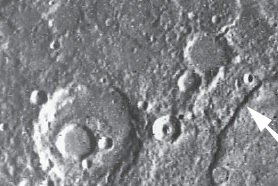 Is the large crater shown on the bottom left older or younger than the smooth, dark, circular crater in the upper right?
 (Multiple Choice)
4.9/5  (73)
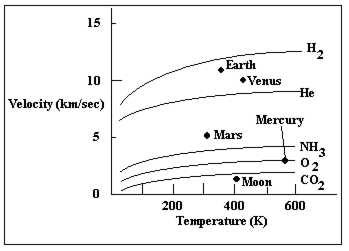
(73) The graph below plots the escape velocity of each planet along the vertical axis and its surface temperature along the horizontal. The lines plotted in the figure are the average speeds of gas particles as a function of temperature for various gases. Which of the planets or satellite plotted in this diagram has the greatest escape velocity?
(Multiple Choice)
5.0/5 (77)
(77) 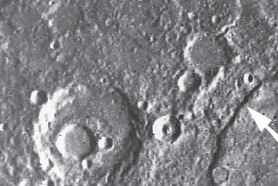 What is the arrow in the above photo pointing to on the surface of Mercury?
 (Multiple Choice)
4.9/5 (83)
(83) Most terrestrial planets have portions of their surface that appear to be significantly older than other portions of their surface. What evidence suggests that the surface of Venus is all of the same age?
(Multiple Choice)
4.8/5 (80)
(80) What evidence do we have that the surface of Mars has never divided into moving plates?
(Essay)
4.9/5 (79)
(79) One hypothesis suggested to explain the uniform age of the surface of Venus is that
(Multiple Choice)
4.9/5 (64)
(64) The daytime surface temperature of Mercury is higher than Earth's Moon's surface temperature because
(Multiple Choice)
4.9/5 (91)
(91) What physical property of Venus is vastly dissimilar compared to Earth?
(Multiple Choice)
4.9/5 (78)
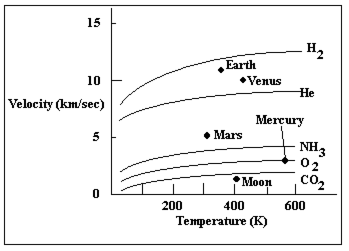
(78) The graph below plots the escape velocity of each planet along the vertical axis and its surface temperature along the horizontal. The lines plotted in the figure are the average speeds of gas particles as a function of temperature for various gases. Which of the planets or satellite plotted in this diagram is least able to hold an atmosphere?
(Multiple Choice)
4.9/5 (87)
(87) Venus is very hot because its atmosphere is rich in carbon dioxide.
(True/False)
4.9/5 (73)
(73) What factors determine the rate of loss of gases from a planet's atmosphere?
(Essay)
4.8/5 (68)
(68) The terrestrial planet with the most effective greenhouse effect is ____________________.
(Short Answer)
5.0/5 (73)
(73) How is the rotation of Venus different from that of other terrestrial planets?
(Essay)
4.8/5 (88)
(88) The greenhouse effect occurs because carbon dioxide is opaque to infrared radiation.
(True/False)
4.7/5 (85)
(85) 
Filters
- Essay(0)
- Multiple Choice(0)
- Short Answer(0)
- True False(0)
- Matching(0)