



 Chat with AI
Exam 8: The Family of Stars

Exam 1: Here and Now97 Questions
Exam 2: A Users Guide to the Sky116 Questions
Exam 3: Cycles of the Sun and Moon154 Questions
Exam 4: The Origin of Modern Astronomy144 Questions
Exam 5: Light and Telescopes156 Questions
Exam 6: Atoms and Spectra125 Questions
Exam 7: The Sun146 Questions
Exam 8: The Family of Stars190 Questions
Exam 9: The Formation and Structure of Stars136 Questions
Exam 10: The Deaths of Stars128 Questions
Exam 11: Neutron Stars and Black Holes99 Questions
Exam 12: The Milky Way Galaxy117 Questions
Exam 13: Galaxies: Normal and Active151 Questions
Exam 14: Modern Cosmology112 Questions
Exam 15: Origin of the Solar System and Extrasolar Planets104 Questions
Exam 16: Earth and Moon: Bases for Comparative Planetology98 Questions
Exam 17: Mercury, Venus, and Mars83 Questions
Exam 18: The Outer Solar System137 Questions
Exam 19: Meteorites, Asteroids, and Comets91 Questions
Exam 20: Astrobiology: Life on Other Worlds97 Questions
Select questions type


Acrux has an M V = -4.2 and an m V = 0.81. Therefore, Acrux is actually brighter than we perceive it to be.
(True/False)
4.9/5  (69)
(69) 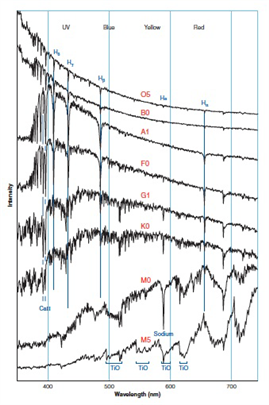 Which statement is incorrect about the above spectra?
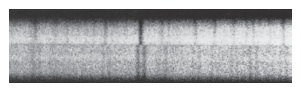 As shown in the above spectra, which is taken at two different times, a ________ is concluded.
 (Multiple Choice)
4.8/5 (81)
(81) A parsec is
I. a unit of length used in astronomy
II. 2.06 × 10⁵ AU
III. the distance to an imaginary star whose stellar parallax is one arc second
IV. 3.26 light years
V. the longest unit of length in astronomy
(Multiple Choice)
4.8/5 (78)
(78) An eclipsing binary has been analyzed and it has been determined that the ratio of the mass of star A to the mass of star B is 6 and the total mass of the two stars is 26 solar masses. What are the masses of star A and star B?
(Multiple Choice)
4.9/5 (75)
(75) Doppler-shift observations of a spectroscopic binary star can enable astronomers to calculate ________ of its individual stars.
(Multiple Choice)
4.9/5 (74)
(74) Diagram 8-1 Use the H-R diagram below to answer the following question(s).  Which star in Diagram 8-1 is most like the Sun?
 (Multiple Choice)
4.9/5 (90)
(90) The absorption lines in the ultraviolet portion of the spectrum of a star that are produced by hydrogen are from the
(Multiple Choice)
4.9/5 (78)
(78) The largest of the red stars are the ____________________ stars.
(Short Answer)
4.8/5 (85)
(85)  -Table 8-1 Use the chart below to answer the following question(s)
From the data given, which star in Table 8-1 would appear the faintest in the night sky?
-Table 8-1 Use the chart below to answer the following question(s)
From the data given, which star in Table 8-1 would appear the faintest in the night sky? (Multiple Choice)
4.8/5 (90)
(90) A G2 I star is ____________________ in diameter and ____________________ luminous than the Sun.
(Short Answer)
4.8/5 (73)
(73) Polaris is 132 pc from Earth and has an absolute visual magnitude of -3.1. What is the apparent visual magnitude of this star?
(Multiple Choice)
4.8/5 (73)
(73) An 05 star has an H α line present in its spectra. What color is the line?
(Multiple Choice)
4.9/5 (76)
(76) White dwarfs have such a low luminosity that even the nearest white dwarfs are not visible to the naked eye.
(True/False)
4.7/5 (84)
(84) Which one of the methods below enables astronomers to measure the distance of a star near the Sun in our galaxy?
(Multiple Choice)
4.8/5 (64)
(64) On the H-R diagram, cool and bright stars are located in the ________ corner.
(Multiple Choice)
5.0/5 (90)
(90) The absolute magnitude of a star is the apparent magnitude it would have if it were 10 pc from Earth.
(True/False)
4.9/5 (95)
(95) 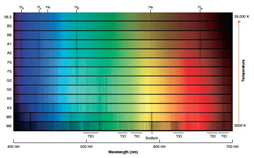 What kind of spectra is shown in the color photographs above?
 (Multiple Choice)
4.9/5 (76)
(76) 
Filters
- Essay(0)
- Multiple Choice(0)
- Short Answer(0)
- True False(0)
- Matching(0)