



 Chat with AI
Exam 18: The Keynesian Model

Exam 1: Introducing the Economic Way of Thinking85 Questions
Exam 2: Production Possibilities Opportunity Cost and Economic Growth107 Questions
Exam 3: Market Demand and Supply176 Questions
Exam 4: Markets in Action137 Questions
Exam 5: Price Elasticity of Demand and Supply151 Questions
Exam 6: Consumer Choice Theory96 Questions
Exam 7: Production Costs131 Questions
Exam 8: Perfect Competition126 Questions
Exam 9: Monopoly81 Questions
Exam 10: Monopolistic Competition and Oligopoly97 Questions
Exam 11: Labor Markets105 Questions
Exam 12: Income Distribution Poverty and Discrimination57 Questions
Exam 13: Antitrust and Regulation96 Questions
Exam 14: Environmental Economics47 Questions
Exam 15: Gross Domestic Product109 Questions
Exam 16: Business Cycles and Unemployment94 Questions
Exam 17: Inflation56 Questions
Exam 18: The Keynesian Model111 Questions
Exam 19: The Keynesian Model in Action105 Questions
Exam 20: Aggregate Demand and Supply94 Questions
Exam 21: Fiscal Policy108 Questions
Exam 22: The Public Sector55 Questions
Exam 23: Federal Deficits Surpluses and the National Debt42 Questions
Exam 24: Money and the Federal Reserve System75 Questions
Exam 25: Money Creation117 Questions
Exam 26: Monetary Policy106 Questions
Exam 27: The Phillips Curve and Expectations Theory59 Questions
Exam 28: International Trade and Finance127 Questions
Exam 29: Economies in Transition46 Questions
Exam 30: Growth and the Less Developed Countries55 Questions
Exam 31: Understanding Direct and Inverse Relationships between Variables172 Questions
Select questions type


Exhibit 8-10 Consumption function
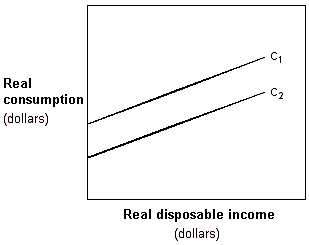 HIn Exhibit 8-10, which of the following could cause the shift from C1 to C2?
 (Multiple Choice)
4.8/5  (82)
(82) A lower interest rate makes more investment projects profitable, meaning that:
(Multiple Choice)
5.0/5 (81)
(81) Exhibit 8-8 Consumption function
 In Exhibit 8-8, which of the following could cause the movement from C1 to C2?
 (Multiple Choice)
4.8/5 (87)
(87) Which one of the following will shift the investment demand curve leftward?
(Multiple Choice)
4.7/5 (87)
(87) When economists say that private investment is "autonomous," they mean that it:
(Multiple Choice)
4.8/5 (76)
(76) If disposable income is $400 billion, consumption spending is $380 billion, and MPC is 0.5, what is the level of saving?
(Multiple Choice)
4.8/5 (85)
(85) An increase in the price level, other things remaining the same, may be expected to result in ____ the consumption function.
(Multiple Choice)
4.9/5 (84)
(84) If your disposable income increases from $30,000 to $35,000 and your consumption increases from $11,000 to $12,000, your marginal propensity to consume (MPC) is:
(Multiple Choice)
4.8/5 (77)
(77) If real disposable income increases from $110,000 to $120,000 and consumption increases from $108,000 to $114,000, the marginal propensity to consume is:
(Multiple Choice)
4.8/5 (82)
(82) Exhibit 8-2 Consumption function
 As shown in Exhibit 8-2, dissaving occurs:
 (Multiple Choice)
4.8/5 (80)
(80) An increase in the wealth of households, other things remaining the same, can result in ____ the consumption function.
(Multiple Choice)
4.9/5 (85)
(85) Exhibit 8-1 Disposable income and consumption data
 In Exhibit 8-1, when disposable income (Y) is increased from $1,000 to $2,000, the marginal propensity to consume is:
 (Multiple Choice)
4.8/5 (81)
(81) If the economy were left on its own without the interference of government or the Fed, it would move toward an equilibrium rate of growth that would produce, with only minor interruptions, full employment without inflation. What school supports this view?
(Multiple Choice)
4.8/5 (92)
(92) The nation has its own MPC. When disposable income increases from $300 billion to $400 billion, national consumption increases from $300 billion to $360 billion. At Y = $400 billion, the MPC is:
(Multiple Choice)
4.9/5 (91)
(91) 
Filters
- Essay(0)
- Multiple Choice(0)
- Short Answer(0)
- True False(0)
- Matching(0)