



 Chat with AI
Exam 15: Gross Domestic Product

Exam 1: Introducing the Economic Way of Thinking85 Questions
Exam 2: Production Possibilities Opportunity Cost and Economic Growth107 Questions
Exam 3: Market Demand and Supply176 Questions
Exam 4: Markets in Action137 Questions
Exam 5: Price Elasticity of Demand and Supply151 Questions
Exam 6: Consumer Choice Theory96 Questions
Exam 7: Production Costs131 Questions
Exam 8: Perfect Competition126 Questions
Exam 9: Monopoly81 Questions
Exam 10: Monopolistic Competition and Oligopoly97 Questions
Exam 11: Labor Markets105 Questions
Exam 12: Income Distribution Poverty and Discrimination57 Questions
Exam 13: Antitrust and Regulation96 Questions
Exam 14: Environmental Economics47 Questions
Exam 15: Gross Domestic Product109 Questions
Exam 16: Business Cycles and Unemployment94 Questions
Exam 17: Inflation56 Questions
Exam 18: The Keynesian Model111 Questions
Exam 19: The Keynesian Model in Action105 Questions
Exam 20: Aggregate Demand and Supply94 Questions
Exam 21: Fiscal Policy108 Questions
Exam 22: The Public Sector55 Questions
Exam 23: Federal Deficits Surpluses and the National Debt42 Questions
Exam 24: Money and the Federal Reserve System75 Questions
Exam 25: Money Creation117 Questions
Exam 26: Monetary Policy106 Questions
Exam 27: The Phillips Curve and Expectations Theory59 Questions
Exam 28: International Trade and Finance127 Questions
Exam 29: Economies in Transition46 Questions
Exam 30: Growth and the Less Developed Countries55 Questions
Exam 31: Understanding Direct and Inverse Relationships between Variables172 Questions
Select questions type


Exhibit 5-6 Use the table below to answer the following question(s).
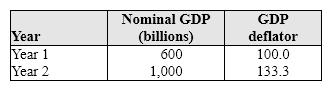 Refer to Exhibit 5-6. Between Year 1 and Year 2, the general level of prices increased by approximately:
 (Multiple Choice)
4.9/5  (79)
(79) Using the income approach, the smallest component in the calculation of GDP is:
(Multiple Choice)
4.8/5 (90)
(90) Using the income approach, the largest component in the calculation of GDP is:
(Multiple Choice)
4.9/5 (82)
(82) Economic values that are measured in units per period of time are referred to as:
(Multiple Choice)
5.0/5 (78)
(78) In a given year, U.S. nominal GDP was $5,744 billion and the GDP chain price index is 93.6. Real GDP is:
(Multiple Choice)
4.9/5 (94)
(94) Because of transactions which take place in the underground economy, the:
(Multiple Choice)
4.9/5 (80)
(80) Which of the following would not be included in the government consumption expenditures and gross investment (G) category of GDP?
(Multiple Choice)
4.7/5 (78)
(78) Exhibit 5-4 Gross domestic product data
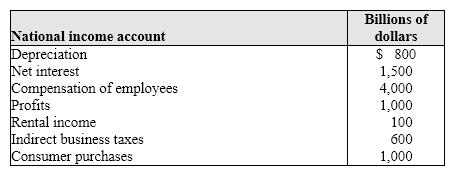 As shown in Exhibit 5-4, using the income approach, gross domestic product (GDP) is:
 (Multiple Choice)
4.7/5 (84)
(84) Which of the following expenditures would not be included in GDP?
(Multiple Choice)
4.8/5 (77)
(77) Which one of the following is not a component of GDP, as measured using the expenditure approach?
(Multiple Choice)
4.8/5 (68)
(68) Because GDP does not account for improvements in the quality of goods, the GDP calculation:
(Multiple Choice)
4.8/5 (90)
(90) The lower portion of the circular flow model contains factor markets in which households receive:
(Multiple Choice)
4.8/5 (72)
(72) Activities that are directly included in GDP accounts include:
(Multiple Choice)
4.8/5 (85)
(85) Exhibit 5-7 GDP data (billions of dollars)
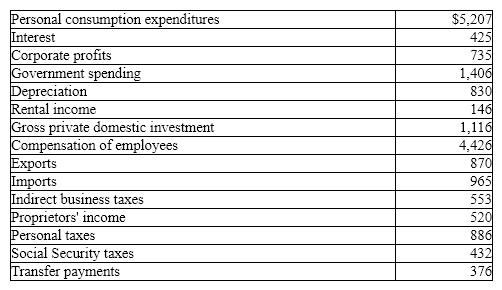 In Exhibit 5-7, personal income (PI) is:
 (Multiple Choice)
4.8/5 (85)
(85) 
Filters
- Essay(0)
- Multiple Choice(0)
- Short Answer(0)
- True False(0)
- Matching(0)