



 Chat with AI
Exam 14: Environmental Economics

Exam 1: Introducing the Economic Way of Thinking85 Questions
Exam 2: Production Possibilities Opportunity Cost and Economic Growth107 Questions
Exam 3: Market Demand and Supply176 Questions
Exam 4: Markets in Action137 Questions
Exam 5: Price Elasticity of Demand and Supply151 Questions
Exam 6: Consumer Choice Theory96 Questions
Exam 7: Production Costs131 Questions
Exam 8: Perfect Competition126 Questions
Exam 9: Monopoly81 Questions
Exam 10: Monopolistic Competition and Oligopoly97 Questions
Exam 11: Labor Markets105 Questions
Exam 12: Income Distribution Poverty and Discrimination57 Questions
Exam 13: Antitrust and Regulation96 Questions
Exam 14: Environmental Economics47 Questions
Exam 15: Gross Domestic Product109 Questions
Exam 16: Business Cycles and Unemployment94 Questions
Exam 17: Inflation56 Questions
Exam 18: The Keynesian Model111 Questions
Exam 19: The Keynesian Model in Action105 Questions
Exam 20: Aggregate Demand and Supply94 Questions
Exam 21: Fiscal Policy108 Questions
Exam 22: The Public Sector55 Questions
Exam 23: Federal Deficits Surpluses and the National Debt42 Questions
Exam 24: Money and the Federal Reserve System75 Questions
Exam 25: Money Creation117 Questions
Exam 26: Monetary Policy106 Questions
Exam 27: The Phillips Curve and Expectations Theory59 Questions
Exam 28: International Trade and Finance127 Questions
Exam 29: Economies in Transition46 Questions
Exam 30: Growth and the Less Developed Countries55 Questions
Exam 31: Understanding Direct and Inverse Relationships between Variables172 Questions
Select questions type


Command-and-control regulation, as compared to incentive-based regulation, is:
(Multiple Choice)
4.7/5  (83)
(83) Which of the following is not an obstacle to achieving environmental efficiency through markets?
(Multiple Choice)
4.8/5 (70)
(70) Cite an advantage and a disadvantage for command-and-control vs. incentive-based approaches. Then do the same for environmental taxes vs. emissions trading.
(Essay)
4.8/5 (76)
(76) Explain why companies that choose low-pollution technologies will find it hard to survive in a competitive industry.
(Essay)
4.8/5 (81)
(81) Which of the following is the environmental approach found in the Clean Air Act of 1990?
(Multiple Choice)
4.9/5 (76)
(76) Exhibit 14-3 Impact of flights on house value Each time Orville flies over Wilber's house, the noise reduces the value of Wilbur's house. The table shows the profits to Orville of each flight, and the value of Wilbur's house.
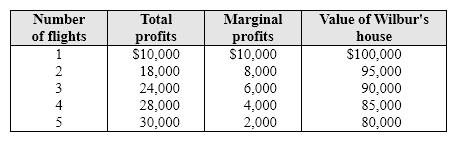 As shown in Exhibit 14-3, at the socially efficient number of flights, what will be the market value of Orville's house?
 (Multiple Choice)
5.0/5 (103)
(103) Suppose a state discovered chemical compounds in their water. The source of these chemicals is the waste discharges of industrial plants in another state. This is an example of a(n):
(Multiple Choice)
4.8/5 (79)
(79) Which of the following is the best example of a command-and-control regulation?
(Multiple Choice)
4.8/5 (95)
(95) To achieve social efficiency, the size of an effluent tax should be based on:
(Multiple Choice)
4.7/5 (78)
(78) To increase society's total welfare (social efficiency), a production process that produces a negative externality should be:
(Multiple Choice)
4.9/5 (96)
(96) Which of the following provides an example of command-and-control regulation?
(Multiple Choice)
4.7/5 (109)
(109) Exhibit 14-1 Private and social cost
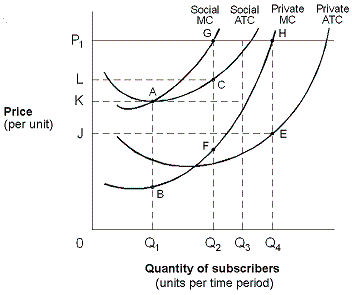 The perfectly competitive profit-maximizing firm in Exhibit 14-1 creates water and air pollution as a consequence of producing its output of pigs. If pollution costs are borne by third parties, the firm will maximize economic profit by choosing to:
 (Multiple Choice)
4.9/5 (73)
(73) Compare market price and quantity to socially optimal price and quantity if hog farmers ignore the polluting effect of hog waste on nearby waterways. Use a graph to assist in your explanation.
(Essay)
4.8/5 (74)
(74) Exhibit 14-2 Cigarette smoking data Jack enjoys smoking, while Jill fears that second-hand smoke will shorten her life. The following table shows the value Jack places on each cigarette he smokes, and the value Jill places on her shortened life. Use the table to answer the following question(s):
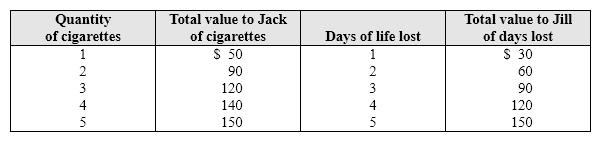 As shown in Exhibit 14-2, if smokers have the right to smoke as many cigarettes as they wish, and non-smokers have the right to negotiate, how many cigarettes will Jack smoke?
 (Multiple Choice)
4.8/5 (79)
(79) A government passes a new law allowing only 1,000 tons of pollution per day to be generated and simultaneously sells 1,000 transferable rights to emit one ton each of pollution per day. Which of the following is true?
(Multiple Choice)
4.7/5 (81)
(81) Exhibit 14-2 Cigarette smoking data Jack enjoys smoking, while Jill fears that second-hand smoke will shorten her life. The following table shows the value Jack places on each cigarette he smokes, and the value Jill places on her shortened life. Use the table to answer the following question(s):
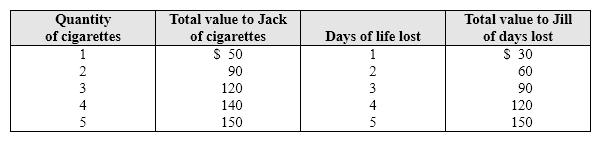 As shown in Exhibit 14-2, what is the socially efficient number of cigarettes?
 (Multiple Choice)
4.8/5 (80)
(80) When using the traditional command-and-control approach to environmental regulation, the government attempts to:
(Multiple Choice)
5.0/5 (78)
(78) 
Filters
- Essay(0)
- Multiple Choice(0)
- Short Answer(0)
- True False(0)
- Matching(0)