



 Chat with AI
Exam 13: Antitrust and Regulation

Exam 1: Introducing the Economic Way of Thinking85 Questions
Exam 2: Production Possibilities Opportunity Cost and Economic Growth107 Questions
Exam 3: Market Demand and Supply176 Questions
Exam 4: Markets in Action137 Questions
Exam 5: Price Elasticity of Demand and Supply151 Questions
Exam 6: Consumer Choice Theory96 Questions
Exam 7: Production Costs131 Questions
Exam 8: Perfect Competition126 Questions
Exam 9: Monopoly81 Questions
Exam 10: Monopolistic Competition and Oligopoly97 Questions
Exam 11: Labor Markets105 Questions
Exam 12: Income Distribution Poverty and Discrimination57 Questions
Exam 13: Antitrust and Regulation96 Questions
Exam 14: Environmental Economics47 Questions
Exam 15: Gross Domestic Product109 Questions
Exam 16: Business Cycles and Unemployment94 Questions
Exam 17: Inflation56 Questions
Exam 18: The Keynesian Model111 Questions
Exam 19: The Keynesian Model in Action105 Questions
Exam 20: Aggregate Demand and Supply94 Questions
Exam 21: Fiscal Policy108 Questions
Exam 22: The Public Sector55 Questions
Exam 23: Federal Deficits Surpluses and the National Debt42 Questions
Exam 24: Money and the Federal Reserve System75 Questions
Exam 25: Money Creation117 Questions
Exam 26: Monetary Policy106 Questions
Exam 27: The Phillips Curve and Expectations Theory59 Questions
Exam 28: International Trade and Finance127 Questions
Exam 29: Economies in Transition46 Questions
Exam 30: Growth and the Less Developed Countries55 Questions
Exam 31: Understanding Direct and Inverse Relationships between Variables172 Questions
Select questions type


During the first phase of regulation in the United States (from 1887 to the Great Depression), the primary target of regulation was the:
(Multiple Choice)
4.8/5  (90)
(90) Which of the following is not an example of government intervention to correct for imperfect information?
(Multiple Choice)
4.9/5 (80)
(80) The rule of reason refers to the interpretation of the courts that dominant firms should be broken up because of their:
(Multiple Choice)
4.9/5 (79)
(79) Exhibit 13-1 Cable television monopolist
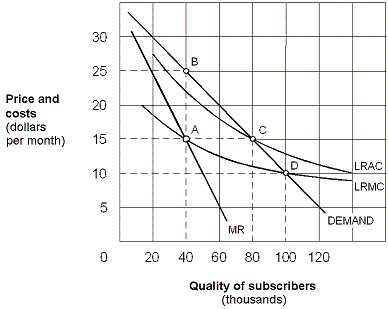 As shown in Exhibit 13-1, regulators might follow a fair return pricing strategy and require the cable television monopolist to operate at point:
 (Multiple Choice)
4.7/5 (91)
(91) To obtain a conviction for price fixing under the Sherman Antitrust Act, the government needs to prove:
(Multiple Choice)
4.8/5 (83)
(83) IBM and Sara Lee are two of the biggest firms in the United States, but they produce different products. Could they legally merge, or would their merger be struck down by the courts?
(Essay)
4.9/5 (77)
(77) The government will have to subsidize a natural monopoly in the long run if regulators choose to pursue:
(Multiple Choice)
4.7/5 (72)
(72) Exhibit 13-1 Cable television monopolist
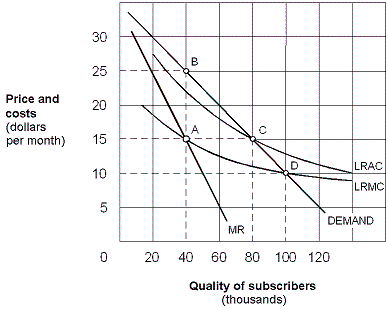 As shown in Exhibit 13-1, if regulators follow a fair return pricing strategy, the price will be:
 (Multiple Choice)
4.9/5 (78)
(78) Consider a regulated natural monopoly. If the regulatory commission wants to establish a fair-return price, then it should set a price ceiling where the demand curve crosses the monopoly's long-run:
(Multiple Choice)
4.8/5 (86)
(86) The landmark antitrust case which established that size alone is not sufficient to prove an antitrust violation is the:
(Multiple Choice)
4.9/5 (73)
(73) Joe works in a factory producing chemicals used in paint manufacturing. If he is concerned about the effects of the chemicals that he works with on his health, he should contact which regulatory agency?
(Multiple Choice)
4.9/5 (84)
(84) If regulation imposes marginal cost pricing on a natural monopoly, then the monopoly will:
(Multiple Choice)
4.9/5 (69)
(69) In the late 1970s and 1980s a movement toward deregulation took place because
(Multiple Choice)
4.8/5 (74)
(74) 
Filters
- Essay(0)
- Multiple Choice(0)
- Short Answer(0)
- True False(0)
- Matching(0)