



 Chat with AI
Exam 12: Income Distribution Poverty and Discrimination

Exam 1: Introducing the Economic Way of Thinking85 Questions
Exam 2: Production Possibilities Opportunity Cost and Economic Growth107 Questions
Exam 3: Market Demand and Supply176 Questions
Exam 4: Markets in Action137 Questions
Exam 5: Price Elasticity of Demand and Supply151 Questions
Exam 6: Consumer Choice Theory96 Questions
Exam 7: Production Costs131 Questions
Exam 8: Perfect Competition126 Questions
Exam 9: Monopoly81 Questions
Exam 10: Monopolistic Competition and Oligopoly97 Questions
Exam 11: Labor Markets105 Questions
Exam 12: Income Distribution Poverty and Discrimination57 Questions
Exam 13: Antitrust and Regulation96 Questions
Exam 14: Environmental Economics47 Questions
Exam 15: Gross Domestic Product109 Questions
Exam 16: Business Cycles and Unemployment94 Questions
Exam 17: Inflation56 Questions
Exam 18: The Keynesian Model111 Questions
Exam 19: The Keynesian Model in Action105 Questions
Exam 20: Aggregate Demand and Supply94 Questions
Exam 21: Fiscal Policy108 Questions
Exam 22: The Public Sector55 Questions
Exam 23: Federal Deficits Surpluses and the National Debt42 Questions
Exam 24: Money and the Federal Reserve System75 Questions
Exam 25: Money Creation117 Questions
Exam 26: Monetary Policy106 Questions
Exam 27: The Phillips Curve and Expectations Theory59 Questions
Exam 28: International Trade and Finance127 Questions
Exam 29: Economies in Transition46 Questions
Exam 30: Growth and the Less Developed Countries55 Questions
Exam 31: Understanding Direct and Inverse Relationships between Variables172 Questions
Select questions type


"Dividing the economic pie more equally may reduce the size of the economic pie." This argument is characterized as:
(Multiple Choice)
4.8/5  (76)
(76) Statistics on families below the poverty line may be overstated because:
(Multiple Choice)
4.9/5 (76)
(76) A negative income tax system would provide all households, including the poor, with:
(Multiple Choice)
4.8/5 (98)
(98) Consider a labor market in which employers discriminate against African Americans. Comparing the labor market equilibrium with no discrimination to the equilibrium with discrimination,
(Multiple Choice)
4.8/5 (71)
(71) Exhibit 12-7 Negative income tax
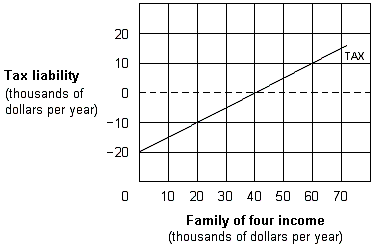 Under the negative income tax scheme in Exhibit 12-7, families earning between $10,000 and $40,000 would:
 (Multiple Choice)
4.8/5 (78)
(78) Because the benefits distributed under TANF and Medicaid are essentially controlled by the states, critics argue that
(Multiple Choice)
4.9/5 (75)
(75) Exhibit 12-9 Negative Income Tax
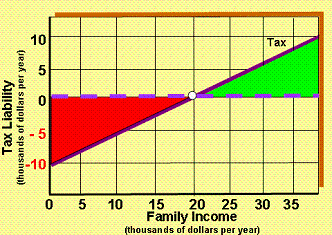
As shown in Exhibit 12-9, a family of four with an income of $20,000 receives ____ from the government:
As shown in Exhibit 12-9, a family of four with an income of $20,000 receives ____ from the government: (Multiple Choice)
4.9/5 (72)
(72) The official poverty rate for all persons declined sharply between 1959 and:
(Multiple Choice)
4.9/5 (75)
(75) Exhibit 12-8 Negative income tax for a family
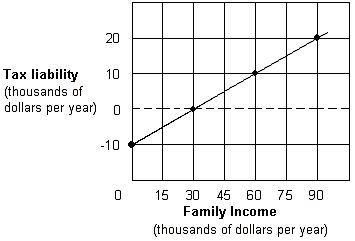 In Exhibit 12-8, consider a family that earns less than the break-even income level. For each $1 of earned income, this family's government payment will be reduced by:
 (Multiple Choice)
4.7/5 (85)
(85) The revenue in the Social Security Trust Fund first fell below the benefits it paid out in 2010. If this trend continues, the Trust Fund will be depleted. What change(s) occurred to cause the revenue to fall below the benefits?
(Multiple Choice)
4.9/5 (79)
(79) Exhibit 12-1 Income distribution for three countries
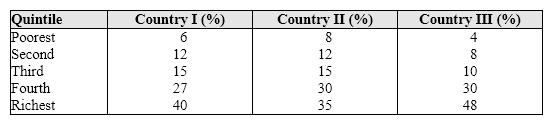 Exhibit 12-1 shows the percentage of income received by each population quintile. In Country I we can conclude that the:
 (Multiple Choice)
4.8/5 (81)
(81) 
Filters
- Essay(0)
- Multiple Choice(0)
- Short Answer(0)
- True False(0)
- Matching(0)