



 Chat with AI
Exam 5: Price Elasticity of Demand and Supply

Exam 1: Introducing the Economic Way of Thinking85 Questions
Exam 2: Production Possibilities Opportunity Cost and Economic Growth107 Questions
Exam 3: Market Demand and Supply176 Questions
Exam 4: Markets in Action137 Questions
Exam 5: Price Elasticity of Demand and Supply151 Questions
Exam 6: Consumer Choice Theory96 Questions
Exam 7: Production Costs131 Questions
Exam 8: Perfect Competition126 Questions
Exam 9: Monopoly81 Questions
Exam 10: Monopolistic Competition and Oligopoly97 Questions
Exam 11: Labor Markets105 Questions
Exam 12: Income Distribution Poverty and Discrimination57 Questions
Exam 13: Antitrust and Regulation96 Questions
Exam 14: Environmental Economics47 Questions
Exam 15: Gross Domestic Product109 Questions
Exam 16: Business Cycles and Unemployment94 Questions
Exam 17: Inflation56 Questions
Exam 18: The Keynesian Model111 Questions
Exam 19: The Keynesian Model in Action105 Questions
Exam 20: Aggregate Demand and Supply94 Questions
Exam 21: Fiscal Policy108 Questions
Exam 22: The Public Sector55 Questions
Exam 23: Federal Deficits Surpluses and the National Debt42 Questions
Exam 24: Money and the Federal Reserve System75 Questions
Exam 25: Money Creation117 Questions
Exam 26: Monetary Policy106 Questions
Exam 27: The Phillips Curve and Expectations Theory59 Questions
Exam 28: International Trade and Finance127 Questions
Exam 29: Economies in Transition46 Questions
Exam 30: Growth and the Less Developed Countries55 Questions
Exam 31: Understanding Direct and Inverse Relationships between Variables172 Questions
Select questions type


Exhibit 5-9 Supply and Demand Curves for Good X
 As shown in Exhibit 5-9, the price elasticity of demand for good X between points E and B is:
 (Multiple Choice)
4.8/5  (72)
(72) As one moves down a straight-line, down-sloping demand curve, price elasticity will:
(Multiple Choice)
4.9/5 (107)
(107) Since it is always a negative number, economists use the convention of taking the absolute value of:
(Multiple Choice)
4.8/5 (84)
(84) As the economy recovers from a recession, we should expect that demand for:
(Multiple Choice)
4.9/5 (83)
(83) Exhibit 5-7 Demand curve for concert tickets
 In Exhibit 5-7, if promoters raise their prices from $10 to $40 per ticket, then their total revenue will:
 (Multiple Choice)
4.8/5 (76)
(76) If a consumer's purchases of a product increase as income increases, this good is classified as a(n):
(Multiple Choice)
4.7/5 (92)
(92) Exhibit 5-9 Supply and Demand Curves for Good X
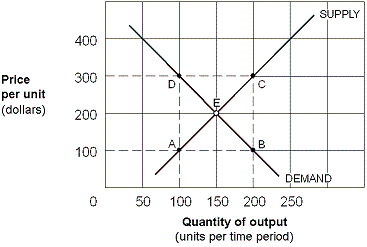 As shown in Exhibit 5-9, the $200 per unit tax on Good X raises tax revenue per time period totaling:
 (Multiple Choice)
4.9/5 (86)
(86) Exhibit 5-8 Supply and demand curves for good X
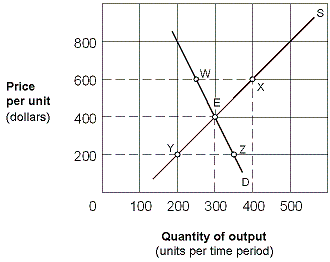 In Exhibit 5-8, the price elasticity of supply for good X between points Y and E is:
 (Multiple Choice)
4.8/5 (78)
(78) You are part of a local community theater group. It is the goal of the group to increase the amount of revenue earned through ticket sales. Mary says the obvious solution is to increase ticket prices. Is Mary correct?
(Multiple Choice)
4.7/5 (73)
(73) An excise tax levied on a product will impose a smaller relative burden on consumers (and a larger relative burden on sellers) when the:
(Multiple Choice)
4.8/5 (74)
(74) Which of the following describes a situation in which demand must be elastic?
(Multiple Choice)
4.7/5 (58)
(58) If the price elasticity of demand is computed for two products, and product A measures .79, and product B measures 1.6, then:
(Multiple Choice)
4.7/5 (85)
(85) If the percentage change in the quantity demanded of a good is less than the percentage change in price, price elasticity of demand is:
(Multiple Choice)
4.8/5 (79)
(79) If a straight-line demand curve slopes down, price elasticity will:
(Multiple Choice)
4.9/5 (85)
(85) A study of consumers in an area found that as family income increased from $25,000 per year to $35, 000 per year, other factors held constant, the number of houses purchased increased from 7,000 per year to 11,000 per year. This finding indicates an income elasticity of demand coefficient for housing over this family income range of:
(Multiple Choice)
4.7/5 (81)
(81) If New York City expects that an increase in bus fares will raise mass transit revenues, it must think that the demand for bus travel is:
(Multiple Choice)
4.8/5 (79)
(79) If Sam, the Pizza Man, lowers the price of his pizzas from $6 to $5 and finds that sales increase from 400 to 600 pizzas per week, then the demand for Sam's pizzas in this range is:
(Multiple Choice)
4.8/5 (70)
(70) 
Filters
- Essay(0)
- Multiple Choice(0)
- Short Answer(0)
- True False(0)
- Matching(0)