



 Chat with AI
Exam 17: Immunization and Immune Testing

Exam 1: A Brief History of Microbiology73 Questions
Exam 2: The Chemistry of Microbiology76 Questions
Exam 3: Cell Structure and Function80 Questions
Exam 4: Microscopy, Staining, and Classification80 Questions
Exam 5: Microbial Metabolism77 Questions
Exam 6: Microbial Nutrition and Growth75 Questions
Exam 7: Microbial Genetics75 Questions
Exam 8: Recombinant DNA Technology75 Questions
Exam 9: Controlling Microbial Growth in the Environment75 Questions
Exam 10: Controlling Microbial Growth in the Body: Antimicrobial Drugs75 Questions
Exam 11: Characterizing and Classifying Prokaryotes75 Questions
Exam 12: Characterizing and Classifying Eukaryotes75 Questions
Exam 13: Characterizing and Classifying Viruses, Viroids, and Prions75 Questions
Exam 14: Infection, Infectious Diseases, and Epidemiology76 Questions
Exam 15: Innate Immunity75 Questions
Exam 16: Adaptive Immunity75 Questions
Exam 17: Immunization and Immune Testing75 Questions
Exam 18: Immune Disorders75 Questions
Exam 19: Pathogenic Gram Positive Bacteria75 Questions
Exam 20: Pathogenic Gram-Negative Cocci and Bacilli77 Questions
Exam 21: Rickettsias, Chlamydias, Spirochetes, and Vibrios75 Questions
Exam 22: Pathogenic Fungi75 Questions
Exam 23: Parasitic Protozoa, Helminths, and Arthropod Vectors75 Questions
Exam 24: Pathogenic DNA Viruses75 Questions
Exam 25: Pathogenic RNA Viruses75 Questions
Exam 26: Applied and Environmental Microbiology74 Questions
Select questions type


Which of the following tests do NOT detect an immune response to a virus infection?
(Multiple Choice)
4.7/5  (83)
(83) The study and diagnosis of antigen-antibody interactions in the blood is known as
(Multiple Choice)
4.8/5 (87)
(87) Which of the following assays is dependent on the ability of antibodies to bind to and crosslink two antigens?
(Multiple Choice)
4.9/5 (80)
(80) In precipitation tests,maximum precipitation takes place when
(Multiple Choice)
4.7/5 (78)
(78) Which of the following statements regarding toxoids is FALSE?
(Multiple Choice)
4.8/5 (70)
(70) What is the most efficient and cost-effective way to control infectious diseases?
(Multiple Choice)
4.9/5 (75)
(75) Discuss the similarities and differences between immunodiffusion and immunochromatographic assays.
(Essay)
5.0/5 (78)
(78) Compare and contrast viral neutralization and viral hemagglutination tests.
(Essay)
4.8/5 (66)
(66) 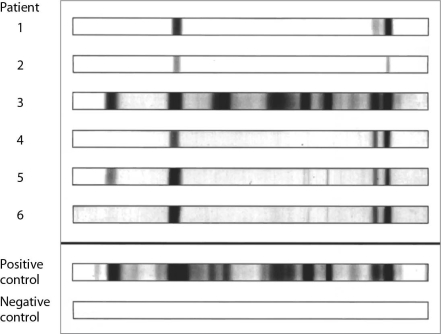 The assay shown in Figure is used for what?
Edward Jenner was the physician who first used cowpox to vaccinate individuals against smallpox.
(True/False)
4.9/5 (84)
(84) When vaccines do not provide lifelong immunity,(adjuvants/reinoculations/subunits)must be given to maintain protection.
(Short Answer)
4.8/5 (80)
(80) The presence of fungus in patient specimens can be detected by the ________ test.
(Multiple Choice)
4.9/5 (81)
(81) The vaccine against smallpox developed by Edward Jenner is an example of a(n)________ vaccine.
(Multiple Choice)
4.9/5 (90)
(90) The immunochromatographic assay uses enzyme-linked anti-antibodies.
(True/False)
4.8/5 (76)
(76) A(n)________ assay is used for rapid identification of strep (group A Streptococcus)infections.
(Multiple Choice)
4.8/5 (88)
(88) The attenuated oral poliovirus vaccine,(OVP), is no longer administered in the U.S.A. because it
(Multiple Choice)
4.8/5 (85)
(85) 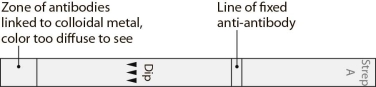 The "dipstick" illustrated in Figure is used in a(n)(immunodiffusion/immunochromatographic/ immunofluorescent)assay.
 (Short Answer)
4.9/5 (79)
(79) 
Filters
- Essay(0)
- Multiple Choice(0)
- Short Answer(0)
- True False(0)
- Matching(0)