



 Chat with AI
Exam 2: The Chemistry of Microbiology

Exam 1: A Brief History of Microbiology73 Questions
Exam 2: The Chemistry of Microbiology76 Questions
Exam 3: Cell Structure and Function80 Questions
Exam 4: Microscopy, Staining, and Classification80 Questions
Exam 5: Microbial Metabolism77 Questions
Exam 6: Microbial Nutrition and Growth75 Questions
Exam 7: Microbial Genetics75 Questions
Exam 8: Recombinant DNA Technology75 Questions
Exam 9: Controlling Microbial Growth in the Environment75 Questions
Exam 10: Controlling Microbial Growth in the Body: Antimicrobial Drugs75 Questions
Exam 11: Characterizing and Classifying Prokaryotes75 Questions
Exam 12: Characterizing and Classifying Eukaryotes75 Questions
Exam 13: Characterizing and Classifying Viruses, Viroids, and Prions75 Questions
Exam 14: Infection, Infectious Diseases, and Epidemiology76 Questions
Exam 15: Innate Immunity75 Questions
Exam 16: Adaptive Immunity75 Questions
Exam 17: Immunization and Immune Testing75 Questions
Exam 18: Immune Disorders75 Questions
Exam 19: Pathogenic Gram Positive Bacteria75 Questions
Exam 20: Pathogenic Gram-Negative Cocci and Bacilli77 Questions
Exam 21: Rickettsias, Chlamydias, Spirochetes, and Vibrios75 Questions
Exam 22: Pathogenic Fungi75 Questions
Exam 23: Parasitic Protozoa, Helminths, and Arthropod Vectors75 Questions
Exam 24: Pathogenic DNA Viruses75 Questions
Exam 25: Pathogenic RNA Viruses75 Questions
Exam 26: Applied and Environmental Microbiology74 Questions
Select questions type


The electron shells of atoms hold eight electrons each.

Free
(True/False)
4.8/5  (72)
(72) Correct Answer: Verified
False
Salts are produced from exchange reactions in which acids and bases neutralize each other.
Free
(True/False)
4.8/5 (70)
(70) Correct Answer:Verified
VerifiedTrue
Which of the following are examples of pyrimidines?
Free
(Multiple Choice)
4.9/5 (71)
(71) Correct Answer:Verified
VerifiedE
A(n)________ is an arrangement of atoms found in a variety of macromolecules.
(Multiple Choice)
4.8/5 (87)
(87) Which of the following is NOT a characteristic of phospholipids?
(Multiple Choice)
4.8/5 (79)
(79) DNA is composed of repeating units of sugars,phosphates,and nucleic acids.This is an example of a
(Multiple Choice)
4.8/5 (83)
(83) Dehydration synthesis is a common feature of polymer production in cells.
(True/False)
5.0/5 (80)
(80) 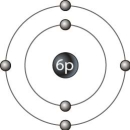 The atomic mass of this stable isotope atom (Figure)is
Two molecules react to produce two products,one of which is water.What type of reaction is likely to be involved?
(Multiple Choice)
4.8/5 (77)
(77) The long-term chemical energy storage molecules in plants are steroids.
(True/False)
4.9/5 (61)
(61) A saturated fatty acid contains (no/one/multiple)double bonds.
(Short Answer)
4.8/5 (90)
(90) Describe the chemical properties of phospholipids that account for their behavior in water.
(Essay)
4.9/5 (79)
(79) 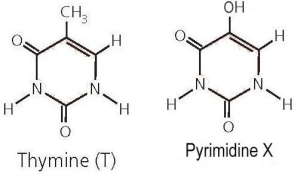 Consider the structure of thymine,shown on the left in Figure above,and compare to the structure of pyrimidine X on the right.What would be the impact if X is incorporated into the structure of a DNA strand in place of thymine?
 (Essay)
4.8/5 (86)
(86) 
Filters
- Essay(0)
- Multiple Choice(0)
- Short Answer(0)
- True False(0)
- Matching(0)