



 Chat with AI
Exam 2: The Chemistry of Microbiology

Exam 1: A Brief History of Microbiology73 Questions
Exam 2: The Chemistry of Microbiology76 Questions
Exam 3: Cell Structure and Function80 Questions
Exam 4: Microscopy, Staining, and Classification80 Questions
Exam 5: Microbial Metabolism77 Questions
Exam 6: Microbial Nutrition and Growth75 Questions
Exam 7: Microbial Genetics75 Questions
Exam 8: Recombinant DNA Technology75 Questions
Exam 9: Controlling Microbial Growth in the Environment75 Questions
Exam 10: Controlling Microbial Growth in the Body: Antimicrobial Drugs75 Questions
Exam 11: Characterizing and Classifying Prokaryotes75 Questions
Exam 12: Characterizing and Classifying Eukaryotes75 Questions
Exam 13: Characterizing and Classifying Viruses, Viroids, and Prions75 Questions
Exam 14: Infection, Infectious Diseases, and Epidemiology76 Questions
Exam 15: Innate Immunity75 Questions
Exam 16: Adaptive Immunity75 Questions
Exam 17: Immunization and Immune Testing75 Questions
Exam 18: Immune Disorders75 Questions
Exam 19: Pathogenic Gram Positive Bacteria75 Questions
Exam 20: Pathogenic Gram-Negative Cocci and Bacilli77 Questions
Exam 21: Rickettsias, Chlamydias, Spirochetes, and Vibrios75 Questions
Exam 22: Pathogenic Fungi75 Questions
Exam 23: Parasitic Protozoa, Helminths, and Arthropod Vectors75 Questions
Exam 24: Pathogenic DNA Viruses75 Questions
Exam 25: Pathogenic RNA Viruses75 Questions
Exam 26: Applied and Environmental Microbiology74 Questions
Select questions type


The reverse of a dehydration synthesis reaction is a(n)________ reaction.
(Multiple Choice)
4.9/5  (82)
(82) Which of the following statements concerning nucleic acids is CORRECT?
(Multiple Choice)
4.9/5 (77)
(77) A(n)(nonpolar/polar/ionic/hydrogen)bond is one in which electrons are shared equally between atoms.
(Short Answer)
4.8/5 (79)
(79) The (atoms/isotopes/stereoisomers)of an element vary in the number of neutrons in the nucleus.
(Short Answer)
4.7/5 (84)
(84) The DNA double helix is held together by (covalent/ionic/hydrogen)bonds.
(Short Answer)
4.9/5 (67)
(67) 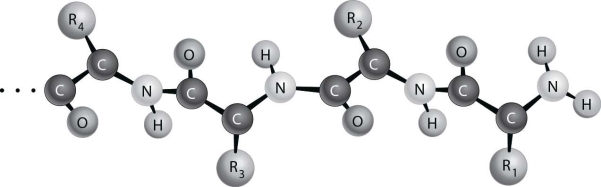 Figure depicts the (primary/secondary/tertiary)structure of a protein.
 (Short Answer)
4.8/5 (73)
(73) An atom or molecule becomes a(n)(anion/ion/cation)when it loses an electron to a more electronegative molecule.
(Short Answer)
4.9/5 (88)
(88) Compare and contrast synthesis reactions with decomposition reactions.
(Essay)
4.9/5 (86)
(86) Lipids found in the cytoplasmic membranes of all eukaryotic cells are
(Multiple Choice)
4.7/5 (77)
(77) Cell surface markers composed of both carbohydrate and lipid molecules are known as (glycoproteins/glycolipids/LPS).
(Short Answer)
4.8/5 (85)
(85) Anna is conducting an experiment using a pH indicator that is red at low pH,green at neutral pH and purple at high pH.She starts with a green solution.When she adds compound X to her solution it turns purple.Then she adds compound Z to the solution and it turns green.She adds more Z,the solution remains green.These observations suggest X is ________ and Z is ________.
(Multiple Choice)
4.7/5 (68)
(68) Jim adds an acid to a solution,but finds the pH has not changed afterward.This suggests the solution contains a(n)(anion/buffer/salt).
(Short Answer)
4.8/5 (95)
(95) Cell walls containing ________ provide the best protection from drying.
(Multiple Choice)
4.9/5 (81)
(81) Organisms use carbohydrates in all of the following ways EXCEPT
(Multiple Choice)
4.9/5 (72)
(72) The double-strands of DNA result from the formation of ________ between the bases.
(Multiple Choice)
4.7/5 (68)
(68) A nitrogenous base composed of two rings is a (purine/pyrimidine/ribose).
(Short Answer)
4.8/5 (69)
(69) 
Filters
- Essay(0)
- Multiple Choice(0)
- Short Answer(0)
- True False(0)
- Matching(0)