



 Chat with AI
Exam 15: Innate Immunity


First line of defense may be described as

 (93)
 Verified
B
What is phagocytosis? What does it involve?
(88) VerifiedPhagocytosis is a process by which a cell can engulf substances and internalize them into the cytoplasm.Cells that are capable of phagocytosis are collectively known as phagocytes and include neutrophils,eosinophils,dendritic cells,and macrophages.Phagocytosis is part of the body's second line of defense,and it is nonspecific.It includes the following steps:
Chemotaxis: a cell moves either toward or away from a chemical stimulus.
Adherence: the phagocyte attaches to the pathogen,through binding of complementary chemicals on the membranes of the pathogen.
Ingestion: after the pseudopodia adhere to the pathogen,the encompassed microbe is internalized as the pseudopodia fuse to form a sac called a phagosome.
Digestion: lysosomes with over 30 digestive enzymes attach to the phagosome and break down the microbe.At the end of this process,the remains of the phagosome are known as the residual body.
Elimination: the phagocyte rids itself of undigested material by exocytosis,which is the opposite of ingestion.
Some pathogens produce toxins which function as (histamines/prostaglandins/pyrogens)to cause fever.
(86) Verifiedpyrogens
Which of the following substances contributes to the edema associated with inflammation?
(73) Proteins on the surface of phagocytes called ________ aid in the detection of pathogen molecules.
(80) Which of the following contributes to protecting the eyes from microbial invasion?
(70) Histamine and prostaglandins are involved in inflammatory reactions.
(96) Which of the following is NOT an example of a walled-off site of infection that contains a fluid made of dead and dying tissue cells,leukocytes,and pathogens?
(76) Which of the following cells increase in number during an infection with parasitic worms?
(80) Which of the following are phagocytic cells descended from monocytes?
(84) The absence of necessary receptors is the basis of the defense against microbial invasion known as (natural/innate/species)resistance.
(88) A type of lymphocyte called a(n)________ detects cells with abnormal surface proteins and kills them.
(78) Protection from infection known as species resistance is a result of
(77) 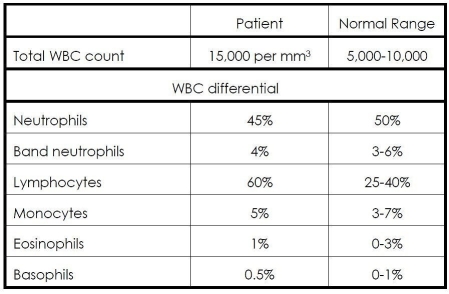 Examine the WBC count and differential data in Table.What type of disease is indicated by this set of data?
 (77) 
Filters
- Essay(0)
- Multiple Choice(0)
- Short Answer(0)
- True False(0)
- Matching(0)