



 Chat with AI
Exam 10: Controlling Microbial Growth in the Body: Antimicrobial Drugs

Exam 1: A Brief History of Microbiology73 Questions
Exam 2: The Chemistry of Microbiology76 Questions
Exam 3: Cell Structure and Function80 Questions
Exam 4: Microscopy, Staining, and Classification80 Questions
Exam 5: Microbial Metabolism77 Questions
Exam 6: Microbial Nutrition and Growth75 Questions
Exam 7: Microbial Genetics75 Questions
Exam 8: Recombinant DNA Technology75 Questions
Exam 9: Controlling Microbial Growth in the Environment75 Questions
Exam 10: Controlling Microbial Growth in the Body: Antimicrobial Drugs75 Questions
Exam 11: Characterizing and Classifying Prokaryotes75 Questions
Exam 12: Characterizing and Classifying Eukaryotes75 Questions
Exam 13: Characterizing and Classifying Viruses, Viroids, and Prions75 Questions
Exam 14: Infection, Infectious Diseases, and Epidemiology76 Questions
Exam 15: Innate Immunity75 Questions
Exam 16: Adaptive Immunity75 Questions
Exam 17: Immunization and Immune Testing75 Questions
Exam 18: Immune Disorders75 Questions
Exam 19: Pathogenic Gram Positive Bacteria75 Questions
Exam 20: Pathogenic Gram-Negative Cocci and Bacilli77 Questions
Exam 21: Rickettsias, Chlamydias, Spirochetes, and Vibrios75 Questions
Exam 22: Pathogenic Fungi75 Questions
Exam 23: Parasitic Protozoa, Helminths, and Arthropod Vectors75 Questions
Exam 24: Pathogenic DNA Viruses75 Questions
Exam 25: Pathogenic RNA Viruses75 Questions
Exam 26: Applied and Environmental Microbiology74 Questions
Select questions type


The ratio of a medication's dose that can be tolerated to its effective dose is the therapeutic (MIC/index/range)of the medication.

Free
(Short Answer)
4.9/5  (91)
(91) Correct Answer: Verified
index
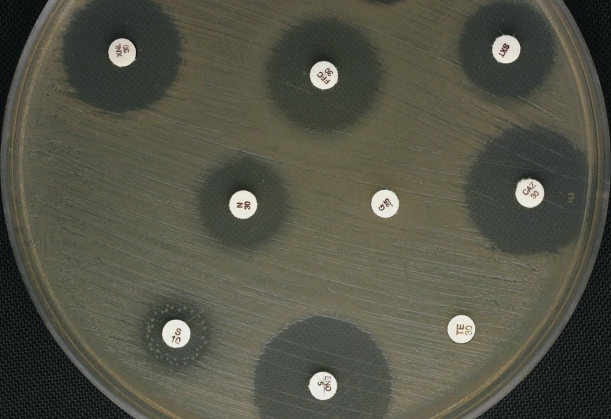 Examine the diffusion susceptibility plate results shown in Figure 10.2.Propose an explanation for the appearance of the zone around the S/10 disk,and discuss the implications for therapeutic use of this antibiotic for the pathogen tested.
Free
(Essay)
4.9/5 (74)
(74) Correct Answer:Verified
VerifiedThe ring of colonies within the outermost limit of the zone of inhibition indicates that there are some cells in the population that are less susceptible to the antibiotic than the rest.If this antibiotic were used to treat an infection with this population,the growth of bacteria with some resistance would be promoted at the expense of the more susceptible cells,potentially giving rise to a new variant that is fully resistant.If this were to occur in a patient being treated,the antibiotic therapy would fail,putting the patient's health at risk.Therefore,drug AM would be a poor choice,perhaps the poorest choice,for chemotherapy against this bacterial species.
Some bacteria are resistant to antimicrobials due to the activity of ________,which removes many of them.
Free
(Multiple Choice)
4.9/5 (81)
(81) Correct Answer:Verified
VerifiedC
External infections can be treated by (intramuscular/surface/topical)administration,in which a drug is applied directly to the site of infection.
(Short Answer)
4.8/5 (71)
(71) Which of the following steps in the folic acid synthesis pathway is specifically inhibited by sulfonamides?
(Multiple Choice)
4.8/5 (79)
(79) An antimicrobial that inhibits cell wall synthesis will result in which of the following?
(Multiple Choice)
4.8/5 (87)
(87) Which of the following antifungals works by binding to ergosterol in membranes?
(Multiple Choice)
4.9/5 (71)
(71) A "zone of inhibition" is associated with which of the following tests used to determine the efficacy of antibiotics?
(Multiple Choice)
4.9/5 (83)
(83) How does resistance to drugs spread in bacterial populations?
(Multiple Choice)
4.9/5 (68)
(68) β-lactamase production is an example of which of the following types of resistance?
(Multiple Choice)
4.8/5 (94)
(94) Competition between beneficial microbes and potential pathogens is called microbial (antagonisms/synergy/toxicity).
(Short Answer)
4.8/5 (76)
(76) Which of the following drugs specifically targets cell walls that contain mycolic acid?
(Multiple Choice)
4.7/5 (85)
(85) The cooperative activity of drugs such as beta-lactam antibiotics and clavulanic acid,a β-lactamase inhibitor,is known as
(Multiple Choice)
4.8/5 (88)
(88) Secondary infections that result from the killing of some of the normal microbiota are called (antagonism/superinfections/resistance).
(Short Answer)
4.8/5 (84)
(84) Most drugs that inhibit the synthesis of the cell wall act by
(Multiple Choice)
4.9/5 (87)
(87) Which of the following is NOT a target of drugs that inhibit protein synthesis?
(Multiple Choice)
4.8/5 (71)
(71) Medications administered intravenously can provide much higher effective concentrations than other delivery methods.
(True/False)
4.7/5 (83)
(83) 
Filters
- Essay(0)
- Multiple Choice(0)
- Short Answer(0)
- True False(0)
- Matching(0)