



 Chat with AI
Exam 22: The Theory of Consumer Choice

Exam 1: Ten Lessons From Economics146 Questions
Exam 2: Thinking Like an Economist133 Questions
Exam 3: Interdependence and the Gains From Trade139 Questions
Exam 4: The Market Forces of Supply and Demand215 Questions
Exam 5: Elasticity and Its Application178 Questions
Exam 6: Supply, Demand and Government Policies145 Questions
Exam 7: Consumers, Producers and the Efficiency of Markets171 Questions
Exam 8: Application: the Costs of Taxation135 Questions
Exam 9: Application: International Trade151 Questions
Exam 10: Externalities199 Questions
Exam 11: Public Goods and Common Resources178 Questions
Exam 12: The Design of the Tax System154 Questions
Exam 13: The Costs of Production191 Questions
Exam 14: Firms in Competitive Markets198 Questions
Exam 15: Monopoly212 Questions
Exam 16: Monopolistic Competition212 Questions
Exam 17: Business Strategy and Oligopoly179 Questions
Exam 18: Competition Policy103 Questions
Exam 19: The Markets for the Factors of Production214 Questions
Exam 20: Earnings, Unions and Discrimination201 Questions
Exam 21: Income Inequity and Poverty111 Questions
Exam 22: The Theory of Consumer Choice158 Questions
Exam 23: Frontiers of Microeconomics111 Questions
Exam 24: Measuring a Nations Income51 Questions
Exam 25: Measuring the Cost of Living55 Questions
Exam 26: Production and Growth62 Questions
Exam 27: Saving, Investment and the Financial System62 Questions
Exam 28: The Natural Rate of Unemployment58 Questions
Exam 29: The Monetary System66 Questions
Exam 30: Inflation: Its Causes and Costs74 Questions
Exam 31: Open-Economy Macroeconomics: Basic Concepts68 Questions
Exam 32: A Macroeconomic Theory of the Open Economy61 Questions
Exam 33: Aggregate Demand and Aggregate Supply81 Questions
Exam 34: The Influence of Monetary and Fiscal Policy on Aggregate Demand73 Questions
Exam 35: The Short-Run Trade-Off Between Inflation and Unemployment57 Questions
Exam 36: Global Financial Crisis of 2008 and Beyond37 Questions
Exam 37: Five Debates Over Macroeconomic Policy38 Questions
Select questions type


Which of the following statements about welfare assistance packages is true? An individual who receives food stamps:
(i) may be indifferent between food stamps and a cash transfer of equal dollar value
(ii) will always be better off with a cash transfer of equal dollar value
(iii) would always choose to spend less money on food with a cash transfer of equal dollar value
(Multiple Choice)
4.8/5  (83)
(83) The backward bending portion of an individual labour supply curve is indicative of:
(Multiple Choice)
4.7/5 (78)
(78) An optimising consumer will select a consumption bundle in which utility is maximised:
(Multiple Choice)
4.7/5 (73)
(73) Graph 22-1 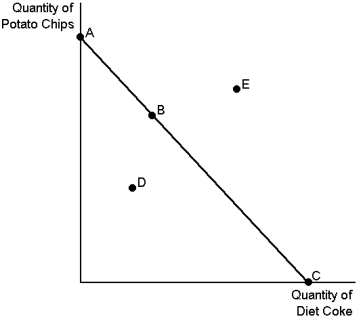 -Refer to Graph 22-1.Which of the points on the graph shown reflects the choice of a consumer who chooses not to spend her entire income?
 (Multiple Choice)
4.8/5 (79)
(79) Graph 22-3 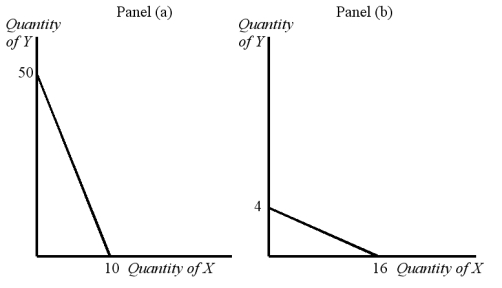 -Refer to Graph 22-3.Suppose that these budget lines exist for the same consumer who faced the same budget constraint in both panels.What can we infer about the prices of the two goods?
 (Multiple Choice)
4.9/5 (75)
(75) A budget constraint shows the bundles of consumption that make the consumer happy.
(True/False)
4.9/5 (80)
(80) When the price of a good decreases, ceteris paribus, the lower price:
(Multiple Choice)
4.8/5 (59)
(59) Refer to the information provided.What is the implicit price that Amy pays for the satisfaction derived from playing an hour of tennis?
(Multiple Choice)
4.8/5 (80)
(80) Consumers are able to select the prices that they pay for commodities.In this sense, a consumer has some control over the budget constraint he/she faces.
(True/False)
5.0/5 (82)
(82) To reach a higher indifference curve a consumer must either obtain an income increase or be offered the goods at lower prices.
(True/False)
4.8/5 (93)
(93) An optimising consumer will select a consumption bundle in which the:
(Multiple Choice)
4.7/5 (70)
(70) Which of the following statements are true?
i. higher indifference curves are preferred to lower ones
ii. indifference curves are always downwards sloping
iii. indifference curves are always bowed inwards (convex)
(Multiple Choice)
4.8/5 (82)
(82) Refer to the information provided.Assume that Diane decides to consume $300 000 in the work period.How much will she consume in her retirement period?
(Multiple Choice)
4.8/5 (75)
(75) A utility-maximising individual will consume a bundle of goods that is:
(Multiple Choice)
5.0/5 (96)
(96) Select the true statements that follow.When the indifference curve is tangent to the budget constraint, a consumer:
(i) cannot be made better off without increasing his or her income
(ii) is consuming the best combination of two goods that are attainable
(iii) must be on a linear indifference curve
(Multiple Choice)
4.8/5 (67)
(67) Explain the relationship between the budget constraint and an indifference curve at consumer optimum.
(Essay)
4.9/5 (88)
(88) The slope of an indifference curve reflects the consumer's willingness to exchange one commodity for another.
(True/False)
4.9/5 (74)
(74) Which of the following statements is correct? If the indifference curves are at right angles to each other, then the consumer will:
(i) be indifferent to trading one good for the other
(ii) always consume the good in constant proportions
(iii) will always consume a bundle on the "point" of the indifference curve (where the indifference curves meet at 90-degrees)
(Multiple Choice)
4.9/5 (91)
(91) 
Filters
- Essay(0)
- Multiple Choice(0)
- Short Answer(0)
- True False(0)
- Matching(0)