



 Chat with AI
Exam 30: Inflation: Its Causes and Costs

Exam 1: Ten Lessons From Economics146 Questions
Exam 2: Thinking Like an Economist133 Questions
Exam 3: Interdependence and the Gains From Trade139 Questions
Exam 4: The Market Forces of Supply and Demand215 Questions
Exam 5: Elasticity and Its Application178 Questions
Exam 6: Supply, Demand and Government Policies145 Questions
Exam 7: Consumers, Producers and the Efficiency of Markets171 Questions
Exam 8: Application: the Costs of Taxation135 Questions
Exam 9: Application: International Trade151 Questions
Exam 10: Externalities199 Questions
Exam 11: Public Goods and Common Resources178 Questions
Exam 12: The Design of the Tax System154 Questions
Exam 13: The Costs of Production191 Questions
Exam 14: Firms in Competitive Markets198 Questions
Exam 15: Monopoly212 Questions
Exam 16: Monopolistic Competition212 Questions
Exam 17: Business Strategy and Oligopoly179 Questions
Exam 18: Competition Policy103 Questions
Exam 19: The Markets for the Factors of Production214 Questions
Exam 20: Earnings, Unions and Discrimination201 Questions
Exam 21: Income Inequity and Poverty111 Questions
Exam 22: The Theory of Consumer Choice158 Questions
Exam 23: Frontiers of Microeconomics111 Questions
Exam 24: Measuring a Nations Income51 Questions
Exam 25: Measuring the Cost of Living55 Questions
Exam 26: Production and Growth62 Questions
Exam 27: Saving, Investment and the Financial System62 Questions
Exam 28: The Natural Rate of Unemployment58 Questions
Exam 29: The Monetary System66 Questions
Exam 30: Inflation: Its Causes and Costs74 Questions
Exam 31: Open-Economy Macroeconomics: Basic Concepts68 Questions
Exam 32: A Macroeconomic Theory of the Open Economy61 Questions
Exam 33: Aggregate Demand and Aggregate Supply81 Questions
Exam 34: The Influence of Monetary and Fiscal Policy on Aggregate Demand73 Questions
Exam 35: The Short-Run Trade-Off Between Inflation and Unemployment57 Questions
Exam 36: Global Financial Crisis of 2008 and Beyond37 Questions
Exam 37: Five Debates Over Macroeconomic Policy38 Questions
Select questions type


Menu costs are costs of inflation limited to restaurants and fast-food establishments and are localised to countries.
(True/False)
4.9/5  (76)
(76) By reducing the cash rate in the US to almost zero per cent, what would critics of the Federal Reserve Bank (the Fed - The US central bank) believe about the Fed's ability to stimulate the economy?
(Essay)
4.8/5 (81)
(81) If between when you purchase an asset and sell it, the general price level and the price of the asset both double, then you have realised a:
(Multiple Choice)
4.8/5 (93)
(93) Two countries, Alpha and Beta, are otherwise identical except that each dollar in Alpha is used more frequently than each dollar in Beta.For this to be true, it must be the case that, holding other factors equal, __________ in Alpha than in Beta.
(Multiple Choice)
4.9/5 (91)
(91) Which of the following statements is not correct when more money is created?
(Multiple Choice)
4.9/5 (87)
(87) In the long run, the _____ adjusts to equilibrate the quantity of money supplied with the quantity demanded.
(Multiple Choice)
5.0/5 (89)
(89) The most important variable affecting the demand for money in the long run is the:
(Multiple Choice)
4.8/5 (82)
(82) The growth of EFTPOS and internet banking has reduced shoeleather costs as people do not need to go into the bank anymore.
(True/False)
4.8/5 (86)
(86) Graph 11-1 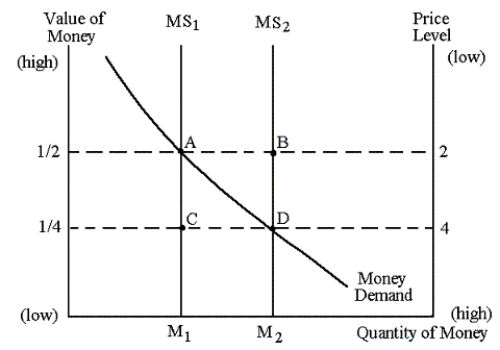 -When the money supply curve in Graph11-1 shifts from MS2 to MS1:
 (Multiple Choice)
4.9/5 (88)
(88) Why has Germany had much lower inflation than the US has over the past 50 years?
(Multiple Choice)
4.9/5 (72)
(72) According to the quantity equation, if velocity is constant at two and real GDP is constant at 10 000, then, if the money supply is increased from 6250 to 6500, the price level:
(Multiple Choice)
4.7/5 (84)
(84) The inflation tax is exactly like other taxes levied when the government prints money.
(True/False)
4.8/5 (76)
(76) The quantity equation shows that if velocity and output are constant, a given percentage in the money supply will lead to the proportionally different percentage increase in the price level.
(True/False)
4.9/5 (79)
(79) 
Filters
- Essay(0)
- Multiple Choice(0)
- Short Answer(0)
- True False(0)
- Matching(0)