



 Chat with AI
Exam 23: Metallurgy and the Chemistry of Metals

Exam 1: Chemistry: the Central Science133 Questions
Exam 2: Atoms, Molecules, and Ions124 Questions
Exam 3: Stoichiometry: Ratios of Combination137 Questions
Exam 4: Reactions in Aqueous Solutions146 Questions
Exam 5: Thermochemistry141 Questions
Exam 6: Quantum Theory and the Electronic Structure of Atoms135 Questions
Exam 7: Electron Configuration and the Periodic Table120 Questions
Exam 8: Chemical Bonding I: Basic Concepts102 Questions
Exam 9: Chemical Bonding II: Molecular Geometry and Bonding Theories139 Questions
Exam 10: Gases137 Questions
Exam 11: Intermolecular Forces and the Physical Properties of Liquids and Solids137 Questions
Exam 12: Modern Materials108 Questions
Exam 13: Physical Properties of Solutions151 Questions
Exam 14: Chemical Kinetics132 Questions
Exam 15: Chemical Equilibrium146 Questions
Exam 16: Acids and Bases137 Questions
Exam 17: Acid-Base Equilibria and Solubility Equilibria133 Questions
Exam 18: Entropy, Free Energy, and Equilibrium107 Questions
Exam 19: Electrochemistry122 Questions
Exam 20: Nuclear Chemistry127 Questions
Exam 21: Environmental Chemistry135 Questions
Exam 22: Coordination Chemistry132 Questions
Exam 23: Metallurgy and the Chemistry of Metals152 Questions
Exam 24: Nonmetallic Elements and Their Compounds117 Questions
Exam 25: Organic Chemistry121 Questions
Select questions type


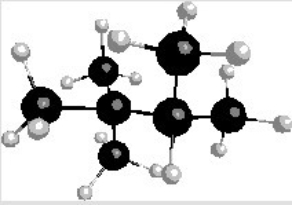
The systematic name for the hydrocarbon with the following structural formula is 1-ethyl-2-methylbutane.

(True/False)
4.8/5  (81)
(81) 
The reaction of hydrogen chloride gas with propene will yield 1-chloropropane as the main product.
(True/False)
4.7/5 (81)
(81) Which one of these hydrocarbons does not have structural isomers?
(Multiple Choice)
4.8/5 (73)
(73) Glucose is an important sugar in a person's metabolic cycle. Identify the functional group circled. 
(Multiple Choice)
4.8/5 (80)
(80) A(n) ________ is an electron lover, positively charged, and an electron pair acceptor (Lewis acid).
(Short Answer)
4.7/5 (86)
(86) List three important intermolecular forces that operate in DNA, and explain what parts of the molecule are involved in these forces.
(Essay)
4.9/5 (91)
(91) 
The compound shown below is responsible for the odor in rancid butter. Identify the functional group circled. 
(Multiple Choice)
4.7/5 (83)
(83) 
Filters
- Essay(0)
- Multiple Choice(0)
- Short Answer(0)
- True False(0)
- Matching(0)