



 Chat with AI
Exam 37: Vital Signs and Measurements

Exam 1: Introduction to Medical Assisting75 Questions
Exam 2: Healthcare and the Healthcare Team80 Questions
Exam 3: Professionalism and Success75 Questions
Exam 4: Interpersonal Communication97 Questions
Exam 5: Legal and Ethical Issues84 Questions
Exam 6: Basic Safety and Infection Control94 Questions
Exam 7: Patient Reception83 Questions
Exam 8: Office Equipment and Supplies156 Questions
Exam 9: Examination and Treatment Areas97 Questions
Exam 10: Written and Electronic Documents84 Questions
Exam 11: Medical Records and Documentation75 Questions
Exam 12: Electronic Health Records71 Questions
Exam 13: Telephone Techniques89 Questions
Exam 14: Patient Education75 Questions
Exam 15: Managing Medical Records74 Questions
Exam 16: Schedule Management80 Questions
Exam 17: Insurance and Billing80 Questions
Exam 18: Diagnostic Coding75 Questions
Exam 19: Procedure Coding75 Questions
Exam 20: Patient Billing and Collection75 Questions
Exam 21: Financial Management Key77 Questions
Exam 22: Organization of the Body145 Questions
Exam 23: The Integumentary System113 Questions
Exam 24: The Skeletal System161 Questions
Exam 25: The Muscular System100 Questions
Exam 26: The Cardiovascular System89 Questions
Exam 27: The Blood74 Questions
Exam 28: The Lymphatic and Immune Systems78 Questions
Exam 29: The Respiratory System91 Questions
Exam 30: The Nervous System140 Questions
Exam 31: The Urinary System88 Questions
Exam 32: The Reproductive System121 Questions
Exam 33: The Digestive System118 Questions
Exam 34: The Endocrine System80 Questions
Exam 35: Special Senses95 Questions
Exam 36: Patient Interview and History93 Questions
Exam 37: Vital Signs and Measurements90 Questions
Exam 38: Assisting With a General Physical Examination75 Questions
Exam 39: Assisting in Reproductive and Urinary Specialties75 Questions
Exam 40: Assisting in Pediatrics75 Questions
Exam 41: Assisting in Geriatrics75 Questions
Exam 42: Assisting in Other Medical Specialties75 Questions
Exam 43: Assisting With Eye and Ear Care75 Questions
Exam 44: Assisting With Minor Surgery111 Questions
Exam 45: Orientation to the Lab81 Questions
Exam 46: Electrocardiography and Pulmonary Function Testing94 Questions
Exam 47: Microbiology and Disease123 Questions
Exam 48: Processing and Testing Urine and Stool Specimens91 Questions
Exam 49: Collecting, Processing, and Testing Blood Specimens75 Questions
Exam 50: Diagnostic Imaging80 Questions
Exam 51: Principles of Pharmacology99 Questions
Exam 52: Dosage Calculation75 Questions
Exam 53: Medication Administration75 Questions
Exam 54: Physical Therapy and Rehabilitation78 Questions
Exam 55: Nutrition and Health88 Questions
Exam 56: Practice Management76 Questions
Exam 57: Emergency Preparedness109 Questions
Exam 58: Preparing for the World of Work75 Questions
Select questions type


Temperature can be measured in degrees Fahrenheit ( F) or degrees ________ (centigrade; C).

Free
(Short Answer)
5.0/5  (78)
(78) Correct Answer: Verified
Celsius
The usual ratio of the pulse rate to the respiration rate is ____.
Free
(Multiple Choice)
4.8/5 (105)
(105) Correct Answer:Verified
VerifiedC
The vital signs are taken in different positions to assess for ________, or postural, hypotension.
Free
(Short Answer)
4.8/5 (82)
(82) Correct Answer:Verified
Verifiedorthostatic
In the figure, the pulse is being taken over the ________ artery. 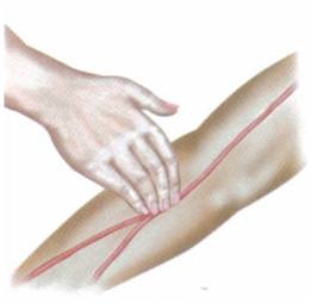
(Short Answer)
4.7/5 (75)
(75) Nina Trevez is a 32-year-old patient who is new to your medical office. During the initial patient interview, Ms. Trevez says her appendix was removed when she was 10 years old, she had a complete mastectomy of the left breast 5 years ago, and she has a severe allergy to penicillin. Which of the following actions would you be careful to take while taking Ms. Trevez's vital signs?
(Multiple Choice)
4.8/5 (87)
(87) A patient is ________ when he has a body temperature within his normal range.
(Short Answer)
4.8/5 (76)
(76) Which of the following is a characteristic of electronic sphygmomanometers?
(Multiple Choice)
4.8/5 (73)
(73) Convert 36.8ºC to Fahrenheit: ________ºF. (round to the nearest tenth)
(Short Answer)
4.9/5 (73)
(73) Which of the following is important when putting on a blood pressure cuff?
(Multiple Choice)
4.7/5 (68)
(68) Temperature can be measured in degrees ________ ( F) or degrees Celsius (centigrade; C).
(Short Answer)
4.9/5 (79)
(79) 
Which of the following pulse points is located in the groove on the thumb side of the inner wrist?
(Multiple Choice)
4.8/5 (81)
(81) Which of the following is a temperature of 98.6ºF converted to Celsius?
(Multiple Choice)
4.9/5 (78)
(78) 
The vital signs are taken in different positions to assess for orthostatic, or ________, hypotension.
(Short Answer)
5.0/5 (86)
(86) The ________ scanner is a noninvasive and quick procedure for taking temperatures by stroking the thermometer across the forehead, crossing over the temporal artery.
(Short Answer)
4.7/5 (77)
(77) Which of the following is important when using a tympanic thermometer?
(Multiple Choice)
4.8/5 (76)
(76) The brachial artery pulse point is located in the bend of the elbow, or the ________ space.
(Short Answer)
4.7/5 (76)
(76) The ________ blood pressure is determined by listening with a stethoscope.
(Short Answer)
4.8/5 (74)
(74) 
Filters
- Essay(0)
- Multiple Choice(0)
- Short Answer(0)
- True False(0)
- Matching(0)