



 Chat with AI
Exam 17: Oligopoly

Exam 1: Ten Principles of Economics220 Questions
Exam 2: Thinking Like an Economist284 Questions
Exam 3: Interdependence and the Gains From Trade192 Questions
Exam 4: The Market Forces of Supply and Demand277 Questions
Exam 5: Elasticity and Its Application222 Questions
Exam 6: Supply, Demand, and Government Policies321 Questions
Exam 7: Consumers, Producers, and the Efficiency of Markets218 Questions
Exam 8: Applications: The Costs of Taxation203 Questions
Exam 9: Application: International Trade214 Questions
Exam 10: Externalities204 Questions
Exam 11: Public Goods and Common Resources182 Questions
Exam 12: The Design of the Tax System225 Questions
Exam 13: The Costs of Production261 Questions
Exam 14: Firms in Competitive Markets243 Questions
Exam 15: Monopoly231 Questions
Exam 16: Monopolistic Competition246 Questions
Exam 17: Oligopoly204 Questions
Exam 18: The Markets for the Factors of Production232 Questions
Exam 19: Earnings and Discrimination230 Questions
Exam 20: Income Inequality and Poverty194 Questions
Exam 21: The Theory of Consumer Choice209 Questions
Exam 22: Frontiers in Microeconomics185 Questions
Exam 23: Measuring a Nations Income231 Questions
Exam 24: Measuring the Cost of Living214 Questions
Exam 25: Production and Growth187 Questions
Exam 26: Saving, Investment, and the Financial System225 Questions
Exam 27: Tools of Finance198 Questions
Exam 28: Unemployment and Its Natural Rate361 Questions
Exam 29: The Monetary System210 Questions
Exam 30: Money Growth and Inflation201 Questions
Exam 31: Open-Economy Macroeconomics: Basic Concepts194 Questions
Exam 32: A Macroeconomic Theory of the Open Economy188 Questions
Exam 33: Aggregate Demand and Aggregate Supply189 Questions
Exam 34: The Influence of Monetary and Fiscal Policy on Aggregate Demand207 Questions
Exam 35: The Short-Run Tradeoff Between Inflation and Unemployment223 Questions
Exam 36: Six Debates Over Macroeconomic Policy154 Questions
Select questions type


Table 17-3
The table shows the demand schedule for a particular product.
Quantity Demanded (Units) Price (Dollars per unit) 0 16 1 14 2 12 3 10 4 8 5 6 6 4 7 2 8 0
-Refer to Table 17-3. Suppose the market for this product is served by two firms that have formed a cartel. If the marginal cost of production is $4 and each firm incurs a fixed cost of $6, the combined profit of the cartel will be
(Multiple Choice)
4.8/5  (96)
(96) Table 17-1
Imagine a small town in which only two residents, Sydney and Matthew, own wells that produce safe drinking water. Each week Sydney and Matthew work together to decide how many gallons of water to pump. They bring the water to town and sell it at whatever price the market will bear. To keep things simple, suppose that Sydney and Matthew can pump as much water as they want without cost so that the marginal cost of water equals zero. The town's weekly demand schedule and total revenue schedule for water is shown in the following table:
Quantity (Gallons) Price (Dollars per gallon) Total Revenue and Total Profit (Dollars) 0 48 0 90 44 3,960 180 40 7,200 270 36 9,720 360 32 11,520 450 28 12,600 540 24 12,960 630 20 12,600 720 16 11,520 810 12 9,720 900 8 7,200 990 4 3,960 1,080 0 0
-Refer to Table 17-1. If Sydney and Matthew operate as a profit-maximizing monopoly in the market for water, how much profit will each of them earn, assuming that the two producers split the market equally?
(Multiple Choice)
4.7/5 (98)
(98) Table 17-15
Suppose that two coal mining companies - Allied and Barclay - own adjacent land suitable for excavating coal mines. The profits that each firm earns depends on both the number of mines it excavates and the number of mines excavated by the other firm. The table below lists each firm's individual profits:
Allied
Excavate one mine Excavate two mines
 -Refer to Table 17-15. Does Allied have a dominant strategy? If so, describe it.
 (Essay)
5.0/5 (77)
(77) Table 17-4
Only two firms, JKL and XYZ, sell a particular product. The following table shows the demand curve for their product. Each firm has the same constant marginal cost of $8 and zero fixed cost.
Price (Dollars per unit) Quantity Demanded (Units) Total Revenue (Dollars) 28 0 0 26 5 130 24 10 240 22 15 330 20 20 400 18 25 450 16 30 480 14 35 490 12 40 480 10 45 450 8 50 400 6 55 330 4 60 240 2 65 130 0 70 0
-Refer to Table 17-4. JKL and XYZ agree to maximize joint profits. However, while JKL produces the agreed-upon amount, XYZ breaks the agreement and produces 5 more than agreed. How much profit does XYZ make?
(Multiple Choice)
4.7/5 (73)
(73) Table 17-2
The information in the following table shows the total demand for internet radio subscriptions in a small urban market. Assume that each company that provides these subscriptions incurs an annual fixed cost of $20,000 (per year) and that the marginal cost of providing an additional subscription is always $16.
Quantity Demanded (Internet radio sub scriptions) Price (Dollars per subscription per year) 0 64 500 60 1,000 56 1,500 52 2,000 48 2,500 44 3,000 40 3,500 36 4,000 32 4,500 28 5,000 24 5,500 20 6,000 16 6,500 12 7,000 8 7,500 4 8,000 0
-Refer to Table 17-2. Assume that there are two profit-maximizing internet radio providers operating in this market. Further assume that they are not able to collude on the price and quantity of subscriptions to sell. How much profit will each firm earn when this market reaches a Nash equilibrium?
(Multiple Choice)
4.9/5 (64)
(64) Explain how the output effect and the price effect influence the production decision of the individual oligopolist.
(Essay)
4.7/5 (88)
(88) Reaching and enforcing an agreement between members of a cartel becomes more difficult as the size of the group __________.
(Short Answer)
4.8/5 (83)
(83) Table 17-7
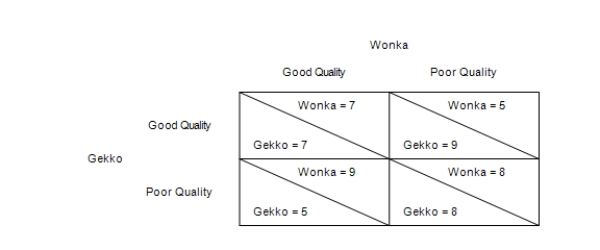
Two companies, Wonka and Gekko, each decide whether to produce a good quality product or a poor quality product. In the figure, the dollar amounts are payoffs and they represent annual profits (in millions of dollars) for the two companies.
 -Juan Pablo and Zak are competitors in a local market. Each is trying to decide if it is better to advertise on TV, on radio, or not at all. If they both advertise on TV, each will earn a profit of $8,000. If they both advertise on radio, each will earn a profit of $14,000. If neither advertises at all, each will earn a profit of $20,000. If one advertises on TV and other advertises on radio, then the one advertising on TV will earn $12,000 and the other will earn $10,000. If one advertises on TV and the other does not advertise, then the one advertising on TV will earn $22,000 and the other will earn $4,000. If one advertises on radio and the other does not advertise, then the one advertising on radio will earn $24,000 and the other will earn $8,000. If both follow their dominant strategy, then Juan Pablo will
 (Multiple Choice)
4.9/5 (82)
(82) Table 17-2
The information in the following table shows the total demand for internet radio subscriptions in a small urban market. Assume that each company that provides these subscriptions incurs an annual fixed cost of $20,000 (per year) and that the marginal cost of providing an additional subscription is always $16.
Quantity Demanded (Internet radio sub scriptions) Price (Dollars per subscription per year) 0 64 500 60 1,000 56 1,500 52 2,000 48 2,500 44 3,000 40 3,500 36 4,000 32 4,500 28 5,000 24 5,500 20 6,000 16 6,500 12 7,000 8 7,500 4 8,000 0
-Refer to Table 17-2. Assume there are two internet radio providers that operate in this market. If they are able to collude on the quantity of subscriptions that will be sold and on the price that will be charged for subscriptions, then their agreement will stipulate that
(Multiple Choice)
4.8/5 (78)
(78) Table 17-1
Imagine a small town in which only two residents, Sydney and Matthew, own wells that produce safe drinking water. Each week Sydney and Matthew work together to decide how many gallons of water to pump. They bring the water to town and sell it at whatever price the market will bear. To keep things simple, suppose that Sydney and Matthew can pump as much water as they want without cost so that the marginal cost of water equals zero. The town's weekly demand schedule and total revenue schedule for water is shown in the following table:
Quantity (Gallons) Price (Dollars per gallon) Total Revenue and Total Profit (Dollars) 0 48 0 90 44 3,960 180 40 7,200 270 36 9,720 360 32 11,520 450 28 12,600 540 24 12,960 630 20 12,600 720 16 11,520 810 12 9,720 900 8 7,200 990 4 3,960 1,080 0 0
-Refer to Table 17-1. What is the socially efficient quantity of water?
(Multiple Choice)
4.9/5 (75)
(75) Table 17-1
Imagine a small town in which only two residents, Sydney and Matthew, own wells that produce safe drinking water. Each week Sydney and Matthew work together to decide how many gallons of water to pump. They bring the water to town and sell it at whatever price the market will bear. To keep things simple, suppose that Sydney and Matthew can pump as much water as they want without cost so that the marginal cost of water equals zero. The town's weekly demand schedule and total revenue schedule for water is shown in the following table:
Quantity (Gallons) Price (Dollars per gallon) Total Revenue and Total Profit (Dollars) 0 48 0 90 44 3,960 180 40 7,200 270 36 9,720 360 32 11,520 450 28 12,600 540 24 12,960 630 20 12,600 720 16 11,520 810 12 9,720 900 8 7,200 990 4 3,960 1,080 0 0
-Refer to Table 17-1. Suppose the town enacts new antitrust laws that prohibit Sydney and Matthew from operating as a monopoly. What will be the price of water once Sydney and Matthew reach a Nash equilibrium?
(Multiple Choice)
4.9/5 (76)
(76) Even when allowed to collude, firms in an oligopoly may choose to cheat on their agreements with the rest of the cartel. Why?
(Essay)
5.0/5 (80)
(80) Table 17-6
Two home-improvement stores (Lopes and HomeMax) in a growing urban area are interested in expanding their market share. Both are interested in expanding the size of their store and parking lot to accommodate potential growth in their customer base. The following game depicts the strategic outcomes that result from the game. Increases in annual profits (in millions of dollars) of the two home-improvement stores are shown in the following figure.
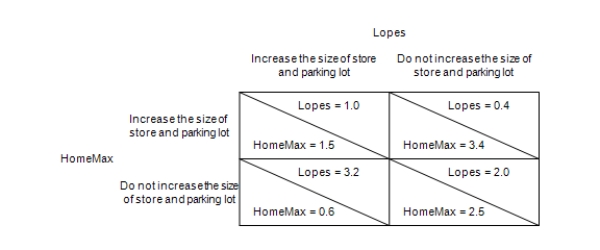 -Refer to Table 17-6. When this game reaches a Nash equilibrium, annual profit will grow by
 (Multiple Choice)
4.9/5 (77)
(77) Table 17-15
Suppose that two coal mining companies - Allied and Barclay - own adjacent land suitable for excavating coal mines. The profits that each firm earns depends on both the number of mines it excavates and the number of mines excavated by the other firm. The table below lists each firm's individual profits:
Allied
Excavate one mine Excavate two mines
-Refer to Table 17-15. Is there a Nash equilibrium? If so, describe it.
-Refer to Table 17-15. Is there a Nash equilibrium? If so, describe it. (Essay)
4.8/5 (85)
(85) Table 17-7
Two companies, Wonka and Gekko, each decide whether to produce a good quality product or a poor quality product. In the figure, the dollar amounts are payoffs and they represent annual profits (in millions of dollars) for the two companies.
-Two suspected drug dealers are stopped by the highway patrol for speeding. The officer searches the car and finds a small bag of marijuana and arrests the two. During the interrogation, each is separately offered the following: "If you confess to dealing drugs and testify against your partner, you will be given immunity and released while your partner will get 10 years in prison. If you both confess, you will each get 5 years." If neither confesses, there is no evidence of drug dealing, and the most they could get is one year each for possession of marijuana. If each suspected drug dealer follows a dominant strategy, what should he/she do?
-Two suspected drug dealers are stopped by the highway patrol for speeding. The officer searches the car and finds a small bag of marijuana and arrests the two. During the interrogation, each is separately offered the following: "If you confess to dealing drugs and testify against your partner, you will be given immunity and released while your partner will get 10 years in prison. If you both confess, you will each get 5 years." If neither confesses, there is no evidence of drug dealing, and the most they could get is one year each for possession of marijuana. If each suspected drug dealer follows a dominant strategy, what should he/she do? (Multiple Choice)
4.9/5 (89)
(89) Suppose a market is initially perfectly competitive with many firms selling an identical product. Over time, however, suppose the merging of firms results in the market being served by only three or four firms selling this same product. As a result, we would expect
(Multiple Choice)
4.8/5 (76)
(76) Table 17-7
Two companies, Wonka and Gekko, each decide whether to produce a good quality product or a poor quality product. In the figure, the dollar amounts are payoffs and they represent annual profits (in millions of dollars) for the two companies.
-Refer to Table 17-7. The more frequently this game is played, the more likely it is that
-Refer to Table 17-7. The more frequently this game is played, the more likely it is that (Multiple Choice)
4.9/5 (80)
(80) Describe the source of tension between cooperation and self-interest in a market characterized by oligopoly. Use an example of an actual cartel arrangement to demonstrate why this tension creates instability in cartels.
(Essay)
4.7/5 (72)
(72) Table 17-2
The information in the following table shows the total demand for internet radio subscriptions in a small urban market. Assume that each company that provides these subscriptions incurs an annual fixed cost of $20,000 (per year) and that the marginal cost of providing an additional subscription is always $16.
Quantity Demanded (Internet radio sub scriptions) Price (Dollars per subscription per year) 0 64 500 60 1,000 56 1,500 52 2,000 48 2,500 44 3,000 40 3,500 36 4,000 32 4,500 28 5,000 24 5,500 20 6,000 16 6,500 12 7,000 8 7,500 4 8,000 0
-Refer to Table 17-2. Suppose there is only one internet radio provider in this market and it seeks to maximize its profit. The company will
(Multiple Choice)
4.8/5 (76)
(76) 
Filters
- Essay(0)
- Multiple Choice(0)
- Short Answer(0)
- True False(0)
- Matching(0)