



 Chat with AI
Exam 17: Oligopoly

Exam 1: Ten Principles of Economics220 Questions
Exam 2: Thinking Like an Economist284 Questions
Exam 3: Interdependence and the Gains From Trade192 Questions
Exam 4: The Market Forces of Supply and Demand277 Questions
Exam 5: Elasticity and Its Application222 Questions
Exam 6: Supply, Demand, and Government Policies321 Questions
Exam 7: Consumers, Producers, and the Efficiency of Markets218 Questions
Exam 8: Applications: The Costs of Taxation203 Questions
Exam 9: Application: International Trade214 Questions
Exam 10: Externalities204 Questions
Exam 11: Public Goods and Common Resources182 Questions
Exam 12: The Design of the Tax System225 Questions
Exam 13: The Costs of Production261 Questions
Exam 14: Firms in Competitive Markets243 Questions
Exam 15: Monopoly231 Questions
Exam 16: Monopolistic Competition246 Questions
Exam 17: Oligopoly204 Questions
Exam 18: The Markets for the Factors of Production232 Questions
Exam 19: Earnings and Discrimination230 Questions
Exam 20: Income Inequality and Poverty194 Questions
Exam 21: The Theory of Consumer Choice209 Questions
Exam 22: Frontiers in Microeconomics185 Questions
Exam 23: Measuring a Nations Income231 Questions
Exam 24: Measuring the Cost of Living214 Questions
Exam 25: Production and Growth187 Questions
Exam 26: Saving, Investment, and the Financial System225 Questions
Exam 27: Tools of Finance198 Questions
Exam 28: Unemployment and Its Natural Rate361 Questions
Exam 29: The Monetary System210 Questions
Exam 30: Money Growth and Inflation201 Questions
Exam 31: Open-Economy Macroeconomics: Basic Concepts194 Questions
Exam 32: A Macroeconomic Theory of the Open Economy188 Questions
Exam 33: Aggregate Demand and Aggregate Supply189 Questions
Exam 34: The Influence of Monetary and Fiscal Policy on Aggregate Demand207 Questions
Exam 35: The Short-Run Tradeoff Between Inflation and Unemployment223 Questions
Exam 36: Six Debates Over Macroeconomic Policy154 Questions
Select questions type


Table 17-7
Two companies, Wonka and Gekko, each decide whether to produce a good quality product or a poor quality product. In the figure, the dollar amounts are payoffs and they represent annual profits (in millions of dollars) for the two companies.
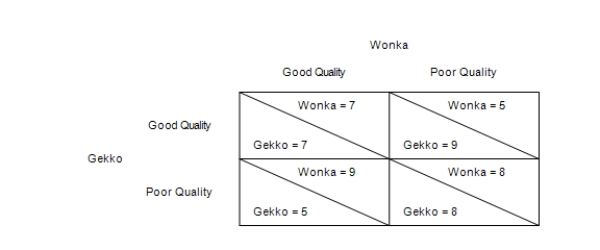 -Refer to Table 17-7. The dominant strategy for Wonka is to
 (Multiple Choice)
4.7/5  (81)
(81) Assume that Samorola has entered into an enforceable resale price maintenance agreement with Trint and U-Mobile. Which of the following will always be true?
(Multiple Choice)
4.7/5 (72)
(72) When prisoners' dilemma games are repeated over and over, sometimes the threat of penalty causes both parties to cooperate.
(True/False)
4.8/5 (80)
(80) Some people consider the NCAA (National Collegiate Athletic Association) to be a __________ in the market for college athletics.
(Short Answer)
4.9/5 (86)
(86) Suppose that Jamir and Haidy are duopolists in the music industry. In June, they agree to work together as a monopolist, charging the monopoly price for their music and producing the monopoly quantity of songs. By July, each singer is considering breaking the agreement. What would you expect to happen next?
(Multiple Choice)
4.8/5 (83)
(83) What effect does the number of firms in an oligopoly have on the characteristics of the market?
(Essay)
5.0/5 (76)
(76) The equilibrium quantity in markets characterized by oligopoly is
(Multiple Choice)
4.8/5 (53)
(53) It is always the case that players in a prisoner's dilemma situation will choose the Nash Equilibrium.
(True/False)
4.8/5 (77)
(77) Oligopolies produce more when they collude then when they do not.
(True/False)
4.8/5 (84)
(84) Table 17-4
Only two firms, JKL and XYZ, sell a particular product. The following table shows the demand curve for their product. Each firm has the same constant marginal cost of $8 and zero fixed cost.
Price (Dollars per unit) Quantity Demanded (Units) Total Revenue (Dollars) 28 0 0 26 5 130 24 10 240 22 15 330 20 20 400 18 25 450 16 30 480 14 35 490 12 40 480 10 45 450 8 50 400 6 55 330 4 60 240 2 65 130 0 70 0
-Refer to Table 17-4. If JKL and XYZ operate to jointly maximize profits, then what is the price?
(Multiple Choice)
4.8/5 (87)
(87) A Nash Equilibrium is a stable outcome for an oligopoly market situation.
(True/False)
4.8/5 (71)
(71) If all of the firms in an oligopoly successfully collude and form a cartel, then total profit for the cartel is equal to what it would be if the market were a monopoly.
(True/False)
4.8/5 (74)
(74) If one firm left a duopoly market where the firms did not cooperate then
(Multiple Choice)
4.7/5 (67)
(67) The notion of a tit-for-tat strategy applies to a prisoners' dilemma game that is played repeatedly, but it does not apply if the game is played only once.
(True/False)
4.8/5 (69)
(69) As the number of firms in an oligopoly increases, the magnitude of the price effect increases.
(True/False)
4.8/5 (90)
(90) 
Filters
- Essay(0)
- Multiple Choice(0)
- Short Answer(0)
- True False(0)
- Matching(0)