



 Chat with AI
Exam 17: Oligopoly

Exam 1: Ten Principles of Economics220 Questions
Exam 2: Thinking Like an Economist284 Questions
Exam 3: Interdependence and the Gains From Trade192 Questions
Exam 4: The Market Forces of Supply and Demand277 Questions
Exam 5: Elasticity and Its Application222 Questions
Exam 6: Supply, Demand, and Government Policies321 Questions
Exam 7: Consumers, Producers, and the Efficiency of Markets218 Questions
Exam 8: Applications: The Costs of Taxation203 Questions
Exam 9: Application: International Trade214 Questions
Exam 10: Externalities204 Questions
Exam 11: Public Goods and Common Resources182 Questions
Exam 12: The Design of the Tax System225 Questions
Exam 13: The Costs of Production261 Questions
Exam 14: Firms in Competitive Markets243 Questions
Exam 15: Monopoly231 Questions
Exam 16: Monopolistic Competition246 Questions
Exam 17: Oligopoly204 Questions
Exam 18: The Markets for the Factors of Production232 Questions
Exam 19: Earnings and Discrimination230 Questions
Exam 20: Income Inequality and Poverty194 Questions
Exam 21: The Theory of Consumer Choice209 Questions
Exam 22: Frontiers in Microeconomics185 Questions
Exam 23: Measuring a Nations Income231 Questions
Exam 24: Measuring the Cost of Living214 Questions
Exam 25: Production and Growth187 Questions
Exam 26: Saving, Investment, and the Financial System225 Questions
Exam 27: Tools of Finance198 Questions
Exam 28: Unemployment and Its Natural Rate361 Questions
Exam 29: The Monetary System210 Questions
Exam 30: Money Growth and Inflation201 Questions
Exam 31: Open-Economy Macroeconomics: Basic Concepts194 Questions
Exam 32: A Macroeconomic Theory of the Open Economy188 Questions
Exam 33: Aggregate Demand and Aggregate Supply189 Questions
Exam 34: The Influence of Monetary and Fiscal Policy on Aggregate Demand207 Questions
Exam 35: The Short-Run Tradeoff Between Inflation and Unemployment223 Questions
Exam 36: Six Debates Over Macroeconomic Policy154 Questions
Select questions type


Table 17-6
Two home-improvement stores (Lopes and HomeMax) in a growing urban area are interested in expanding their market share. Both are interested in expanding the size of their store and parking lot to accommodate potential growth in their customer base. The following game depicts the strategic outcomes that result from the game. Increases in annual profits (in millions of dollars) of the two home-improvement stores are shown in the following figure.
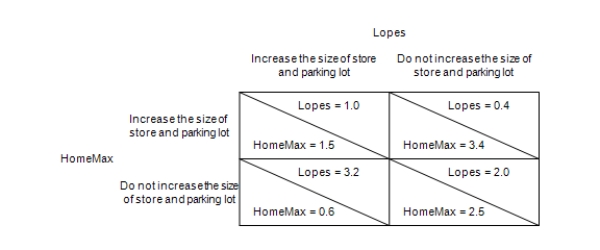 -Refer to Table 17-6. Increasing the size of its store and parking lot is a dominant strategy for
 (Multiple Choice)
4.8/5  (88)
(88) Briefly describe the two arguments that economists make to defend the practice of resale price maintenance.
(Essay)
4.9/5 (93)
(93) Which potentially anti-competitive business practice is often justified on the grounds that it corrects for the free rider problem?
(Short Answer)
4.9/5 (80)
(80) Table 17-5
The table shows the town of Driveaway's demand schedule for gasoline. Assume the town's gasoline seller(s) incurs a cost of $2 for each gallon sold, with no fixed cost.
Quantity (Gallons) Price (Dollars per gallon) Total Revenue (Dollars) 0 8 0 50 7 350 100 6 600 150 5 750 200 4 800 250 3 750 300 2 600 350 1 350 400 0 0
-Refer to Table 17-5. Suppose we observe that the price of a gallon of gasoline in Driveaway is $5; we observe as well that a particular seller's profit is $150. Given this observation, which of the following scenarios is most likely?
(Multiple Choice)
4.8/5 (74)
(74) In imperfectly competitive markets, increasing production will decrease the price of all units sold. This concept is known as the
(Multiple Choice)
4.9/5 (79)
(79) OPEC (Organization of Petroleum Exporting Countries) is an example of a cartel in the output market for petroleum. Major League Baseball could be considered a cartel in the __________ market for baseball players.
(Short Answer)
4.9/5 (92)
(92) Scenario 17-1
Assume that a local restaurant sells two items, salads and steaks. The restaurant's only two customers on a particular day are Mr. Carnivore and Ms. Leafygreens. Mr. Carnivore is willing to pay $20 for a steak and $7 for a salad. Ms. Leafygreens is willing to pay only $8 for a steak, but is willing to pay $12 for a salad. Assume that the restaurant can provide each of these items at zero marginal cost.
-Refer to Scenario 17-1. If the restaurant is able to use tying to price salads and steaks, what is the profit-maximizing price to charge for the "tied" good?
(Multiple Choice)
4.9/5 (75)
(75) If firms in an oligopoly agree to produce according to the monopoly outcome, they will produce the same level of output as they would produce in a Nash equilibrium.
(True/False)
4.8/5 (77)
(77) In a prisoner's dilemma, the Nash Equilibrium might not have a dominant strategy for either player.
(True/False)
4.8/5 (74)
(74) Table 17-5
The table shows the town of Driveaway's demand schedule for gasoline. Assume the town's gasoline seller(s) incurs a cost of $2 for each gallon sold, with no fixed cost.
Quantity (Gallons) Price (Dollars per gallon) Total Revenue (Dollars) 0 8 0 50 7 350 100 6 600 150 5 750 200 4 800 250 3 750 300 2 600 350 1 350 400 0 0
-Refer to Table 17-5. If there are exactly five sellers of gasoline in Driveaway and if they collude, then which of the following outcomes is most likely?
(Multiple Choice)
4.8/5 (80)
(80) Cartels with a small number of firms have a greater probability of reaching the monopoly outcome than do cartels with a larger number of firms.
(True/False)
4.9/5 (84)
(84) Table 17-4
Only two firms, JKL and XYZ, sell a particular product. The following table shows the demand curve for their product. Each firm has the same constant marginal cost of $8 and zero fixed cost.
Price (Dollars per unit) Quantity Demanded (Units) Total Revenue (Dollars) 28 0 0 26 5 130 24 10 240 22 15 330 20 20 400 18 25 450 16 30 480 14 35 490 12 40 480 10 45 450 8 50 400 6 55 330 4 60 240 2 65 130 0 70 0
-Refer to Table 17-4. If this market were perfectly competitive instead of oligopolistic, what quantity would be produced?
(Multiple Choice)
4.9/5 (64)
(64) For a firm, strategic interactions with other firms in the market become more important as the number of firms in the market becomes larger.
(True/False)
4.9/5 (68)
(68) As the number of firms in an oligopoly becomes very large, the price effect disappears.
(True/False)
4.8/5 (87)
(87) As the number of sellers in an oligopoly becomes very large,
(Multiple Choice)
4.7/5 (84)
(84) Table 17-5
The table shows the town of Driveaway's demand schedule for gasoline. Assume the town's gasoline seller(s) incurs a cost of $2 for each gallon sold, with no fixed cost.
Quantity (Gallons) Price (Dollars per gallon) Total Revenue (Dollars) 0 8 0 50 7 350 100 6 600 150 5 750 200 4 800 250 3 750 300 2 600 350 1 350 400 0 0
-Refer to Table 17-5. If there are exactly five sellers of gasoline in Driveaway and if they collude, then which of the following outcomes is most likely?
(Multiple Choice)
4.8/5 (72)
(72) Scenario 17-1
Assume that a local restaurant sells two items, salads and steaks. The restaurant's only two customers on a particular day are Mr. Carnivore and Ms. Leafygreens. Mr. Carnivore is willing to pay $20 for a steak and $7 for a salad. Ms. Leafygreens is willing to pay only $8 for a steak, but is willing to pay $12 for a salad. Assume that the restaurant can provide each of these items at zero marginal cost.
-Refer to Scenario 17-1. How much additional profit can the restaurant earn by switching to the use of a tying strategy to price salads and steaks rather than pricing these goods separately?
(Multiple Choice)
4.9/5 (84)
(84) Scenario 17-2
Assume that a local telecommunications company sells high speed internet access and cable television. The company's only two customers are Taylor and Tim. Taylor is willing to pay $50 per month for high speed internet access and $50 per month for cable television. Tim is willing to pay only $20 per month for high speed internet access, but is willing to pay $70 per month for cable television. Assume that the telecommunications company can provide each of these products at zero marginal cost.
-Refer to Scenario 17-2. How much additional profit can the telecommunications company earn by switching to the use of a tying strategy to price high speed internet access and cable television rather than pricing these goods separately?
(Short Answer)
4.8/5 (86)
(86) 
Filters
- Essay(0)
- Multiple Choice(0)
- Short Answer(0)
- True False(0)
- Matching(0)