



 Chat with AI
Exam 17: Oligopoly

Exam 1: Ten Principles of Economics220 Questions
Exam 2: Thinking Like an Economist284 Questions
Exam 3: Interdependence and the Gains From Trade192 Questions
Exam 4: The Market Forces of Supply and Demand277 Questions
Exam 5: Elasticity and Its Application222 Questions
Exam 6: Supply, Demand, and Government Policies321 Questions
Exam 7: Consumers, Producers, and the Efficiency of Markets218 Questions
Exam 8: Applications: The Costs of Taxation203 Questions
Exam 9: Application: International Trade214 Questions
Exam 10: Externalities204 Questions
Exam 11: Public Goods and Common Resources182 Questions
Exam 12: The Design of the Tax System225 Questions
Exam 13: The Costs of Production261 Questions
Exam 14: Firms in Competitive Markets243 Questions
Exam 15: Monopoly231 Questions
Exam 16: Monopolistic Competition246 Questions
Exam 17: Oligopoly204 Questions
Exam 18: The Markets for the Factors of Production232 Questions
Exam 19: Earnings and Discrimination230 Questions
Exam 20: Income Inequality and Poverty194 Questions
Exam 21: The Theory of Consumer Choice209 Questions
Exam 22: Frontiers in Microeconomics185 Questions
Exam 23: Measuring a Nations Income231 Questions
Exam 24: Measuring the Cost of Living214 Questions
Exam 25: Production and Growth187 Questions
Exam 26: Saving, Investment, and the Financial System225 Questions
Exam 27: Tools of Finance198 Questions
Exam 28: Unemployment and Its Natural Rate361 Questions
Exam 29: The Monetary System210 Questions
Exam 30: Money Growth and Inflation201 Questions
Exam 31: Open-Economy Macroeconomics: Basic Concepts194 Questions
Exam 32: A Macroeconomic Theory of the Open Economy188 Questions
Exam 33: Aggregate Demand and Aggregate Supply189 Questions
Exam 34: The Influence of Monetary and Fiscal Policy on Aggregate Demand207 Questions
Exam 35: The Short-Run Tradeoff Between Inflation and Unemployment223 Questions
Exam 36: Six Debates Over Macroeconomic Policy154 Questions
Select questions type


Table 17-1
Imagine a small town in which only two residents, Sydney and Matthew, own wells that produce safe drinking water. Each week Sydney and Matthew work together to decide how many gallons of water to pump. They bring the water to town and sell it at whatever price the market will bear. To keep things simple, suppose that Sydney and Matthew can pump as much water as they want without cost so that the marginal cost of water equals zero. The town's weekly demand schedule and total revenue schedule for water is shown in the following table:
Quantity (Gallons) Price (Dollars per gallon) Total Revenue and Total Profit (Dollars) 0 48 0 90 44 3,960 180 40 7,200 270 36 9,720 360 32 11,520 450 28 12,600 540 24 12,960 630 20 12,600 720 16 11,520 810 12 9,720 900 8 7,200 990 4 3,960 1,080 0 0
-Refer to Table 17-1. If this market for water were perfectly competitive instead of monopolistic, what price would be charged?
(Multiple Choice)
4.9/5  (76)
(76) Table 17-4
Only two firms, JKL and XYZ, sell a particular product. The following table shows the demand curve for their product. Each firm has the same constant marginal cost of $8 and zero fixed cost.
Price (Dollars per unit) Quantity Demanded (Units) Total Revenue (Dollars) 28 0 0 26 5 130 24 10 240 22 15 330 20 20 400 18 25 450 16 30 480 14 35 490 12 40 480 10 45 450 8 50 400 6 55 330 4 60 240 2 65 130 0 70 0
-Refer to Table 17-4. How much less do each of these firms earn in the Nash equilibrium than if they jointly maximize profits?
(Multiple Choice)
4.8/5 (76)
(76) What are the three examples of controversial business practices that antitrust laws often prohibit?
(Essay)
5.0/5 (85)
(85) Table 17-15
Suppose that two coal mining companies - Allied and Barclay - own adjacent land suitable for excavating coal mines. The profits that each firm earns depends on both the number of mines it excavates and the number of mines excavated by the other firm. The table below lists each firm's individual profits:
Allied
Excavate one mine Excavate two mines
 -Refer to Table 17-15. Does Barclay have a dominant strategy? If so, describe it.
 (Essay)
4.9/5 (85)
(85) Scenario 17-1
Assume that a local restaurant sells two items, salads and steaks. The restaurant's only two customers on a particular day are Mr. Carnivore and Ms. Leafygreens. Mr. Carnivore is willing to pay $20 for a steak and $7 for a salad. Ms. Leafygreens is willing to pay only $8 for a steak, but is willing to pay $12 for a salad. Assume that the restaurant can provide each of these items at zero marginal cost.
-Refer to Scenario 17-1. If the restaurant is unable to use tying, what is the profit-maximizing price to charge for a salad?
(Multiple Choice)
5.0/5 (62)
(62) Table 17-5
The table shows the town of Driveaway's demand schedule for gasoline. Assume the town's gasoline seller(s) incurs a cost of $2 for each gallon sold, with no fixed cost.
Quantity (Gallons) Price (Dollars per gallon) Total Revenue (Dollars) 0 8 0 50 7 350 100 6 600 150 5 750 200 4 800 250 3 750 300 2 600 350 1 350 400 0 0
-Refer to Table 17-5. If there are exactly two sellers of gasoline in Driveaway and if they collude, then which of the following outcomes is most likely?
(Multiple Choice)
4.8/5 (87)
(87) Assume that Bart's Batteries has entered into a resale price maintenance agreement with Radio Shanty but not with Prime Purchase. In this case,
(Multiple Choice)
4.9/5 (86)
(86) A cooperative agreement among oligopolists is more likely to be maintained,
(Multiple Choice)
4.9/5 (78)
(78) If a certain market were a monopoly, then the monopolist would maximize its profit by producing 4,000 units of output. If, instead, that market were a duopoly, then which of the following outcomes would be most likely if the duopolists successfully collude?
(Multiple Choice)
4.9/5 (77)
(77) Nike and Reebok (athletic shoe companies) are considering whether to advertise during the Super Bowl. Devise a simple prisoners' dilemma game to demonstrate the strategic considerations that are relevant to this decision. Does the repeated game scenario differ from a single period game? Is it possible that a repeated game (without collusive agreements) could lead to an outcome that is better than a single-period game? Explain the circumstances in which this may be true.
(Essay)
4.8/5 (84)
(84) The Sherman Antitrust Act prohibits competing firms from even talking about fixing prices.
(True/False)
4.8/5 (64)
(64) Why are the actions of firms interdependent in an oligopoly market but not in a monopolistically competitive market?
(Essay)
4.8/5 (64)
(64) Table 17-8
This table shows the payoffs for a game played between two players, A and B.
 -Refer to Table 17-8. Which of the following statements regarding this game is true?
 (Multiple Choice)
4.7/5 (90)
(90) How did the Clayton Act of 1914 differ from the Sherman Antitrust Act of 1890?
(Essay)
4.7/5 (74)
(74) Table 17-9
Hanna and Alicia are two college roommates who both prefer a clean common space in their dorm room, but neither enjoys cleaning. The roommates must each make a decision to either clean or not clean the dorm room's common space. The following table shows the payoffs for this situation, where the higher a player's payoff number, the better off that player is.
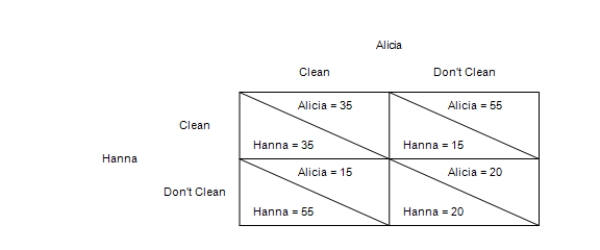
-Refer to Table 17-9. What is Alicia's dominant strategy?
-Refer to Table 17-9. What is Alicia's dominant strategy? (Multiple Choice)
4.9/5 (73)
(73) Figure 17-1
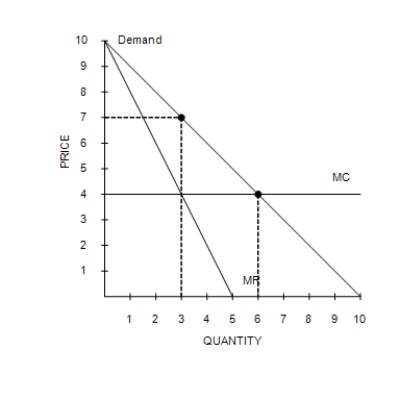 -Refer to Figure 17-1. Suppose this market is served by two firms who each face the marginal cost curve shown in the diagram. The marginal revenue curve that a monopolist would face in this market is also shown. If the firms are able to collude successfully,
 (Multiple Choice)
4.8/5 (91)
(91) The game that oligopolists play in trying to reach the oligopoly outcome is similar to the game that the two prisoners play in the prisoners' dilemma.
(True/False)
4.7/5 (65)
(65) Table 17-4
Only two firms, JKL and XYZ, sell a particular product. The following table shows the demand curve for their product. Each firm has the same constant marginal cost of $8 and zero fixed cost.
Price (Dollars per unit) Quantity Demanded (Units) Total Revenue (Dollars) 28 0 0 26 5 130 24 10 240 22 15 330 20 20 400 18 25 450 16 30 480 14 35 490 12 40 480 10 45 450 8 50 400 6 55 330 4 60 240 2 65 130 0 70 0
-Refer to Table 17-4. If this market were perfectly competitive instead of oligopolistic, what would the price be?
(Multiple Choice)
4.8/5 (68)
(68) Scenario 17-2
Assume that a local telecommunications company sells high speed internet access and cable television. The company's only two customers are Taylor and Tim. Taylor is willing to pay $50 per month for high speed internet access and $50 per month for cable television. Tim is willing to pay only $20 per month for high speed internet access, but is willing to pay $70 per month for cable television. Assume that the telecommunications company can provide each of these products at zero marginal cost.
-Refer to Scenario 17-2. If the telecommunications company is unable to use tying, what is the profit-maximizing price to charge for cable television?
(Short Answer)
4.9/5 (76)
(76) 
Filters
- Essay(0)
- Multiple Choice(0)
- Short Answer(0)
- True False(0)
- Matching(0)