



 Chat with AI
Exam 17: Oligopoly

Exam 1: Ten Principles of Economics220 Questions
Exam 2: Thinking Like an Economist284 Questions
Exam 3: Interdependence and the Gains From Trade192 Questions
Exam 4: The Market Forces of Supply and Demand277 Questions
Exam 5: Elasticity and Its Application222 Questions
Exam 6: Supply, Demand, and Government Policies321 Questions
Exam 7: Consumers, Producers, and the Efficiency of Markets218 Questions
Exam 8: Applications: The Costs of Taxation203 Questions
Exam 9: Application: International Trade214 Questions
Exam 10: Externalities204 Questions
Exam 11: Public Goods and Common Resources182 Questions
Exam 12: The Design of the Tax System225 Questions
Exam 13: The Costs of Production261 Questions
Exam 14: Firms in Competitive Markets243 Questions
Exam 15: Monopoly231 Questions
Exam 16: Monopolistic Competition246 Questions
Exam 17: Oligopoly204 Questions
Exam 18: The Markets for the Factors of Production232 Questions
Exam 19: Earnings and Discrimination230 Questions
Exam 20: Income Inequality and Poverty194 Questions
Exam 21: The Theory of Consumer Choice209 Questions
Exam 22: Frontiers in Microeconomics185 Questions
Exam 23: Measuring a Nations Income231 Questions
Exam 24: Measuring the Cost of Living214 Questions
Exam 25: Production and Growth187 Questions
Exam 26: Saving, Investment, and the Financial System225 Questions
Exam 27: Tools of Finance198 Questions
Exam 28: Unemployment and Its Natural Rate361 Questions
Exam 29: The Monetary System210 Questions
Exam 30: Money Growth and Inflation201 Questions
Exam 31: Open-Economy Macroeconomics: Basic Concepts194 Questions
Exam 32: A Macroeconomic Theory of the Open Economy188 Questions
Exam 33: Aggregate Demand and Aggregate Supply189 Questions
Exam 34: The Influence of Monetary and Fiscal Policy on Aggregate Demand207 Questions
Exam 35: The Short-Run Tradeoff Between Inflation and Unemployment223 Questions
Exam 36: Six Debates Over Macroeconomic Policy154 Questions
Select questions type


If duopoly firms that are not colluding were able to successfully collude, then
(Multiple Choice)
4.8/5  (86)
(86) Suppose three firms form a cartel and agree to charge a specific price for their output. Each individual firm has an incentive to maintain the agreement because the firm's individual profits will be the greatest under the cartel arrangement.
(True/False)
4.8/5 (79)
(79) Table 17-6
Two home-improvement stores (Lopes and HomeMax) in a growing urban area are interested in expanding their market share. Both are interested in expanding the size of their store and parking lot to accommodate potential growth in their customer base. The following game depicts the strategic outcomes that result from the game. Increases in annual profits (in millions of dollars) of the two home-improvement stores are shown in the following figure.
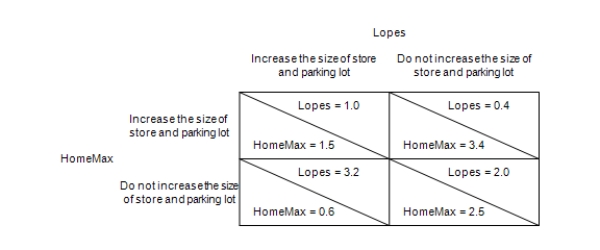 -Refer to Table 17-6. Suppose the owners of Lopes and HomeMax meet for a friendly game of golf one afternoon and happen to discuss a strategy to optimize growth related profit. They should both agree to
 (Multiple Choice)
4.9/5 (77)
(77) Table 17-6
Two home-improvement stores (Lopes and HomeMax) in a growing urban area are interested in expanding their market share. Both are interested in expanding the size of their store and parking lot to accommodate potential growth in their customer base. The following game depicts the strategic outcomes that result from the game. Increases in annual profits (in millions of dollars) of the two home-improvement stores are shown in the following figure.
-Refer to Table 17-6. Pursuing its own best interest, Lopes will
-Refer to Table 17-6. Pursuing its own best interest, Lopes will (Multiple Choice)
4.8/5 (83)
(83) Table 17-10
Imagine a small town in which only two residents, Abby and Brad, own wells that produce safe drinking water. Each week Abby and Brad work together to decide how many gallons of water to pump. They bring water to town and sell it at whatever price the market will bear. To keep things simple, suppose that Abby and Brad can pump as much water as they want without cost so that the marginal cost is zero. The weekly town demand schedule and total revenue schedule for water is shown in the table below:
Quantity (in gallons) Price Total Revenue (and Total Profit) 0 \ 12 \ 0 1 \ 11 \ 11 2 \ 10 \ 20 3 \ 9 \ 27 4 \ 8 \ 32 5 \ 7 \ 35 6 \ 6 \ 36 7 \ 5 \ 35 8 \ 4 \ 32 9 \ 3 \ 27 10 \ 2 \ 20 11 \ 1 \ 11 12 \ 0 \ 0
-Refer to Table 17-10. Discuss the difference between the monopoly outcome and the Nash equilibrium.
(Essay)
4.9/5 (91)
(91) To function as a monopoly, OPEC and other cartels rely on __________ among members.
(Short Answer)
4.9/5 (83)
(83) A manufacturer of light bulbs sells its products to retail stores and requires the stores to sell the bulbs to customers for $2 per bulb. This practice is known as tying.
(True/False)
4.7/5 (68)
(68) Table 17-6
Two home-improvement stores (Lopes and HomeMax) in a growing urban area are interested in expanding their market share. Both are interested in expanding the size of their store and parking lot to accommodate potential growth in their customer base. The following game depicts the strategic outcomes that result from the game. Increases in annual profits (in millions of dollars) of the two home-improvement stores are shown in the following figure.
-Refer to Table 17-6. If both stores follow a dominant strategy, Lopes's annual profit will grow by
-Refer to Table 17-6. If both stores follow a dominant strategy, Lopes's annual profit will grow by (Multiple Choice)
4.9/5 (78)
(78) The decisions of the US and Soviet Union to build nuclear weapons is much like the prisoners' dilemma.
(True/False)
4.9/5 (73)
(73) Table 17-14
Suppose that two oil companies - BP and Exxon - own adjacent natural gas fields. The profits that each firm earns depends on both the number of wells it drills and the number of wells drilled by the other firm. The table below lists each firm's individual profits:
Exxon
Drill one well Drill two wells
 -Refer to Table 17-14. Does Exxon have a dominant strategy? If so, describe it.
 (Essay)
4.9/5 (77)
(77) One way that public policy encourages cooperation among oligopolists is through antitrust law.
(True/False)
4.7/5 (69)
(69) Table 17-10
Imagine a small town in which only two residents, Abby and Brad, own wells that produce safe drinking water. Each week Abby and Brad work together to decide how many gallons of water to pump. They bring water to town and sell it at whatever price the market will bear. To keep things simple, suppose that Abby and Brad can pump as much water as they want without cost so that the marginal cost is zero. The weekly town demand schedule and total revenue schedule for water is shown in the table below:
Quantity (in gallons) Price Total Revenue (and Total Profit) 0 \ 12 \ 0 1 \ 11 \ 11 2 \ 10 \ 20 3 \ 9 \ 27 4 \ 8 \ 32 5 \ 7 \ 35 6 \ 6 \ 36 7 \ 5 \ 35 8 \ 4 \ 32 9 \ 3 \ 27 10 \ 2 \ 20 11 \ 1 \ 11 12 \ 0 \ 0
-Refer to Table 17-10. Briefly explain why each duopolist earns a lower profit at the Nash equilibrium than if they cooperated to produce the monopoly output.
(Essay)
4.8/5 (78)
(78) Two CEOs from different firms in the same market collude to fix the price in the market. This action violates the
(Multiple Choice)
4.9/5 (76)
(76) Any market that is served by an oligopoly is in effect served by a monopoly.
(True/False)
4.8/5 (90)
(90) Table 17-7
Two companies, Wonka and Gekko, each decide whether to produce a good quality product or a poor quality product. In the figure, the dollar amounts are payoffs and they represent annual profits (in millions of dollars) for the two companies.
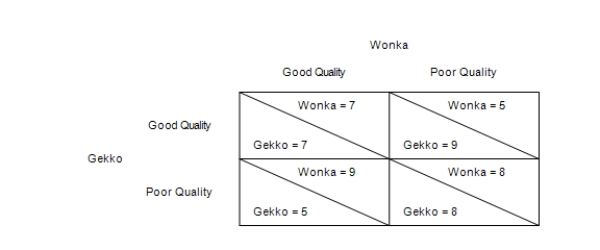 -Refer to Table 17-7. If this game is played only once, then the most likely outcome is that
 (Multiple Choice)
4.9/5 (83)
(83) Table 17-1
Imagine a small town in which only two residents, Sydney and Matthew, own wells that produce safe drinking water. Each week Sydney and Matthew work together to decide how many gallons of water to pump. They bring the water to town and sell it at whatever price the market will bear. To keep things simple, suppose that Sydney and Matthew can pump as much water as they want without cost so that the marginal cost of water equals zero. The town's weekly demand schedule and total revenue schedule for water is shown in the following table:
Quantity (Gallons) Price (Dollars per gallon) Total Revenue and Total Profit (Dollars) 0 48 0 90 44 3,960 180 40 7,200 270 36 9,720 360 32 11,520 450 28 12,600 540 24 12,960 630 20 12,600 720 16 11,520 810 12 9,720 900 8 7,200 990 4 3,960 1,080 0 0
-Refer to Table 17-1. Suppose the town enacts new antitrust laws that prohibit Sydney and Matthew from operating as a monopoly. How many gallons of water will be produced and sold once Sydney and Matthew reach a Nash equilibrium?
(Multiple Choice)
4.8/5 (60)
(60) 
Filters
- Essay(0)
- Multiple Choice(0)
- Short Answer(0)
- True False(0)
- Matching(0)