



 Chat with AI
Exam 17: Oligopoly

Exam 1: Ten Principles of Economics220 Questions
Exam 2: Thinking Like an Economist284 Questions
Exam 3: Interdependence and the Gains From Trade192 Questions
Exam 4: The Market Forces of Supply and Demand277 Questions
Exam 5: Elasticity and Its Application222 Questions
Exam 6: Supply, Demand, and Government Policies321 Questions
Exam 7: Consumers, Producers, and the Efficiency of Markets218 Questions
Exam 8: Applications: The Costs of Taxation203 Questions
Exam 9: Application: International Trade214 Questions
Exam 10: Externalities204 Questions
Exam 11: Public Goods and Common Resources182 Questions
Exam 12: The Design of the Tax System225 Questions
Exam 13: The Costs of Production261 Questions
Exam 14: Firms in Competitive Markets243 Questions
Exam 15: Monopoly231 Questions
Exam 16: Monopolistic Competition246 Questions
Exam 17: Oligopoly204 Questions
Exam 18: The Markets for the Factors of Production232 Questions
Exam 19: Earnings and Discrimination230 Questions
Exam 20: Income Inequality and Poverty194 Questions
Exam 21: The Theory of Consumer Choice209 Questions
Exam 22: Frontiers in Microeconomics185 Questions
Exam 23: Measuring a Nations Income231 Questions
Exam 24: Measuring the Cost of Living214 Questions
Exam 25: Production and Growth187 Questions
Exam 26: Saving, Investment, and the Financial System225 Questions
Exam 27: Tools of Finance198 Questions
Exam 28: Unemployment and Its Natural Rate361 Questions
Exam 29: The Monetary System210 Questions
Exam 30: Money Growth and Inflation201 Questions
Exam 31: Open-Economy Macroeconomics: Basic Concepts194 Questions
Exam 32: A Macroeconomic Theory of the Open Economy188 Questions
Exam 33: Aggregate Demand and Aggregate Supply189 Questions
Exam 34: The Influence of Monetary and Fiscal Policy on Aggregate Demand207 Questions
Exam 35: The Short-Run Tradeoff Between Inflation and Unemployment223 Questions
Exam 36: Six Debates Over Macroeconomic Policy154 Questions
Select questions type


Table 17-4
Only two firms, JKL and XYZ, sell a particular product. The following table shows the demand curve for their product. Each firm has the same constant marginal cost of $8 and zero fixed cost.
Price (Dollars per unit) Quantity Demanded (Units) Total Revenue (Dollars) 28 0 0 26 5 130 24 10 240 22 15 330 20 20 400 18 25 450 16 30 480 14 35 490 12 40 480 10 45 450 8 50 400 6 55 330 4 60 240 2 65 130 0 70 0
-Refer to Table 17-4. If JKL and XYZ operate to jointly maximize profits, then what quantity is sold?
(Multiple Choice)
4.7/5  (86)
(86) Table 17-1
Imagine a small town in which only two residents, Sydney and Matthew, own wells that produce safe drinking water. Each week Sydney and Matthew work together to decide how many gallons of water to pump. They bring the water to town and sell it at whatever price the market will bear. To keep things simple, suppose that Sydney and Matthew can pump as much water as they want without cost so that the marginal cost of water equals zero. The town's weekly demand schedule and total revenue schedule for water is shown in the following table:
Quantity (Gallons) Price (Dollars per gallon) Total Revenue and Total Profit (Dollars) 0 48 0 90 44 3,960 180 40 7,200 270 36 9,720 360 32 11,520 450 28 12,600 540 24 12,960 630 20 12,600 720 16 11,520 810 12 9,720 900 8 7,200 990 4 3,960 1,080 0 0
-Refer to Table 17-1. If Sydney and Matthew operate as a profit-maximizing monopoly in the market for water, how many gallons of water will be produced and sold?
(Multiple Choice)
4.8/5 (78)
(78) If the output effect from increased production is larger than the price effect, then an oligopolist would increase production.
(True/False)
4.8/5 (78)
(78) Suppose that Ngoc and Kalene are duopolists. Ngoc is producing 580 units of output, and Kalene is producing 880 units of output. When Kalene produces 880 units, Ngoc maximizes profit by producing 580 units. When Ngoc produces 580 units of output, Kalene maximizes profit by producing 880 units. Ngoc and Kalene are
(Multiple Choice)
4.9/5 (65)
(65) Table 17-4
Only two firms, JKL and XYZ, sell a particular product. The following table shows the demand curve for their product. Each firm has the same constant marginal cost of $8 and zero fixed cost.
Price (Dollars per unit) Quantity Demanded (Units) Total Revenue (Dollars) 28 0 0 26 5 130 24 10 240 22 15 330 20 20 400 18 25 450 16 30 480 14 35 490 12 40 480 10 45 450 8 50 400 6 55 330 4 60 240 2 65 130 0 70 0
-Refer to Table 17-4. JKL and XYZ agree to jointly maximize profits. If JKL and XYZ each break the agreement and each produce 5 more than agreed upon, how much less profit does each make, compared to the profit at the cartel output?
(Multiple Choice)
4.8/5 (72)
(72) In which of the following markets are strategic interactions among firms most likely to occur?
(Multiple Choice)
4.8/5 (73)
(73) Before the __________, agreements between oligopolists were unenforceable contracts; afterwards, such agreements were criminal conspiracies.
(Short Answer)
4.8/5 (89)
(89) A dominant strategy exists for at least one player in every game.
(True/False)
4.9/5 (85)
(85) Whether an oligopoly consists of 3 firms or 10 firms, the level of output likely will be the same.
(True/False)
4.8/5 (83)
(83) A dominant strategy is a strategy that is best for a player in a game regardless of the strategies chosen by the other players.
(True/False)
4.8/5 (94)
(94) In the case of oligopolistic markets, self-interest makes cooperation difficult and it often leads to an undesirable outcome for the firms that are involved.
(True/False)
4.9/5 (77)
(77) Policymakers should be aggressive in using their powers to place limits on firm behavior, because business practices that appear to reduce competition never have any legitimate purposes.
(True/False)
4.9/5 (79)
(79) The manufacturer of South Face sells jackets to retail stores for $105 each, and it requires the retail stores to charge customers $135 per jacket. Any retailer that charges less than $135 would violate its contract with South Face. What do economists call this business practice?
(Multiple Choice)
4.7/5 (93)
(93) Describe the output and price effects that influence the profit-maximizing decision faced by a firm in an oligopoly market. How does this differ from output and price effects in a monopoly market?
(Essay)
4.9/5 (68)
(68) Which of the following examples illustrates an oligopoly market?
(Multiple Choice)
4.7/5 (80)
(80) A Nash Equilibrium always results in the highest total profit for the firms in an oligopoly market.
(True/False)
4.8/5 (72)
(72) Table 17-3
The table shows the demand schedule for a particular product.
Quantity Demanded (Units) Price (Dollars per unit) 0 16 1 14 2 12 3 10 4 8 5 6 6 4 7 2 8 0
-Refer to Table 17-3. Suppose the market for this product is served by two firms that have formed a cartel. What price will the cartel charge in this market if the marginal cost of production is $4?
(Multiple Choice)
4.9/5 (72)
(72) Table 17-1
Imagine a small town in which only two residents, Sydney and Matthew, own wells that produce safe drinking water. Each week Sydney and Matthew work together to decide how many gallons of water to pump. They bring the water to town and sell it at whatever price the market will bear. To keep things simple, suppose that Sydney and Matthew can pump as much water as they want without cost so that the marginal cost of water equals zero. The town's weekly demand schedule and total revenue schedule for water is shown in the following table:
Quantity (Gallons) Price (Dollars per gallon) Total Revenue and Total Profit (Dollars) 0 48 0 90 44 3,960 180 40 7,200 270 36 9,720 360 32 11,520 450 28 12,600 540 24 12,960 630 20 12,600 720 16 11,520 810 12 9,720 900 8 7,200 990 4 3,960 1,080 0 0
-Refer to Table 17-1. If the market for water were perfectly competitive instead of monopolistic, how many gallons of water would be produced and sold?
(Multiple Choice)
4.8/5 (84)
(84) Table 17-9
Hanna and Alicia are two college roommates who both prefer a clean common space in their dorm room, but neither enjoys cleaning. The roommates must each make a decision to either clean or not clean the dorm room's common space. The following table shows the payoffs for this situation, where the higher a player's payoff number, the better off that player is.
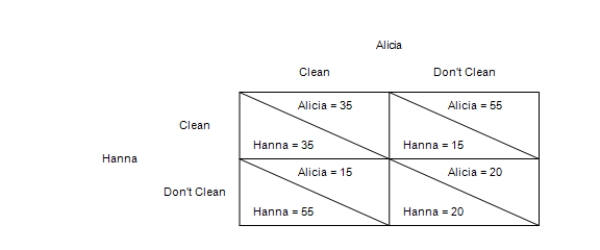
-Refer to Table 17-9. If Alicia chooses not to clean, then Hanna will
-Refer to Table 17-9. If Alicia chooses not to clean, then Hanna will (Multiple Choice)
4.8/5 (78)
(78) In the prisoners' dilemma game, one prisoner is always better off confessing, no matter what the other prisoner does.
(True/False)
4.9/5 (87)
(87) 
Filters
- Essay(0)
- Multiple Choice(0)
- Short Answer(0)
- True False(0)
- Matching(0)