Multiple Choice
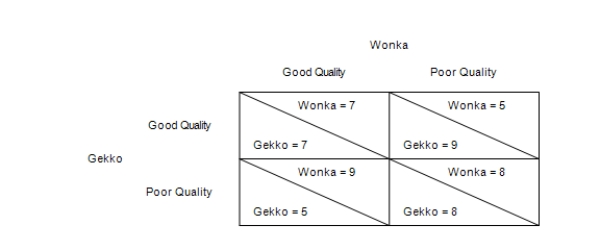
Table 17-7
Two companies, Wonka and Gekko, each decide whether to produce a good quality product or a poor quality product. In the figure, the dollar amounts are payoffs and they represent annual profits (in millions of dollars) for the two companies.
-Juan Pablo and Zak are competitors in a local market. Each is trying to decide if it is better to advertise on TV, on radio, or not at all. If they both advertise on TV, each will earn a profit of $8,000. If they both advertise on radio, each will earn a profit of $14,000. If neither advertises at all, each will earn a profit of $20,000. If one advertises on TV and other advertises on radio, then the one advertising on TV will earn $12,000 and the other will earn $10,000. If one advertises on TV and the other does not advertise, then the one advertising on TV will earn $22,000 and the other will earn $4,000. If one advertises on radio and the other does not advertise, then the one advertising on radio will earn $24,000 and the other will earn $8,000. If both follow their dominant strategy, then Juan Pablo will
A) advertise on TV and earn $8,000.
B) advertise on radio and earn $14,000.
C) advertise on TV and earn $22,000.
D) not advertise and earn $20,000.
Correct Answer:

Verified
Correct Answer:
Verified
Q163: Table 17-15<br>Suppose that two coal mining companies
Q164: Table 17-4<br>Only two firms, JKL and
Q165: Table 17-2<br>The information in the following
Q166: Explain how the output effect and the
Q167: Reaching and enforcing an agreement between members
Q169: Table 17-2<br>The information in the following
Q170: Table 17-1<br>Imagine a small town in
Q171: Table 17-1<br>Imagine a small town in
Q172: Even when allowed to collude, firms in
Q173: Table 17-6<br>Two home-improvement stores (Lopes and HomeMax)