Multiple Choice
Table 17-6
Two home-improvement stores (Lopes and HomeMax) in a growing urban area are interested in expanding their market share. Both are interested in expanding the size of their store and parking lot to accommodate potential growth in their customer base. The following game depicts the strategic outcomes that result from the game. Increases in annual profits (in millions of dollars) of the two home-improvement stores are shown in the following figure.
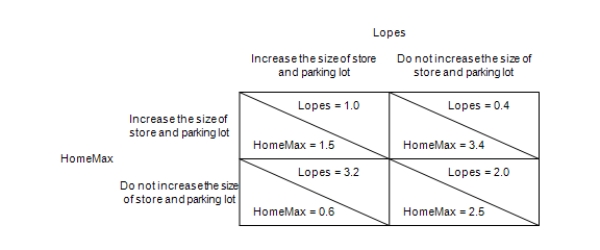
-Refer to Table 17-6. When this game reaches a Nash equilibrium, annual profit will grow by
A) $1.5 million for HomeMax and by $1.0 million for Lopes.
B) $3.4 million for HomeMax and by $0.4 million for Lopes.
C) $0.6 million for HomeMax and by $3.2 million for Lopes.
D) $2.5 million for HomeMax and by $2.0 million for Lopes.
Correct Answer:

Verified
Correct Answer:
Verified
Q168: Table 17-7<br>Two companies, Wonka and Gekko, each
Q169: Table 17-2<br>The information in the following
Q170: Table 17-1<br>Imagine a small town in
Q171: Table 17-1<br>Imagine a small town in
Q172: Even when allowed to collude, firms in
Q174: Table 17-15<br>Suppose that two coal mining companies
Q175: Table 17-7<br>Two companies, Wonka and Gekko, each
Q176: Economists use game theory to analyze _.
Q177: Suppose a market is initially perfectly competitive
Q178: Table 17-7<br>Two companies, Wonka and Gekko, each