



 Chat with AI
Exam 19: Earnings and Discrimination

Exam 1: Ten Principles of Economics220 Questions
Exam 2: Thinking Like an Economist284 Questions
Exam 3: Interdependence and the Gains From Trade192 Questions
Exam 4: The Market Forces of Supply and Demand277 Questions
Exam 5: Elasticity and Its Application222 Questions
Exam 6: Supply, Demand, and Government Policies321 Questions
Exam 7: Consumers, Producers, and the Efficiency of Markets218 Questions
Exam 8: Applications: The Costs of Taxation203 Questions
Exam 9: Application: International Trade214 Questions
Exam 10: Externalities204 Questions
Exam 11: Public Goods and Common Resources182 Questions
Exam 12: The Design of the Tax System225 Questions
Exam 13: The Costs of Production261 Questions
Exam 14: Firms in Competitive Markets243 Questions
Exam 15: Monopoly231 Questions
Exam 16: Monopolistic Competition246 Questions
Exam 17: Oligopoly204 Questions
Exam 18: The Markets for the Factors of Production232 Questions
Exam 19: Earnings and Discrimination230 Questions
Exam 20: Income Inequality and Poverty194 Questions
Exam 21: The Theory of Consumer Choice209 Questions
Exam 22: Frontiers in Microeconomics185 Questions
Exam 23: Measuring a Nations Income231 Questions
Exam 24: Measuring the Cost of Living214 Questions
Exam 25: Production and Growth187 Questions
Exam 26: Saving, Investment, and the Financial System225 Questions
Exam 27: Tools of Finance198 Questions
Exam 28: Unemployment and Its Natural Rate361 Questions
Exam 29: The Monetary System210 Questions
Exam 30: Money Growth and Inflation201 Questions
Exam 31: Open-Economy Macroeconomics: Basic Concepts194 Questions
Exam 32: A Macroeconomic Theory of the Open Economy188 Questions
Exam 33: Aggregate Demand and Aggregate Supply189 Questions
Exam 34: The Influence of Monetary and Fiscal Policy on Aggregate Demand207 Questions
Exam 35: The Short-Run Tradeoff Between Inflation and Unemployment223 Questions
Exam 36: Six Debates Over Macroeconomic Policy154 Questions
Select questions type


Figure 19-7

-Refer to Figure 19-7. Given demand, D1, and supply, S1, what is the quantity of labor demanded if a minimum wage of $8 per hour is imposed on this market?
-Refer to Figure 19-7. Given demand, D1, and supply, S1, what is the quantity of labor demanded if a minimum wage of $8 per hour is imposed on this market? (Short Answer)
5.0/5  (86)
(86) Discrimination is a reflection of some people's prejudice against certain groups in society.
(True/False)
4.9/5 (63)
(63) Which of the following could explain the changing gap in income between unskilled and skilled workers in the United States?
(Multiple Choice)
4.9/5 (70)
(70) Figure 19-5  -Refer to Figure 19-5. Given demand for labor, D1, and supply of labor, S1, what is the surplus of labor if a minimum wage of $8 per hour is imposed on this market?
 (Multiple Choice)
4.9/5 (85)
(85) Differences in human capital among groups of workers is possibly a reflection of past discrimination.
(True/False)
4.9/5 (69)
(69) Discrimination is an emotionally charged issue that is impossible to study objectively.
(True/False)
4.8/5 (80)
(80) Name two occupations that have the two characteristics required for the superstar phenomenon.
(Short Answer)
4.7/5 (86)
(86) According to research by Bertrand and Mullainathan, which job applicants, those with "white" names or those with "black" names, received more calls from interested employers? What percent more?
(Essay)
4.9/5 (72)
(72) Over the past 30 years, the number of jobs in the United States requiring skilled labor has been declining as foreign countries steal these jobs away from the U.S. As a result, the domestic demand for skilled labor has been falling and the wage gap between skilled and unskilled labor has been narrowing.
(True/False)
4.9/5 (67)
(67) Evaluate the following statement: "The gender pay gap provides evidence of widespread, severe, ongoing discrimination by employers and fellow workers."
(Essay)
4.9/5 (79)
(79) Figure 19-2 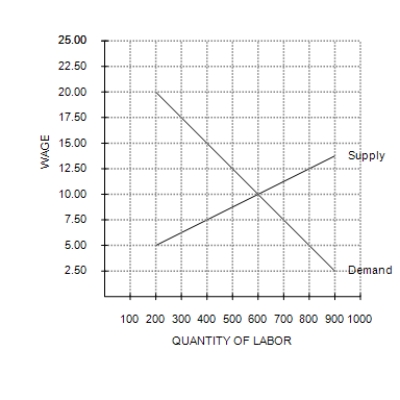 -Refer to Figure 19-2. This figure depicts labor demand and supply in a nonunionized labor market. The original equilibrium is at $10. If a labor union subsequently establishes a union shop and negotiates an hourly wage of $12.50, then employment is
 (Multiple Choice)
4.9/5 (70)
(70) Evidence of differences in average wages of women compared to men
(Multiple Choice)
4.8/5 (85)
(85) The signaling theory of education maintains that workers who complete specific levels of education signal their high productivity to potential employers.
(True/False)
4.8/5 (84)
(84) Most economists believe that the higher average salaries earned by men in comparison to women arise from
(Multiple Choice)
4.8/5 (84)
(84) On average professors of finance earn more than professors of economics. Other things the same, what does this imply about the supply of each type of professor?
(Essay)
4.8/5 (76)
(76) Job A is hard, dull, and dangerous. Job B is easy, fun, and safe. All else equal, we would expect Job A to pay
(Multiple Choice)
4.9/5 (80)
(80) Among female workers over age 25, about what percent has a college degree? What is this percentage for black female workers over age 25?
(Short Answer)
4.8/5 (86)
(86) Scenario 19-7
Suppose that in the competitive market for auto repair, firms prefer to hire men rather than women. Assume that the women applying for positions have the same skills, experience, and work ethic as the men. As a result of this discrimination, the demand for women is lower than it otherwise would be.
-Refer to Scenario 19-7. What conclusion can you draw about women's wages compared to men's wages in this industry?
(Short Answer)
4.8/5 (69)
(69) What is the term for offering different opportunities to similar individuals who differ only by race, ethnic group, sex, age, or other personal characteristics?
(Short Answer)
4.9/5 (69)
(69) 
Filters
- Essay(0)
- Multiple Choice(0)
- Short Answer(0)
- True False(0)
- Matching(0)