



 Chat with AI
Exam 19: Earnings and Discrimination

Exam 1: Ten Principles of Economics220 Questions
Exam 2: Thinking Like an Economist284 Questions
Exam 3: Interdependence and the Gains From Trade192 Questions
Exam 4: The Market Forces of Supply and Demand277 Questions
Exam 5: Elasticity and Its Application222 Questions
Exam 6: Supply, Demand, and Government Policies321 Questions
Exam 7: Consumers, Producers, and the Efficiency of Markets218 Questions
Exam 8: Applications: The Costs of Taxation203 Questions
Exam 9: Application: International Trade214 Questions
Exam 10: Externalities204 Questions
Exam 11: Public Goods and Common Resources182 Questions
Exam 12: The Design of the Tax System225 Questions
Exam 13: The Costs of Production261 Questions
Exam 14: Firms in Competitive Markets243 Questions
Exam 15: Monopoly231 Questions
Exam 16: Monopolistic Competition246 Questions
Exam 17: Oligopoly204 Questions
Exam 18: The Markets for the Factors of Production232 Questions
Exam 19: Earnings and Discrimination230 Questions
Exam 20: Income Inequality and Poverty194 Questions
Exam 21: The Theory of Consumer Choice209 Questions
Exam 22: Frontiers in Microeconomics185 Questions
Exam 23: Measuring a Nations Income231 Questions
Exam 24: Measuring the Cost of Living214 Questions
Exam 25: Production and Growth187 Questions
Exam 26: Saving, Investment, and the Financial System225 Questions
Exam 27: Tools of Finance198 Questions
Exam 28: Unemployment and Its Natural Rate361 Questions
Exam 29: The Monetary System210 Questions
Exam 30: Money Growth and Inflation201 Questions
Exam 31: Open-Economy Macroeconomics: Basic Concepts194 Questions
Exam 32: A Macroeconomic Theory of the Open Economy188 Questions
Exam 33: Aggregate Demand and Aggregate Supply189 Questions
Exam 34: The Influence of Monetary and Fiscal Policy on Aggregate Demand207 Questions
Exam 35: The Short-Run Tradeoff Between Inflation and Unemployment223 Questions
Exam 36: Six Debates Over Macroeconomic Policy154 Questions
Select questions type


Which of the following is an example of labor-market discrimination? You may assume that worker A and worker B have identical characteristics except for the ones listed. A firm offers a higher salary to worker A than worker B because worker A
(Multiple Choice)
4.8/5  (75)
(75) Explain the role that consumers play in perpetuating discrimination in labor markets.
(Essay)
4.9/5 (75)
(75) It is likely that efficiency wages will decrease employee effort.
(True/False)
4.9/5 (78)
(78) Explain the theory that education acts as a signaling device. How does this contrast with the theory of education as an investment in human capital?
(Essay)
4.9/5 (84)
(84) If we find that some schools direct females away from science and math courses, we have evidence of
(Multiple Choice)
4.7/5 (69)
(69) A recent law school graduate is considering two offers to practice law, one in Louisiana and the other in Nebraska. The Louisiana bar exam is very difficult to pass compared with Nebraska's exam. Assuming all other things equal, the attorney would expect
(Multiple Choice)
4.7/5 (71)
(71) The differences in the desirability of different jobs within a company could give rise to a compensating differential between workers.
(True/False)
4.8/5 (76)
(76) If government regulations make a certain job less dangerous, then we'd expect that the supply of labor for that job would
(Multiple Choice)
4.7/5 (78)
(78) Is measuring the effect of discrimination on wages relatively easy or relatively difficult? Explain?
(Essay)
4.9/5 (76)
(76) Which of the following represents an example of labor-market discrimination?
(Multiple Choice)
4.8/5 (92)
(92) One example of labor-market discrimination is that a firm may be less likely to interview a job candidate whose resume clearly indicates he is not a good fit for the job.
(True/False)
4.8/5 (81)
(81) Maria has just graduated from Princeton University and has applied for a job at a major bank. The bank decides to offer Maria a job because they perceive her degree from Princeton to be an indication of her high-ability. To which of the following views of education does the bank subscribe?
(Multiple Choice)
4.8/5 (82)
(82) Economists who attempt to explain the increasing earnings gap between skilled and unskilled workers offer two main hypotheses:
(Multiple Choice)
4.9/5 (66)
(66) Figure 19-2 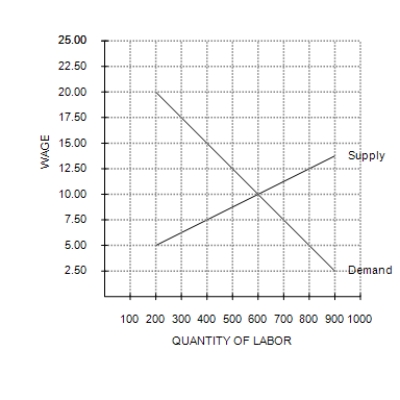 -Refer to Figure 19-2. This figure depicts labor demand and supply in a nonunionized labor market. The original equilibrium wage is $10. If a labor union subsequently establishes a union shop and negotiates an hourly wage of $12.50, then there will be an excess
 (Multiple Choice)
5.0/5 (84)
(84) As a result of an increase in the earnings gap between skilled and unskilled jobs, the incentive to get a college education has been declining.
(True/False)
4.8/5 (88)
(88) A compensating differential is a difference in wages due to higher levels of education or other forms of human capital.
(True/False)
4.9/5 (80)
(80) Some economists suggest that increased international trade with countries that have a greater proportion of unskilled workers has led to an expanding wage gap between high-skill and low-skill workers in the United States.
(True/False)
4.9/5 (79)
(79) Which of the following examples best describes the signaling theory of education?
(Multiple Choice)
4.8/5 (73)
(73) 
Filters
- Essay(0)
- Multiple Choice(0)
- Short Answer(0)
- True False(0)
- Matching(0)