



 Chat with AI
Exam 19: Earnings and Discrimination

Exam 1: Ten Principles of Economics220 Questions
Exam 2: Thinking Like an Economist284 Questions
Exam 3: Interdependence and the Gains From Trade192 Questions
Exam 4: The Market Forces of Supply and Demand277 Questions
Exam 5: Elasticity and Its Application222 Questions
Exam 6: Supply, Demand, and Government Policies321 Questions
Exam 7: Consumers, Producers, and the Efficiency of Markets218 Questions
Exam 8: Applications: The Costs of Taxation203 Questions
Exam 9: Application: International Trade214 Questions
Exam 10: Externalities204 Questions
Exam 11: Public Goods and Common Resources182 Questions
Exam 12: The Design of the Tax System225 Questions
Exam 13: The Costs of Production261 Questions
Exam 14: Firms in Competitive Markets243 Questions
Exam 15: Monopoly231 Questions
Exam 16: Monopolistic Competition246 Questions
Exam 17: Oligopoly204 Questions
Exam 18: The Markets for the Factors of Production232 Questions
Exam 19: Earnings and Discrimination230 Questions
Exam 20: Income Inequality and Poverty194 Questions
Exam 21: The Theory of Consumer Choice209 Questions
Exam 22: Frontiers in Microeconomics185 Questions
Exam 23: Measuring a Nations Income231 Questions
Exam 24: Measuring the Cost of Living214 Questions
Exam 25: Production and Growth187 Questions
Exam 26: Saving, Investment, and the Financial System225 Questions
Exam 27: Tools of Finance198 Questions
Exam 28: Unemployment and Its Natural Rate361 Questions
Exam 29: The Monetary System210 Questions
Exam 30: Money Growth and Inflation201 Questions
Exam 31: Open-Economy Macroeconomics: Basic Concepts194 Questions
Exam 32: A Macroeconomic Theory of the Open Economy188 Questions
Exam 33: Aggregate Demand and Aggregate Supply189 Questions
Exam 34: The Influence of Monetary and Fiscal Policy on Aggregate Demand207 Questions
Exam 35: The Short-Run Tradeoff Between Inflation and Unemployment223 Questions
Exam 36: Six Debates Over Macroeconomic Policy154 Questions
Select questions type


List the productivity factors that may explain the differences in pay between men and women in similar occupations. Do any of these factors arise as a result of cultural or social traditions? If so, describe how changes in social relationships will affect the pay gap over time.
(Essay)
4.8/5  (74)
(74) After graduating from college, you receive job offers from five different accounting firms. All job offers have a different compensation package. Is it irrational for you to accept an offer that doesn't provide the highest level of monetary compensation? Use the concept of compensating differentials to explain your answer.
(Essay)
4.9/5 (88)
(88) Many studies of wage discrimination have been conducted on professional sports teams. This industry is easier to study than others because the professional teams have many objective measures of
(Short Answer)
4.9/5 (82)
(82) Scenario 19-6
The after-school tutoring industry is competitive, and so is the labor market for after-school tutors. Suppose male and female tutors have equal experience and skill. Currently, some tutoring centers are biased and will only hire male tutors, whereas unbiased tutoring centers desire to hire the cheapest tutors and do not care about their genders. As a result, the equilibrium wage for male tutors is higher than that of female tutors.
-Refer to Scenario 19-6. If some families strongly prefer their children to be tutored by male tutors, then
(Multiple Choice)
4.9/5 (87)
(87) Superstars arise in markets in which every customer in the market is able to enjoy the good supplied by the
(Short Answer)
4.8/5 (77)
(77) Which of the following scenarios would serve to decrease the demand for unskilled labor in the United States?
(Multiple Choice)
4.9/5 (71)
(71) Which of the following comparisons best illustrates a compensating differential?
(Multiple Choice)
4.8/5 (81)
(81) Artie and Angelina attended the same university, graduated with the same degree and grade point average, and are equally productive in their identical new jobs. Still, Angelina's salary is 10% lower than Artie's salary. One can conclude that Angelina likely suffers from
(Short Answer)
4.8/5 (90)
(90) Labor-market discrimination based solely on age is illegal in the United States.
(True/False)
4.7/5 (88)
(88) Figure 19-6 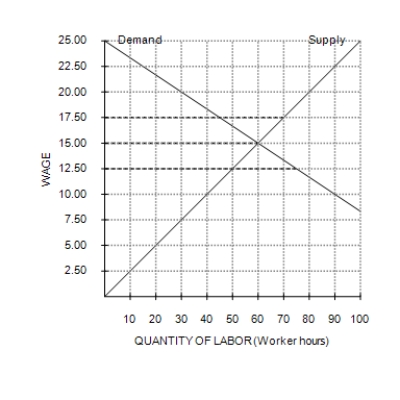 -Refer to Figure 19-6. This figure depicts labor demand and supply for the widget industry. The equilibrium market wage is $15. Suppose a labor union forms and subsequently negotiates an hourly wage of $17.50. Which of the following statements about the impact of the union's formation on labor hours demanded is true?
 (Multiple Choice)
4.8/5 (79)
(79) Assume men, on balance, have lower amounts of human capital than women have. Then we would expect the
(Multiple Choice)
5.0/5 (81)
(81) Consumers are often a primary source of discrimination in labor markets.
(True/False)
4.9/5 (72)
(72) People who grew up in the western part of Aquilonia have an accent distinct from people who grew up in the eastern part of the country. People from the west also receive lower wages than people from the east. From this information alone, which of the following is not a possible explanation for this wage differential?
(Multiple Choice)
4.9/5 (98)
(98) Daryn earns a higher salary than his friend Nick because Daryn is willing to work on the loading dock, whereas Nick prefers to work in an air-conditioned office. The difference in salary could illustrate a compensating differential.
(True/False)
4.8/5 (74)
(74) A recent study of the determinants of wages for clerical staff at a state university found that years of schooling, years of experience, age and job characteristics only explained about one-half of the difference in wages. Describe other factors that may be important in explaining wages differences for clerical staff.
(Essay)
4.7/5 (72)
(72) 
Filters
- Essay(0)
- Multiple Choice(0)
- Short Answer(0)
- True False(0)
- Matching(0)