



 Chat with AI
Exam 19: Earnings and Discrimination

Exam 1: Ten Principles of Economics220 Questions
Exam 2: Thinking Like an Economist284 Questions
Exam 3: Interdependence and the Gains From Trade192 Questions
Exam 4: The Market Forces of Supply and Demand277 Questions
Exam 5: Elasticity and Its Application222 Questions
Exam 6: Supply, Demand, and Government Policies321 Questions
Exam 7: Consumers, Producers, and the Efficiency of Markets218 Questions
Exam 8: Applications: The Costs of Taxation203 Questions
Exam 9: Application: International Trade214 Questions
Exam 10: Externalities204 Questions
Exam 11: Public Goods and Common Resources182 Questions
Exam 12: The Design of the Tax System225 Questions
Exam 13: The Costs of Production261 Questions
Exam 14: Firms in Competitive Markets243 Questions
Exam 15: Monopoly231 Questions
Exam 16: Monopolistic Competition246 Questions
Exam 17: Oligopoly204 Questions
Exam 18: The Markets for the Factors of Production232 Questions
Exam 19: Earnings and Discrimination230 Questions
Exam 20: Income Inequality and Poverty194 Questions
Exam 21: The Theory of Consumer Choice209 Questions
Exam 22: Frontiers in Microeconomics185 Questions
Exam 23: Measuring a Nations Income231 Questions
Exam 24: Measuring the Cost of Living214 Questions
Exam 25: Production and Growth187 Questions
Exam 26: Saving, Investment, and the Financial System225 Questions
Exam 27: Tools of Finance198 Questions
Exam 28: Unemployment and Its Natural Rate361 Questions
Exam 29: The Monetary System210 Questions
Exam 30: Money Growth and Inflation201 Questions
Exam 31: Open-Economy Macroeconomics: Basic Concepts194 Questions
Exam 32: A Macroeconomic Theory of the Open Economy188 Questions
Exam 33: Aggregate Demand and Aggregate Supply189 Questions
Exam 34: The Influence of Monetary and Fiscal Policy on Aggregate Demand207 Questions
Exam 35: The Short-Run Tradeoff Between Inflation and Unemployment223 Questions
Exam 36: Six Debates Over Macroeconomic Policy154 Questions
Select questions type


If there is systematic discrimination against a group of workers, then the wage paid to those workers likely will be
(Multiple Choice)
4.9/5  (80)
(80) Which of the following is an example of a compensating differential?
(Multiple Choice)
4.9/5 (86)
(86) When comparing average wages for black and white men in the United States, wages paid to black men have been about 20 percent less than those paid to white men.
(True/False)
4.8/5 (68)
(68) The theory of education that states firms use educational attainment as a way of sorting between high-ability and low-ability workers is called
(Short Answer)
4.8/5 (82)
(82) Figure 19-8
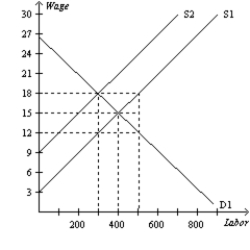
-Refer to Figure 19-8. The figure shows labor demand and labor supply in a non-unionized labor market. If the current labor demand is D1 and the current labor supply is S1, what is the equilibrium wage and quantity of labor?
-Refer to Figure 19-8. The figure shows labor demand and labor supply in a non-unionized labor market. If the current labor demand is D1 and the current labor supply is S1, what is the equilibrium wage and quantity of labor? (Short Answer)
4.9/5 (75)
(75) If an older worker earns less than a younger worker for the same job, we have proof of age discrimination.
(True/False)
5.0/5 (84)
(84) Many economists believe that competitive, market economies provide a natural antidote to employer discrimination known as the
(Short Answer)
4.8/5 (79)
(79) One reason why better-looking workers may have higher earnings is that physical attractiveness may enhance a worker's productivity for certain jobs, especially for those workers who deal with the public.
(True/False)
4.9/5 (84)
(84) Scenario 19-7
Suppose that in the competitive market for auto repair, firms prefer to hire men rather than women. Assume that the women applying for positions have the same skills, experience, and work ethic as the men. As a result of this discrimination, the demand for women is lower than it otherwise would be.
-Refer to Scenario 19-7. If the firms in this market are profit-maximizers and customers do not care if a woman or a man works on their car, what will likely happen?
(Essay)
4.8/5 (78)
(78) Table 19-1
Men High school, no college \ 48,720 \4 6,038 College graduates \ 69,146 \ 80,508 Percent extra for college grads +42\% +75\% Women High school, no college \ 28,006 \ 32,249 College graduates \ 37,804 \ 58,229 Percent extra for college grads +35\% +81\% Source: US Census Bureau and Mankiw's calculations
-Refer to Table 19-1. What conclusion can you draw about the changes in the gaps in earnings between skilled and unskilled workers between 1975 and 2011?
(Essay)
4.9/5 (77)
(77) Unions are often able to sustain wages above the equilibrium wage because they can threaten to
(Short Answer)
4.8/5 (80)
(80) In a labor market free from discrimination, wages for workers that are employed by the same company will still differ.
(True/False)
4.9/5 (79)
(79) Experimental evidence indicates women choose less competitive environments than men.
(True/False)
4.8/5 (75)
(75) Wages of doctors tend to be higher than wages of dental hygienists. Which of the following is not a compensating differential explaining the difference in wages?
(Multiple Choice)
4.7/5 (73)
(73) Scenario 19-1
Ferris B., a student at a community college, is considering what he should do for summer employment. Two recruiters show up at his school in search of summer workers. Recruiter A is looking for lifeguards to patrol the beach at an exclusive island resort in the Caribbean. Recruiter B is looking for workers to staff positions at a summer youth camp.
-Refer to Scenario 19-1. Ferris is carefully considering the options that each recruiter presents. On the basis of knowledge obtained in his economics class, Ferris concludes that
(Multiple Choice)
4.8/5 (64)
(64) Chloe and Adrian went to trade school at the same time. Each graduated with an associate's degree. They have received similar performance evaluations. Adrian's employer is not a good business manager, and the sales manager lost a major deal. Because of the decrease in profits, the employees did not receive raises last year. Chloe's employer is a savvy business manager and the sales manager is experienced and works hard. If Chloe has higher earnings than Adrian, the difference is most likely a function of
(Multiple Choice)
4.8/5 (93)
(93) A manager of a small firm who believes in the signaling theory of education would encourage her employees to obtain additional education to raise their on-the-job productivity.
(True/False)
4.9/5 (88)
(88) Most of the time, a profit motive eliminates discriminatory behavior from a market; however, a discriminatory wage gap can persist even if the firm owners only care about profit if there is
(Short Answer)
4.9/5 (66)
(66) 
Filters
- Essay(0)
- Multiple Choice(0)
- Short Answer(0)
- True False(0)
- Matching(0)