



 Chat with AI
Exam 19: Earnings and Discrimination

Exam 1: Ten Principles of Economics220 Questions
Exam 2: Thinking Like an Economist284 Questions
Exam 3: Interdependence and the Gains From Trade192 Questions
Exam 4: The Market Forces of Supply and Demand277 Questions
Exam 5: Elasticity and Its Application222 Questions
Exam 6: Supply, Demand, and Government Policies321 Questions
Exam 7: Consumers, Producers, and the Efficiency of Markets218 Questions
Exam 8: Applications: The Costs of Taxation203 Questions
Exam 9: Application: International Trade214 Questions
Exam 10: Externalities204 Questions
Exam 11: Public Goods and Common Resources182 Questions
Exam 12: The Design of the Tax System225 Questions
Exam 13: The Costs of Production261 Questions
Exam 14: Firms in Competitive Markets243 Questions
Exam 15: Monopoly231 Questions
Exam 16: Monopolistic Competition246 Questions
Exam 17: Oligopoly204 Questions
Exam 18: The Markets for the Factors of Production232 Questions
Exam 19: Earnings and Discrimination230 Questions
Exam 20: Income Inequality and Poverty194 Questions
Exam 21: The Theory of Consumer Choice209 Questions
Exam 22: Frontiers in Microeconomics185 Questions
Exam 23: Measuring a Nations Income231 Questions
Exam 24: Measuring the Cost of Living214 Questions
Exam 25: Production and Growth187 Questions
Exam 26: Saving, Investment, and the Financial System225 Questions
Exam 27: Tools of Finance198 Questions
Exam 28: Unemployment and Its Natural Rate361 Questions
Exam 29: The Monetary System210 Questions
Exam 30: Money Growth and Inflation201 Questions
Exam 31: Open-Economy Macroeconomics: Basic Concepts194 Questions
Exam 32: A Macroeconomic Theory of the Open Economy188 Questions
Exam 33: Aggregate Demand and Aggregate Supply189 Questions
Exam 34: The Influence of Monetary and Fiscal Policy on Aggregate Demand207 Questions
Exam 35: The Short-Run Tradeoff Between Inflation and Unemployment223 Questions
Exam 36: Six Debates Over Macroeconomic Policy154 Questions
Select questions type


Figure 19-3 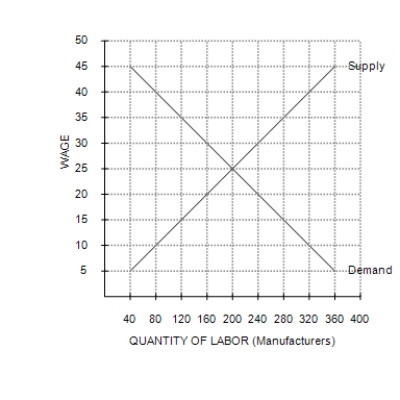 -Refer to Figure 19-3. Suppose the manufacturing labor market, which is nonunionized, is in equilibrium at a wage equal to $25. Suppose now that the AFL-CIO (a labor organization) organizes the workers in the manufacturing market and negotiates a wage of $30 per hour. Because of the union,
 (Multiple Choice)
4.8/5  (86)
(86) Which theory states that education makes workers more productive?
(Short Answer)
4.7/5 (86)
(86) Figure 19-7

-Refer to Figure 19-7. Given demand, D1, and supply, S1, if wages adjust to balance labor supply and labor demand, what are the wage and quantity of labor?
-Refer to Figure 19-7. Given demand, D1, and supply, S1, if wages adjust to balance labor supply and labor demand, what are the wage and quantity of labor? (Short Answer)
4.8/5 (78)
(78) When comparing average wages for male and female workers in the United States, wages paid to females have been about 40 percent less than those paid to male workers.
(True/False)
4.8/5 (84)
(84) Table 19-1
Men High school, no college \ 48,720 \4 6,038 College graduates \ 69,146 \ 80,508 Percent extra for college grads +42\% +75\% Women High school, no college \ 28,006 \ 32,249 College graduates \ 37,804 \ 58,229 Percent extra for college grads +35\% +81\% Source: US Census Bureau and Mankiw's calculations
-Refer to Table 19-1. What are two possible hypotheses to explain the changes in relative demand for high-skilled workers and low-skilled workers in recent years?
(Essay)
4.9/5 (96)
(96) The superstar phenomenon explains why professional athletes earn more than amateur athletes.
(True/False)
5.0/5 (80)
(80) Lucy and Lincoln are salespeople working for the same company with equal skills, ability, and experience. Both are paid a small base salary but the majority of their compensation is in the form of a commission, which is a percentage of the sales they make. Lucy earns more each year than Lincoln. What can you conclude about Lucy and Lincoln?
(Essay)
4.8/5 (89)
(89) Economists would argue that the gender wage gap is narrowing because of efficiency wages.
(True/False)
4.7/5 (61)
(61) The changing gap in wages between unskilled and skilled workers is most likely related to a larger increase in demand for unskilled occupations relative to skilled occupations.
(True/False)
4.9/5 (77)
(77) Scenario 19-6
The after-school tutoring industry is competitive, and so is the labor market for after-school tutors. Suppose male and female tutors have equal experience and skill. Currently, some tutoring centers are biased and will only hire male tutors, whereas unbiased tutoring centers desire to hire the cheapest tutors and do not care about their genders. As a result, the equilibrium wage for male tutors is higher than that of female tutors.
-Refer to Scenario 19-6. Long-run competition in the after-school tutoring market is consistent with which of the following statements, assuming consumers do not discriminate between male and female tutors?
(Multiple Choice)
5.0/5 (77)
(77) Figure 19-5  -Refer to Figure 19-5. Given demand for labor, D1, and supply of labor, S1, what are the equilibrium wage and quantity of labor?
 (Multiple Choice)
4.9/5 (70)
(70) Table 19-1
Men High school, no college \ 48,720 \4 6,038 College graduates \ 69,146 \ 80,508 Percent extra for college grads +42\% +75\% Women High school, no college \ 28,006 \ 32,249 College graduates \ 37,804 \ 58,229 Percent extra for college grads +35\% +81\% Source: US Census Bureau and Mankiw's calculations
-Refer to Table 19-1. In 2011, on average how much more income would a man with a college degree earn than a man with a high school degree?
(Short Answer)
4.7/5 (94)
(94) Higher levels of human capital are correlated with higher earnings because firms are willing to pay more for better-educated workers who have higher marginal productivities.
(True/False)
4.9/5 (86)
(86) Figure 19-8
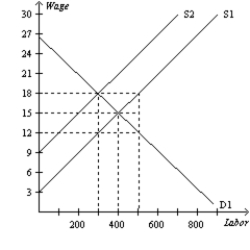
-Refer to Figure 19-8. The figure shows labor demand and labor supply in a non-unionized labor market. If the current labor demand is D1 and the current labor supply is S1, when a minimum wage of $18 per hour is imposed in this market, how many unemployed workers result?
-Refer to Figure 19-8. The figure shows labor demand and labor supply in a non-unionized labor market. If the current labor demand is D1 and the current labor supply is S1, when a minimum wage of $18 per hour is imposed in this market, how many unemployed workers result? (Short Answer)
4.9/5 (83)
(83) Scenario 19-6
The after-school tutoring industry is competitive, and so is the labor market for after-school tutors. Suppose male and female tutors have equal experience and skill. Currently, some tutoring centers are biased and will only hire male tutors, whereas unbiased tutoring centers desire to hire the cheapest tutors and do not care about their genders. As a result, the equilibrium wage for male tutors is higher than that of female tutors.
-Refer to Scenario 19-6. If consumers do not discriminate between male and female tutors, then the
(Multiple Choice)
4.7/5 (92)
(92) Dr. Benson is regarded as, by far, the best dentist in his part of the country, yet his income is not significantly higher than the average income for a dentist in his area. In contrast, Bo Johnson, the best baseball player in that region, earns five times the average salary of all baseball players. The most likely explanation is that
(Multiple Choice)
4.9/5 (83)
(83) The human-capital theory of education maintains that workers who complete specific levels of education enhance their productivity through education.
(True/False)
4.9/5 (78)
(78) Suppose that the country of Libraria made a concerted effort to increase the educational level of its people. If this effort had no effect on the wages of its workers, one might consider this as evidence in support of
(Multiple Choice)
4.9/5 (60)
(60) 
Filters
- Essay(0)
- Multiple Choice(0)
- Short Answer(0)
- True False(0)
- Matching(0)