



 Chat with AI
Exam 19: Earnings and Discrimination

Exam 1: Ten Principles of Economics220 Questions
Exam 2: Thinking Like an Economist284 Questions
Exam 3: Interdependence and the Gains From Trade192 Questions
Exam 4: The Market Forces of Supply and Demand277 Questions
Exam 5: Elasticity and Its Application222 Questions
Exam 6: Supply, Demand, and Government Policies321 Questions
Exam 7: Consumers, Producers, and the Efficiency of Markets218 Questions
Exam 8: Applications: The Costs of Taxation203 Questions
Exam 9: Application: International Trade214 Questions
Exam 10: Externalities204 Questions
Exam 11: Public Goods and Common Resources182 Questions
Exam 12: The Design of the Tax System225 Questions
Exam 13: The Costs of Production261 Questions
Exam 14: Firms in Competitive Markets243 Questions
Exam 15: Monopoly231 Questions
Exam 16: Monopolistic Competition246 Questions
Exam 17: Oligopoly204 Questions
Exam 18: The Markets for the Factors of Production232 Questions
Exam 19: Earnings and Discrimination230 Questions
Exam 20: Income Inequality and Poverty194 Questions
Exam 21: The Theory of Consumer Choice209 Questions
Exam 22: Frontiers in Microeconomics185 Questions
Exam 23: Measuring a Nations Income231 Questions
Exam 24: Measuring the Cost of Living214 Questions
Exam 25: Production and Growth187 Questions
Exam 26: Saving, Investment, and the Financial System225 Questions
Exam 27: Tools of Finance198 Questions
Exam 28: Unemployment and Its Natural Rate361 Questions
Exam 29: The Monetary System210 Questions
Exam 30: Money Growth and Inflation201 Questions
Exam 31: Open-Economy Macroeconomics: Basic Concepts194 Questions
Exam 32: A Macroeconomic Theory of the Open Economy188 Questions
Exam 33: Aggregate Demand and Aggregate Supply189 Questions
Exam 34: The Influence of Monetary and Fiscal Policy on Aggregate Demand207 Questions
Exam 35: The Short-Run Tradeoff Between Inflation and Unemployment223 Questions
Exam 36: Six Debates Over Macroeconomic Policy154 Questions
Select questions type


Compensating differentials are differences in wages related to the characteristics of a job.
(True/False)
5.0/5  (94)
(94) The human-capital theory explanation for why people invest in education has been challenged by a theory that suggests
(Multiple Choice)
4.7/5 (80)
(80) Figure 19-7
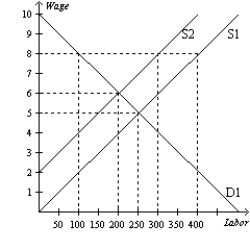
-Refer to Figure 19-7. Given demand, D1, and supply, S2, how many fewer people are employed if a minimum wage of $8 per hour is imposed on this market as compared to allowing wages to adjust to balance labor demand and labor supply?
-Refer to Figure 19-7. Given demand, D1, and supply, S2, how many fewer people are employed if a minimum wage of $8 per hour is imposed on this market as compared to allowing wages to adjust to balance labor demand and labor supply? (Short Answer)
4.8/5 (79)
(79) Which theory states that education is correlated with natural ability?
(Short Answer)
4.8/5 (80)
(80) Scenario 19-4
Assume that the labor market for barbers is competitive and that it is differentiated into two groups: barbers who are bald (or going bald) and those who have a full head of hair. Assume that the barbers in this market have identical hair-cutting ability, regardless of whether they are bald or not. Currently, the equilibrium wage in the bald barber market is lower than that in the nonbald market. Further assume that the market for haircuts is competitive.
-Refer to Scenario 19-4. If consumers do not discriminate between bald barbers and barbers with hair, then
(Multiple Choice)
4.9/5 (87)
(87) It is illegal in the United States for firms to pay different employees different wages for doing the same job.
(True/False)
4.9/5 (82)
(82) A compensating differential refers to a difference in wages that arises from nonmonetary characteristics.
(True/False)
4.7/5 (88)
(88) Streetcar owners in the early 20th century were against segregation for profit maximizing reasons.
(True/False)
4.7/5 (73)
(73) Cheryl is a professor at a local university. She hired a student from the university to babysit for her children and paid the student a wage higher than the typical wage paid to babysitters in her area to ensure the babysitter's reliability and that attention is paid to her children. What is the name for this above-equilibrium wage?
(Short Answer)
4.9/5 (62)
(62) The statement that "the rich get richer, and the poor get poorer" is supported by evidence of an expanding wage gap between high-skill and low-skill workers.
(True/False)
4.9/5 (89)
(89) Suppose that an employer can hire workers with straight hair and workers with curly hair. Each type of worker has the same productivity. Which of the following is correct if the employer discriminates by hiring only workers with straight hair?
(Multiple Choice)
4.9/5 (85)
(85) Noah and Alyssa have 130 hours of college credit each from Impressive University. Each has 30 hours of economics. Noah has a bachelor's degree, whereas Alyssa is three credits short of required history classes and therefore does not have a degree. Each of them has one year of experience as a market analyst for ABC Company. Assuming that the history class would not enhance Alyssa's job performance, if Noah earns a higher salary than Alyssa, the ABC Company may subscribe to the
(Multiple Choice)
4.8/5 (81)
(81) A group of firms working together and acting as a supplier of a product is called a cartel. A group of employees working together and acting as a single supplier of labor is called a
(Short Answer)
4.9/5 (77)
(77) When the supply of workers is plentiful, one would predict that market wages would be
(Multiple Choice)
4.9/5 (73)
(73) Explain the role of job experience in explaining the differences between the average wages of men and women.
(Essay)
4.9/5 (80)
(80) All differences in wages that are not accounted for by differences in human-capital investment are likely to be a result of discrimination.
(True/False)
4.9/5 (76)
(76) 
Filters
- Essay(0)
- Multiple Choice(0)
- Short Answer(0)
- True False(0)
- Matching(0)